Tuesday, January 14, 2014

The Runaway Scrape

By Anna Kathryn Lanier

At the beginning of 1836, General Santa Anna and his Mexican troops of 4,000 men and artillery crossed the Rio Grande River. As news of this invasion spread from San Patricio, Refugio and San Antonio, panic also increased and families fled. When the Alamo fell on March 6, 1836, full-fledged terror set in. Sam Houston, commander of the Texas Army, was in Gonzalez at the time. Thirty-two of the town’s men were killed at the Alamo, so everyone was related to or knew of someone who died.  Expecting Santa Anna to continue his march across Texas, Houston ordered the evacuation of and the burning of the Gonzalez to prevent the Mexican army any provisions. Thus began the largest exodus to take place in the United States as thousands of Texans made their way east toward the Louisiana border (and the United States).

People packed and left so fast that it is said one household left a dinner of fried chicken, coffee and a fresh pitcher of milk on the table. Families quickly hauled clothes, bedding, provisions onto sleighs, wagons, handcarts and often, their backs.  Recently widowed women gathered up children and babes in arms and made for safety in America. The travel, however, was anything but swift and sure.

Recent and continuing rains made the wagon trails boggy and muddy.  People slogged along in the sucking muck. Rivers were raging waters that made each crossing a horrifying event.  Horse thieves, claiming to be with Army, would steal the animals. Indian war parties struck families that fled, as well as those who stayed behind, kidnapping women and children.

Conrad Juergans and his very pregnant wife Mary stayed behind, thinking Santa Anna’s army would pass north of them, which they did. Shortly afterward, though, a party of Indian braves attacked the cabin.  Conrad was injured, but managed to escape to the woods.  Mary and her two young sons, however were taken captive and forced to trek toward the Red River valley.  Three months later, Mary appeared at a trading post within Indian Territory. Her family arrived and paid the $300 bounty for her release.  She had given birth to a daughter while in captivity (am not sure if she had her daughter with her or not). The fate of her two sons is unknown.

One excellent source of the Runaway Scrape was documented by Dr. Pleasant W. Rose, who lived with his family near Stafford Point.  In 1900, his daughter, Dilue Rose Harris published an account of the Runaway Scrape in the Quarterly of the Texas State Historical Association. While recalling her own memories as an eleven-year-old at the time of the Scrape, Dilue relied heavily on her father’s journal, which by 1900 had been lost for some time, but that she had read it multiple times before its disappeared.  The events of the Rose family were typical of other fleeing families.

Dilue recalled that the family quickly put belongings into a sleigh and traveled eastward with several other local families. The family’s hardship began at the Trinity River. Though the family made it across the treacherous river, the last trip made by the ferry boat, it swamped badly, leaving them stranded for several hours in the middle of the river. Finally they were rescued, but their river ordeal was only one of many faced by the evacuees.

W.G. Dewees recalled another river crossing. “There were about seventy-five wagons in the company and on arriving at the river we found no way to cross; the river was up to the top of the banks and there was no ferry.” Eventually, two large pine trees were cut down “so their length might be sufficient to reach across the river…that we might place the wagons on them and pull them across…with a rope.”

At Cedar Bayou, Emily Bryan Perry took charge of a situation when the cart of a woman and two small girls became stuck in the middle of the stream, efficiently blocking everyone else’s progress.  Emily handed off her new born baby, climbed down from her wagon and waded out to the woman. She spoke softly but firmly to the woman, encouraging her to try again.  “Up Buck!  Up Ball! Do your duty!” the woman yelled as she cracked the whip over the oxen’s head. The oxen strained hard, and managed to pull the cart free.

Dilue Rose reported seeing “children falling from the wagons which still kept on leaving the children behind, till another wagon came along and picked them up. Mothers in this manner have been separated from their children for days, and some for weeks, as the wagons would often take a different course.” William Fairfax Gary relayed seeing a family that had found a small, unattended infant. The family now had the care of the child, which they and others took turns carrying.

After a very difficult trip in mud and muck, the Roses finally arrived in Liberty. It was there that Dilue’s little sister died. The rigors of the escape proved hard, illnesses ran rampant through the groups heading toward Louisiana, and infants, small children and the elderly were particularly vulnerable. Many families lost a loved one to such diseases as cholera.

The Roses stayed in Liberty for several weeks and one day heard what they thought was distant thunder. Instead, it was the sound of cannon fire.  Sam Houston and his troops had caught up with Santa Anna and his troops. The Battle of San Jacinto could be heard thirty-five miles away. On April 21, 1836, in less than fifteen minutes, Sam Houston overtook the Mexican Army and forced their surrender.  Texas had won the war.

When word of the defeat of Santa Anna’s army reached the evacuees, they made their way back homes.  Some were burned to the ground, others had been ransacked, while others were found to be as they’d been left. The Roses returned home to find the hogs running wild. Her father’s bookcase had been toppled and his medical books and supplies scattered on the ground, the hogs sleeping on them. Emily Perry’s plantation near Peach Point didn’t fare any better. Although the house was not robbed, it was in disarray. “The hens had taken possession of beds, closet, bureaus,” Emily’s cousin wrote.   On the upside, there was an abundant supply of eggs.

In Women and the Texas Revolution, edited by Mary L Scheer, it says “The Runaway Scrape occurred in several stages. It began as an evacuation, starting South of San Antonio in February before it spread eastward to Gonzalez and Victoria early in the following month, culminating in civilian flight from the Colorado and Brazos valleys in mid- to late March.” (pp 159). Thousands, mostly women and children joined the flight away from the Mexican Army. It was an event that would define their life and the memories outlasted most of the hardships.

Works cited:

In Women and the Texas Revolution, edited by Mary L Scheer ISBN 978-57441-469-1


Anna Kathryn Lanier
Romance Author, A GIFT BEYOND ALL MEASURE
http://aklanier.com/
Never let your memories be greater than your dreams. ~Doug Ivester 

Sunday, January 12, 2014

Nuns on the Frontier

By Kathleen Rice Adams

Sister Vincent Cottier, one of ten
Sisters of Charity of the Incarnate Word
who died during the 1900 Storm.
(courtesy Sisters of Charity
of the Incarnate Word, Houston)
When the sun rose on Sept. 9, 1900, the island city of Galveston, Texas, lay in ruins. What would come to be called The Great Storm, a hurricane of massive proportions, had roared ashore from the Gulf of Mexico overnight, sweeping “the Wall Street of the Southwest” from the face of the Earth.

Over the following weeks, rescuers pulled more than 6,000 bodies from the rubble, piled the remains on the beach, and burned them to prevent an outbreak of disease. Among the departed, discovered amid the wreckage of St. Mary’s Orphan Asylum, were the bodies of ninety children ages 2 to 13 and all ten Sisters of Charity of the Incarnate Word. In a valiant, yet ultimately futile, attempt to save the children from floodwaters that rose to twenty feet above sea level, each sister bound six to eight orphans to her waist with a length of clothesline. The lines tangled in debris as the water destroyed the only home some of the children had ever known.

All that survived of the orphanage were the three oldest boys and an old French seafaring hymn: “Queen of the Waves.” To this day, every Sept. 8, the Sisters of Charity of the Incarnate Word worldwide sing the hymn in honor of the sisters and orphans who died in what remains the deadliest natural disaster ever to strike U.S. soil.

Two postulants from the Congregation of the Incarnate Word
in San Antonio, Texas, ca. 1890. (courtesy University of
Texas at San Antonio’s Institute of Texan Cultures)
Established in Galveston in 1866 by three Catholic sisters from France, the Sisters of Charity of the Incarnate Word is a congregation of women religious. Not technically nuns because they take perpetual simple vows instead of perpetual solemn vows and work among secular society instead of living in seclusion behind cloistered walls, they nevertheless wear habits and bear the title “Sister.” Today the original congregation is based in Houston, but back then Galveston seemed an ideal spot for the women to build a convent, an orphanage, and a hospital. By 1869, they had founded a second congregation in San Antonio. From there, the sisters expanded to other cities in Texas, including Amarillo, and even farther west, all the way to California. In 2013, the sisters operated missions in Ireland, Guatemala, El Salvador, and Kenya in addition to the United States.

Sister Cleophas Hurst, first administrator
of St. Anthony’s Sanitarium in Amarillo,
Texas, 1901. (courtesy Sisters of Charity
of the Incarnate Word, San Antonio)
Armed with faith instead of guns, the sisters did their part to civilize Texas’s notoriously wild frontier. They did not do so without significant hardship. Catholics often were not well-tolerated in 19th Century America, although in Galveston the sisters were admired and even loved for their industry and benevolence. That benevolence led to the deaths of two of the original three Sisters of Charity of the Incarnate Word, who perished during Galveston’s yellow fever epidemic of 1867.

As a Galvestonian, the history of the island city and its diverse people fascinates me. I continue to hope for inspiration that will grow into a story set here, where the past overflows with tales of adventure dating back well before the pirate Jean Lafitte built the fortified mansion Maison Rouge on Galveston in 1815. In the meantime, the Sisters of Charity of the Incarnate Word provided the inspiration for the heroine in a short story that appears in Prairie Rose Publications’ new western historical anthology, Hearts and Spurs. The collection of short stories by Linda Broday, Livia J. Washburn, Cheryl Pierson, Sarah J. McNeal, Tanya Hanson, Jacquie Rogers, Tracy Garrett, Phyliss Miranda, and me, is set to debut within days in both e-book and print.


“The Second-Best Ranger in Texas”

A washed-up Texas Ranger. A failed nun with a violent past. A love that will redeem them both.

His partner’s grisly death destroyed Texas Ranger Quinn Barclay. Cashiered for drunkenness and refusal to follow orders, he sets out to fulfill his partner’s dying request, armed only with a saloon girl’s name.

Sister María Tomás thought she wanted to become a nun, but five years as a postulant have convinced her childhood dreams aren’t always meant to be. At last ready to relinquish the temporary vows she never should have made, she begs the only man she trusts to collect her from a mission in the middle of nowhere.

When the ex-Ranger’s quest collides with the ex-nun’s plea in a burned-out border town, unexpected love blooms among shared memories of the dead man who was a brother to them both.

Too bad he was also the only man who could have warned them about the carnage to come.


Friday, January 10, 2014

LOCATION, LOCATION, LOCATION


Finding a location in which to plop our characters has tremendous bearing on the story, but can be a bit of a dilemma for the author. Several elements come into play and must be considered. For instance what is the time period? Is the story a historical, contemporary, or futuristic? Is the story a time travel or paranormal?

I decided early on that all my stories would take place in my native state of Texas. This worked for me because first and foremost I'm comfortable writing about Texas and would need little additional research. Next, the state has any terrain I might need for any time period and with its multiple areas to choose from, each story can be unique unto itself.

When it came time to choose an area in which to base my Texas Code Series, the natural choice for me was right here in North Central Texas. The history of the Bennings and McTiernans started back in 1859 when Ian Benning and Dermot McTiernan came from Ireland with its political unrest to start their lives anew in Texas with the land grant amended in 1850. The Texas Emigration and Land Company offered 160 acres to single men, plus a free cabin, seed, and musket balls.


North Central Texas Land - Peters Colony


The two men received their land located north of Dallas in the originally named Peters Colony. Each generation will have a chance to tell their stories in and around the fictitious town of McTiernan, along with the ever changing landscape that will either be a blessing or a challenge all the way to present day when the first novel, CODE OF HONOR, takes place.

El Pasofar west Texas, a beautiful area of desert and Mountains, is the location of, Book Two, CODE OF CONSCIENCE. CODE OF JUSTICE, Book Three, is set in Dallas, back in North Central Texas, and Book Four, CODE OF LAW, may be in the lush land of The Hill Country.
 El Paso, Texas and the Franklin Mountains
                                                        Dallas, Texas, City Skyline

Two other areas of this great state range from the mountains of Big Bend, to the coast at Galveston. 
 Big Bend National Park

Galveston, Texas
Anyway, you see what I mean about the choice of location. My stories could be located anywhere in our beautiful country. The details might change depending which area is chosen and that has the potential to redirect a storyline. My choice was logical for me and I hope resonates well with you the reader.
Thank you for visiting with Sweethearts of the West today. I hope you'll leave a comment to tell me your thoughts on this subject. Love hearing from you!
Carra

http://www.carracopelin.com


 CODE OF HONOR can be found on Amazon for kindle and print at http://tinyurl.com/muln4r9

Follow me on
Facebook  http://facebook.com/CarraCopelin

Twitter   http://twitter.com/CarraCopelin

Goodreads  http://tinyurl.com/mfynmj2

Pinterest  http://pinterest.com/carrcope/boards/

Wednesday, January 8, 2014

MARY AND A HORSE NAMED TORMENTOR


 Texas was not settled solely by men. Their mothers, sisters, and wives were not just along for the ride. Many Texas pioneers who made huge contributions in civilizing the state were women.
Honorable women. Women of strength and character. Courageous women.

Mary Crownover Rabb was such a women. She was born in 1805 in North Carolina, but her father moved the family to Arkansas Territory in 1820. There she met and married John Rabb, with whom she eventually had nine children.

In 1823 at age eighteen, Mary left Arkansas with her husband and infant to begin a new life in Stephen F. Austin's colony in Texas--The Old Three Hundred. They brought with them a few cattle and horses.

I IMAGINE TORMENTOR LOOKED
LIKE THIS GRAY HORSE.
One of the horses was a "large iron gray." Mary, in her own written account, said,
"This horse was very tall and his name was Tormentor, and that horse and I rode to Texas."
Mary and her baby rode the horse one hundred miles on their way to the Colorado River. Since she rode Tormentor, she said her feet didn't even get wet while others struggled across the river.
THE COLORADO RIVER IN TEXAS
In one place where they built a cabin, Indians roamed all around at night. Mary's husband had built a spinning wheel for her, and when the men had to leave to work away from the cabin, she bolted the door and ran her spinning wheel. The loud whirring it made covered the sounds the Indians made outside as they sought something to steal.
Since they'd steal axes and saws, along with all the horses, John Rabb put a chain around Tormentor's neck every night and padlocked him to corner of the cabin.

In another place they lived, her husband and another settler were clearing six acres. At the end of the week, they left their axes, malls, and iron wedges there, expecting the tools to be there on Monday morning when they returned to work. Later, they found the Indians had made a pen out of the rails the men put aside as they cleared the field,  and had captured all of John Rabb's horses. The pen was still there, but all the horses were gone.

That left only Tormentor because he was chained to the corner of the cabin.

John's father gave him a horse named Nickety Poly. John told Mary he would not live in a place where the Indians were so bad, so he left home for a time, searching for a new place to build--about fifteen miles away.

While he was away for ten days, Mary continued chaining Tormentor to the house every night.
Soon, they moved to the new place, and once again, Mary rode Tormentor.
However, on the next move, Tormentor died.

John Rabb moved his growing family dozens of times over the next couple of decades, trying to escape Indians, gnats, sand flies, alligators, or mosquitoes.
One seemed as bad as the other.
They lived in Fayette County and up and down the Colorado and Brazos Rivers . Some of the moves were short distances. Other moves were farther away.

In Mary's memoirs and other writings about her, she never seemed to resent whatever her husband asked of her.

Mary was a small women with a brave heart. But she did have fears.
She feared --alligators that might eat her babies;
--the Indians who were a constant presence but never seemed to harm anyone;
--the gnats and mosquitoes and sand flies that could torment one to distraction;
--flood waters that filled their cabin to the bed before she noticed;
--and most of all the Mexican Army who forced them to join the Runaway Scrape, in which her infant son Lorenzo died.

Though all the years, Mary lived in small cabins, tents made of quilts and sheets, a lean-to shed during one winter, and a mere campsite under the shelter of trees.

She gave birth to eight children to add to the one she had before she arrived in Texas. And all during these times, she was never settled into a permanent home.


Their last home was on the banks of Barton Springs in Austin, Texas. John built a small cabin for them. They had amassed land in Fayette County, and wealth from cattle operations. With the wealth and prosperity they now enjoyed, they gave funds to start Rutersville College, the first college in Texas and a precursor of Southwestern University.

Her beloved John passed away around 1861.

In 1867, Mary built a two-story house of limestone near the old cabin by Barton Springs. Safe at last from floods, alligators, and Indians, she continued ranching operations to support the Methodist Church until she passed away on October 15, 1882.

I wonder if she often thought of Tormentor, the huge horse that brought her to Texas. The horse she loved.
~~*~~
Sources:
The Handbook of Texas On-Line: Texas State Historical Association (TSHA)
Texas Tears and Texas Sunshine-Voices of Frontier Women-Texas A&M University Press
Wikipedia-Old Three Hundred; John Rabb; Mary Crownover Rabb
Wikimedia Commons
Celia Yeary
Romance...and a little bit of Texas


Monday, January 6, 2014

Notorious Brothel of Cripple Creek

My family just spent a wonderful 4 nights and 4 days in Cripple Creek Colorado at the Hotel St. Nicholas. While there, my bother-in-law took us on several tours around the area so we could get a sense and feel of the place. On Thursday, my sister-in-law took us to the Old Homestead, a brothel that surpassed all others of its time. The establishment was run by a well educated and beautiful woman named Pearl De Vere.

To make the town more safe, Marshall Hi Wilson moved all the dance halls, houses of ill repute and cribs to Myers Avenue which became the red light district. While prostitution wasn't exactly legal, he established a system that benefitted both the girls and the police force. The girls paid a yearly "fine" for their activities that went right into police funds. They also had monthly check ups with a physician to determine they were disease free. Pearl took very good care of her girls, insisting they use good hygiene and providing them with two good meals a day.

Pearl ran her house differently than the other madams. A gentleman had to apply to visit. After she determined his wealth, he was then allowed admittance. If there for the first time, he would be shown to the viewing room, a small room upstairs. The girls would enter the adjoining room and disrobe. He could peer in at them and make his selection. Most evenings began with some form of entertainment in the parlor or music room. Gents could play cards with their favorite ladies, dance or just visit before being led upstairs.

The Old Homestead is filled with all sorts of original antiques and well worth the visit. There are many more stories the curator tells and all very interesting. I was surprised that the rooms were rather small but furnished with rare imports.

In 1897, Pearl died of a morphine overdose. As the use of drugs in these houses was commonplace, no one knows for sure if she merely took a dose  to help her sleep or if she committed suicide. When her sister came all the way from Indiana to claim the body, she had no idea the profession her sister enjoyed. When she discovered Pearl was a madam, she refused to take responsibility for the funeral an disowned any relations to the woman. Prior to dying, Pearl had hosted a lavish party sponsored by a prominent Denver man. He'd bought her a $800 Parisian dress. They argued that night but after her death and anonymous donor sent $1000 dollars and a note that she was to be buried in the dress. She had the most lavish funeral ever with several wealthy business men in attendance and a band that accompanied them to the gravesite.

Hazel Vernon eventually took over running the Old Homestead. She would be known as the longest reigning madam of Cripple Creek. She sold the house in 1905. Even then, the house continued as a place of ill repute. As the mines dried out, business decreased and in 1917, the house became a boarding house.

Product DetailsWhile at the museum, I bought 3 books. One was a romance by Anna DeForest that was written in 1997 and featured the town of Cripple Creek and the Old Homestead. I'm reading Golden Dreams now and while it's typical for the time written, it's still a good romance. The best part is how she incorporated the history of the area into her story. It's no longer in print but the copy I got was signed and I think you can still find a few older copies at Amazon. The other two books were research books addressing the Old Homestead and Myers Avenue.

Saturday, January 4, 2014

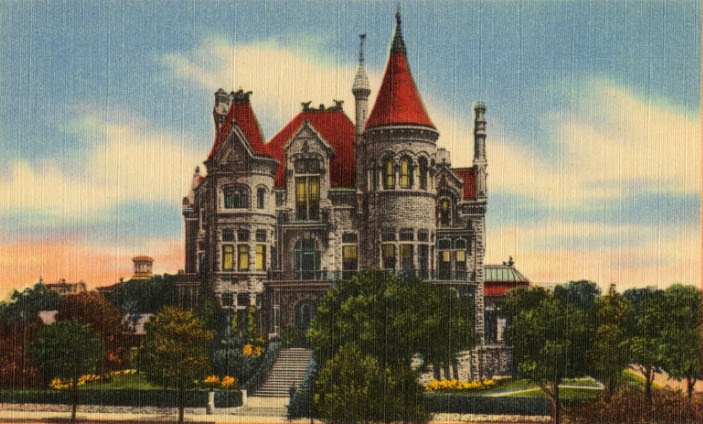
The Bishop's Palace in Galveston, Texas


by Linda LaRoque

Postcard of the Bishop's Palace. Photograph courtesy of Wikipedia Commons.

On one of my many trips with cousins, we visited Galveston and toured the Bishop’s Palace, a castle like structure built by Galveston’s premier architect, Nicholas Clayton. Construction began on the Victorian building in 1887 and was finished in 1893. It stands proudly today, a survivor of the worst hurricane disaster in 1900 in this country’s history. The house cost $250,000 to build. 
Gresham's Castle stand proud and tall amid the wreckage
of Galveston's hurricane in 1900.
Photo courtesy of Wikipedia Commons.

The home, first named Gresham’s Castle, was designed for Colonel Walter Gresham, a native Virginian, and his wife and cousin Josephine. Walter served in the Civil War earning the honorary title of Colonel. With the upheaval in Virginia during reconstruction, he moved to Galveston to begin anew.

Photo courtesy of Wikipedia Commons


A lawyer and entrepreneur, Gresham founded the Gulf, Colorado, and Santa Fe Railroad and was later instrumental in Galveston becoming the only deep water sea port west of the Mississippi. He served in the Texas Legislature and died in Washington in 1920 while serving in the United States Congress. Josephine remained in Washington and the house in Galveston remained vacant. She died in 1933.

In 1926 Josephine sold the house to the Catholic Diocese for $40,500 as a home for Bishop Christopher C. E. Byrne. At that time it became known as the Bishop’s Palace. Though run by Galveston’s Historical Society, the house is still owned by the Catholic Diocese.

The home was the first ever to boast recessed lighting, a Clayton design. At the far end of the entry hall, a fireplace, combination gas and coal, has a flue below the fireplace, an oddity that no one knows exactly how it works. A beautiful solid oak staircase curves up and over the fireplace and has a Bishop’s pulpit where the Gresham children often observed party festivities of Galveston’s elite. Above the staircase is a rotunda with cooling vents in the upper windows. The house was lit with gasoliers, combination gas and electric lights. Can you imagine the fire hazard they must have been?

Josephine was a great entertainer. She loved to travel and did so extensively. On her travels she mailed post cards home to add to her collection. Many ladies in her circle also had collections and gatherings gave hostesses the opportunity to boast of the places they’d been. On display in the parlor is the box Mrs. Gresham had made to display her cards. At one end of the parlor is an alcove where as guests danced on the pine floors, musicians played behind hand-painted screens and palms. The entertainers were to be heard, not seen. It is in this alcove where after his death, Bishop Byrne lay in state.

Mrs. Gresham was an accomplished artist and painted many of the murals on the ceilings. Some of her paintings remain on display. In the dining room, Lincrusta, a wall covering similar to linoleum is shaped to adhere to the curved area below the ceiling.

Fresh water was a commodity in Galveston. A drainage system allowed rain water to be collected and stored. In the master bathroom, the bathtub has three faucets—one for cold water, one for hot water, and one for rain water to wash the mistress’s hair.

When the house was built, the kitchen was located in the basement. There were three kitchens—one to cook breakfast, one for lunch, and one for dinner. During Bishop Byrne’s time, a modernized kitchen was installed in the warming room behind the butler’s pantry where the food was held until it was served. On display in the kitchen today is an old Crescent stove that used both wood and gas.

Many of the windows on the first and second floors open from the floor up to allow air flow and individuals to step out on the porch that surrounds the house. The house is filled with stained glass, Italian pink marble fireplaces, a hand carved mantle made of Santa Domingo mahogany that won first- place at the World’s Fair in Philadelphia in 1876, and another made of onyx, pewter, and silver that won first-prize at the New Orleans Exhibition. 

Hand carved woodwork abounds in the house—light mahogany in the music room, black burl walnut in the library, dark mahogany in the parlor. The lower floor rooms have massive sliding doors with different woods on each side so they’ll match the wood of each room. In the library, the glass doors on the books shelves slide rather than open out and all of the windows have folding inside shutters. Of the beautiful woods used in the house, the most valuable is located in the servant’s entry area and staircase. It is long leaf pine which is very rare and expensive today. The servant’s stairs go up to the third floor. There are ninety-three steps. Women servants of the era wore corsets and long dresses. Off of this area is a cloak room with pegs to hold coats of guests. Though the servants didn’t live on site, they had their own bathroom complete with bathtub just off this area.

Mr. and Mrs. Gresham’s rooms, along with those of their three daughters, are on the second floor. The rooms are elaborate, many containing half-canopy beds with painted murals. The girls had their own bathroom, but it’s half the size of the master. The boy’s rooms were on the third floor. Though we were not allowed on that level, the guide explained the rooms were spartan compared to those of the girls. Boys needed space to run and play, decoration wasn’t important. They had their own toilet, the girls most likely wouldn’t have approved of sharing, but bathed in the girl’s bathroom or downstairs in the servant’s bathroom.


Mr. Gresham’s bedroom was converted into a private chapel for Bishop Byrne and remains as such today. If you have time to only visit one of the historical homes in Galveston, The Bishop’s Palace is the one to see.


I took the picture above on the day we visited the castle. Alas, I was unable to get a shot without traffic. If you will Google Images of the Bishop's Palace you can see many of the rooms inside including the Preacher's Pulpit and the fireplace in the entry hall mentioned above. 

Thanks you for stopping by today. Please leave a comment.

Thanks,

Linda LaRoque

Thursday, January 2, 2014

Bulls vs. Bears

By Paisley Kirkpatrick
One of the most popular Sunday afternoon entertainments for miners was the bull-and-bear fight. As reported in 1849 by the local Sonora newspaper: A fantastically dressed Mexican clown, preceded by a band of shockingly bad music, parades the streets notifying the citizens of a fight about to come off.
Bear and bull fighting, a favorite Sunday afternoon diversion for miners, was certainly not for the fainthearted.
A 600 pound grizzly bear was enclosed in a pen -- chained either to a post or his opponent, a mean bull twice his size. If they didn't take unkindly enough to one another on initial meeting, the promoters got up a little spirit by goading them with spears. It didn't much matter to the spectators whether the bear, with his sharp teeth and powerful jaws, got to the bull's neck first -- or the bull, with superior weight and sharp horns, gored the bear. Blood was the object.
Sometimes the spectators themselves became part of the sport. In a Sonora arena, jammed with 2,000 spectators, a wounded bull jumped the fence and ran wild through the crowd, goring one man to death and trampling several others.
Meanwhile, another incident was taking place inside the area. The promoter decided to throw some water on the exhausted bear. He was grabbed by the animal who started chewing on the man's leg. Several volleys of pistol shots killed the bear, but not in time to save his victim.
An attempt was made to discourage this cruel sport in 1856 by imposing a $25 licensing fee (not much of a deterrent), but it wasn't until 1905 that it was outlawed altogether.
By 1854 Sonora had turned to more sedate family life. Instead of the bull-and-bear fights on this sacred day, troops of rosy-faced, quiet, orderly children are seen returning from Sunday school. Where men from the surrounding camps once quarreled, fought, drank, swore, and squandered their hard-earned means at the gambling table or low brothel, well-dressed men and women attended church. What has caused this great change in public sentiment? It was the presence of women -- virtuous, pure, sympathizing women, the great controller of public opinion, without whom society is dull and existence a blank.
From: California Gold Story of the Rush to Riches