Showing posts with label wild turkeys. Show all posts

Monday, August 12, 2019

Wild Turkeys -- summer

by Rain Trueax


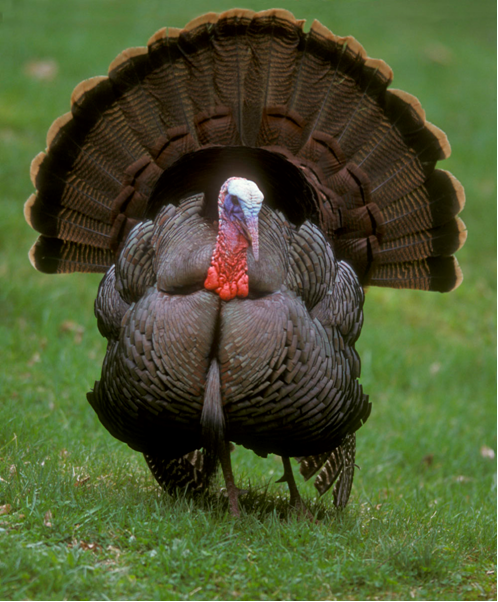
Living on  little ranch in the Oregon Coast Range, we have wildlife as our neighbors. Sometimes that's worrisome like coyotes with sheep. Other times, it's such a blessing. Such is with the wild turkeys that live part of the year in our yard and pastures. I learned a bit about them out of curiosity as to how they fit into history.

In Oregon, they don't. It is claimed that the first wild turkeys were introduced here in 1961. I thought maybe they'd been over hunted as they had other places but apparently no evidence to show that they were ever here. They were elsewhere in the United States and have played a role in even stories about pioneers and Native Americans.

Of the four subspecies of turkeys, we have two in Oregon. The Merriam's wild turkeys were the first. They were live-trapped in Colorado, Arizona, New Mexico, Nebraska, and Montana. Today, it's believed that they hybridized with Rio Grande
wild turkeys brought to southwestern Oregon in 1975. They were native to riparian zones and scrub woodlands from the southern Great Plains into northeastern Mexico. They flourish in places like our ranch land here in the Coast Range.  
In researching, I learned wild turkeys evolved more than 11 million years ago although probably not exactly as they are today.  There are five subspecies of wild turkeys with different ranges and feathers. 

Ancient civilizations, like the Aztecs revered the birds and held religious festivals twice a
year. They thought the turkey was a bird manifestation of one of their gods-- a trickster. In the Mayan and Aztec culture, turkey feathers were used to adorn jewelry, clothing and headdresses. Although they regarded the turkey as of spiritual significance, they did also eat them. Navajos, in the American Southwest, penned wild turkeys to fatten them. 
In pagan and nature based religions, the turkey represents spirituality and Earth Mother. The red wattle, which is that flap of skin that originates from the forehead and is seen on the toms, is said to represent the energy center of intuition. 

The stories of them with the pilgrims and the first Thanksgiving are well known. Maybe less so is that Benjamin Franklin wanted the turkey to be our national bird. He considered the proud, adaptable turkey superior to the eagle, whom he had little use for.

Most of the West had turkeys and then they were nearly hunted to extinction along with their natural habitat being reduced. It was time for an intervention and that was begun as hunting was limited to seasons and the birds were moved into areas, like Oregon, where they had never been. 

We had long seen them around us but two years ago is the first time that they began to raise their broods here where it's a natural habitat for them with the oaks and meadow like pastures. 

Some think of them like domestic turkeys, but they are not. Domestication takes a lot out of any animal. Wild turkeys have a wide variety of sounds they make to call each other, fight, or just express enjoyment. To hear them outside is one of the more enjoyable part of my life here in Oregon. 

Most often, we see the toms and hens together with the chicks but they are not monogamous birds. It's about the community. A tom may mate with several females but the hens only with one. They lay about twelve eggs, one egg a day for two weeks. The hens sit on the nest until the eggs hatch after four weeks. She stays there to protect those babies from all that would eat the eggs. 

When the poults hatch, they are up inside of a day. They must walk to find food as this isn't like the birds that can feed their young. The job of the flock is to get the young to food sources. Until the chicks get their flying feathers, they are vulnerable on the ground to snakes and other predators. Turkeys can be very aggressive and don't have spurs on their legs for nothing. One year, Ranch Boss watched a sad story as a hawk was attacking a chick that appeared crippled. The hen fought with him but the battle was hers to lose.

Something many don't know is adult wild turkeys fly quite well. They roost in trees as soon as their babies have enough feathers to fly. Ours here roost about 40 or 50 feet up. To hear them take off for their big branches is like a whirl of wind. They come down with less noise. The sounds in the trees range from gobble gobble to tweets and almost purring sounds. 

They generally will not stay one place for long. Even though we put out some grain for sheep and birds, they never linger but always move on. I expect them to not stay on the farm here although they get along quite well with the sheep. Both like the grains from tall grasses and what drops off the hay bales. It appears we have four flocks with varying ages of chicks. Earlier as the chicks were growing, it seemed the toms hung with the flock for protection. Now, they are hanging more together than with the hens and chicks. 

We have taken a lot of photos but haven't had much luck in capturing the sounds they make. They are very defensive and if you watch them in a flock, some will be looking behind and some ahead for predators.

What I have seen besides photos are a LOT of feathers. I don't know why they drop so
many, but they seem to be most heavily below where they roost. I am trying to figure out if I can use these in any productive way. Someone told me it's illegal to keep any feathers, even from game birds. I need to do some research on this. The striped ones look like many Native American headdresses, where they suggest eagle feathers. Some say their feathers have spiritual significance.

This week, when I had to deliver a message to Ranch Boss at the barns, walking down the gravel and dirt road, there were two hens ahead of me, without their chicks. As Ranch Boss
approached from the other barn side, the hens saw they had a problem. They ran toward him, then looked back at me. I was standing still. I knew that soon they'd have to choose to fly, something they prefer not doing. First one, then the other took to the air, very cool to watch and part of the joy of living with wildlife.
They are hunted in Oregon in two seasons-- spring and fall. I guess it's a popular sport, but nobody better try shooting the ones on our land. This is a sanctuary. :) They are not as afraid of us anymore, but they still run when we approach, which is good. Not all humans can be trusted. 

All photos are from our Oregon home from June to August.

Tuesday, November 20, 2018

Tales of Thanksgivings Past


Since it’s so close to Thanksgiving, I will share with you a few stories of pioneer Thanksgivings that I enjoyed reading. I hope you do too.


Thanksgiving on the Frontier

Wild turkeys were present on the frontier, but on one occasion thankfulness came not for enjoying the turkey, but for still being alive, as recalled by Mrs. Hulda Esther Thorpe.  “One of the best Thanksgiving dinners we ever knew of was when a family of settlers had their nice wild turkey dinner taken by the Indians, who came in silently and just shoved the folks back and eat [ate] it up.

“They did not harm the white people though and after they were gone the women made a big corn bread and with what few things the Indians left, they had a feast, the best as the daughter tells, that she ever eat [ate]. This was because they were so happy and thankful that the Indians spared them.”   (Excerpt from American Life Histories: Manuscripts from the Federal Writers’ Project, 1936-1940, a public government work).
Miracle of the Gulls Monument, Salt Lake City;
photo by David McConeghy; wikipedia creative commons 2.0

The Mormons’ First Thanksgiving

The first Mormon pioneers arrived in the Salt Lake Valley in 1847. They got a late start on planting that summer, and the crops didn’t yield a plentiful harvest, not allowing for any thanksgiving feast. The hundreds of Saints who arrived that year had a rough time just surviving winter.
A late frost in May 1848 killed many crops, and a lack of rain caused further difficulty. The warmer summer planting season would have allowed some of the frozen crops to recover, but crickets came on the frost’s heels and destroyed the few healthy plants that remained.
It was a difficult time to live in the Valley—the outlook was so bleak that a few people continued on to California or returned to the United States. But most of the Saints stuck it out, did all they could to preserve their crops, and trusted that God would make up the difference.
That’s when the famous seagulls came to their rescue, consuming the destructive crickets and leaving the Saints with a chance to plant again. By midsummer they were hopeful for a plentiful harvest. They believed God had brought the seagulls and provided much-needed assistance. They decided to set aside a day for giving thanks to God—August 10, 1848.
That morning, the Saints gathered for the celebration. They raised a white flag on a pole—a traditional symbol of freedom—and decorated the pole with wheat, barley, oats and corn. They fired a cannon and a band played. The Saints shouted “Hosannah to God and the Lamb, for ever and ever, Amen.”
Then they feasted on bread, butter, cheese, cakes, beef, pastries, corn, lettuce, melons, radishes, beets, carrots, peas, onions, cucumbers, parsnips, squash and beans. No Jello salad!


How to Season the Dressing
The most famous Laura Ingalls Wilder Thanksgiving story is the argument between Laura and her sister Mary about how to season the dressing. The argument began when their Pa announced he intended to shoot a goose for Thanksgiving dinner. After he left to hunt, Laura delighted over the prospect of dressing seasoned with onion. Mary objected, saying she doesn’t like it seasoned with onion and wanted it seasoned with sage instead.

The sisters continued to bicker back and forth: “Sage.” “Onion.” “SAGE!” “ONION!” Until Pa came back without the goose. This evidently remained a favorite story for Laura because it’s a reminder at Thanksgiving to look around and be grateful even if “the seasoning of my blessings has not been just as I would have chosen.”

Sources


http://littlehouseontheprairie.com/thanksgiving-laura-ingalls-wilder/

Lyn Horner is a multi-published, award-winning author of western historical romance and romantic suspense novels, all spiced with paranormal elements. She is a former fashion illustrator and art instructor who resides in Fort Worth, Texas – “Where the West Begins” - with her husband and a pair of very spoiled cats. As well as crafting passionate love stories, Lyn enjoys reading, gardening, genealogy, visiting with family and friends, and cuddling her furry, four-legged children.

Amazon Author Page: viewAuthor.at/LynHornerAmazon (universal link)
Newsletter:  Lyn’s Romance Gazette http://eepurl.com/bMYkeX
Website:  Lyn Horner’s Corner 


Thursday, November 20, 2014

Cuero, Texas: Turkey Capital of the World

by Lyn Horner

When our kids were young, my husband and I once took them to a drive-thru wildlife preserve here in Texas. Among the animals we saw that day was a small flock of wild turkeys. They roamed free and showed no sign of fear as we stopped to snap pictures. Those birds were impressive, a lot bigger than I expected and a little bit scary. I mean I wouldn’t care to meet one on foot, especially a large male with his tail spread out in challenge like a huge fan.

Male turkey with tail spread; Wikipedia commons
 

Now imagine watching thousands of these birds trotting along the main street of a small town in south Texas in the early 1900s. That’s exactly what happened in Cuero, TX, (pronounced Quair-oh) beginning around 1908, when a processing plant opened on the outskirts of the town. Turkey raising soon became a major industry in the area. Buyers bought flocks of birds from outlying farms and herded them through town to the plant.

J. C. Howerton, publisher of the Cuero Record, is credited with suggesting a Turkey Trot. The local chamber of commerce took up the idea in order to advertise South Texas turkeys and encourage turkey raising. The Cuero Fair and Turkey Trot Association was formed, and the first official Turkey Trot took place in 1912, at the opening of the fall marketing season.

Named for the popular "turkey trot" dance of the period, the event was a hit, attended even by Texas governor Oscar Colquitt and other dignitaries. They were entertained by a parade of “floats festooned with turkey feathers” as well as 18,000 or more turkeys strutting down Main Street. Cuero merchants reaped benefits by providing visitors with food, drink and lodgings.

Cuero Turkey Trot, 1912; Wikipedia commons, public domain
 

The following year, a Turkish theme was introduced for the Turkey Trot. Sultan Yekrut (turkey spelled backwards) and Sultana Oreuc (Cuero backwards) reigned over the festivities. Over time, the pageantry became more elaborate. The Sultan and Sultana acquired an entire royal court with attendants in Turkish costumes. Cuero became, for a short time each autumn, an exotic oasis amid the mesquite trees and sagebrush.


Apparently, the event was not held every year. The thirteenth Turkey Trot took place in 1967. Unfortunately, many of the broad-breasted feedlot turkeys collapsed, and thereafter the Trot was replaced by a seven-county South Texas Livestock Show. However, as part of Cuero's centennial in 1972, the Turkey Trot was revived, using hardy range-raised turkeys in the parade.

Today, Cuero holds "Turkeyfest" each October, featuring a parade, arts and crafts show, food booths and a Miss Turkeyfest beauty pageant. A highlight is the "Great Gobbler Gallop," a race between prize turkeys from Cuero and Worthington, Minnesota. This competition resulted from a Worthington newspaper editor's claim that his town was the world's turkey capital, not Cuero. Contestants’ names are always Ruby Begonia for the Texas turkey and Paycheck for the Minnesota bird. They vie for the title of World's Fastest Turkey, racing in two heats, one in each city over a two-year period.
 
Cuero's population in 2010 was 6,841. It is the county seat of DeWitt County, Texas, and is unofficially known as the "turkey capital of the world." Cuero High School teams are called the Gobblers. Also in 2010, Cuero was named one of the 'Coolest Small Towns in America,' by Budget Travel Magazine. ~ Wikipedia

All thanks to our wild Texas turkeys!

Three Turkey Facts from TEXAS PARKS & WILDLIFE

  1. If Wild Turkeys could smell, they'd be nearly impossible to hunt. The eyes and ears of a turkey make it one of the toughest of all Texas game animals. Their vision is the keenest among all Texas game animals. They are especially astute at pinpointing movement and can hone in on noises from a mile away.
  2. Wild Turkey Revival! A hundred years ago, turkeys almost disappeared from Texas due to unregulated hunting and loss of habitat. Now, thanks to hunter and landowner support, bag limits and a restocking program, they are making a steady comeback.
  3. Where the Wild Turkeys are. Turkeys now inhabit 223 of the 254 counties in Texas. You can see them roam at many Texas State Parks. One of the most substantial and oldest winter turkey roosts is at South Llano River State Park near Junction.