by Rain Trueax
Living
on little ranch in the Oregon Coast Range, we have wildlife as our
neighbors. Sometimes that's worrisome like coyotes with sheep. Other
times, it's such a blessing. Such is with the wild turkeys that live
part of the year in our yard and pastures. I learned a bit about them
out of curiosity as to how they fit into history.
In
Oregon, they don't. It is claimed that the first wild turkeys were
introduced here in 1961. I thought maybe they'd been over hunted as they
had other places but apparently no evidence to show that they
were ever here. They were elsewhere in the United States and have played
a role in even stories about pioneers and Native Americans.
Of
the four subspecies of turkeys, we have two in Oregon. The Merriam's
wild turkeys were the first. They were live-trapped in Colorado,
Arizona, New Mexico, Nebraska, and Montana. Today, it's believed that
they hybridized with Rio Grande
wild turkeys brought to southwestern
Oregon in 1975. They were native to riparian zones and scrub woodlands
from the southern Great Plains into northeastern Mexico. They flourish
in places like our ranch land here in the Coast Range.
In
researching, I learned wild turkeys evolved more than 11 million years
ago although probably not exactly as they are today. There are five
subspecies of wild turkeys with different ranges and feathers.
Ancient
civilizations, like the Aztecs revered the birds and held religious
festivals twice a
year. They thought the turkey was a bird manifestation
of one of their gods-- a trickster. In the Mayan and Aztec culture,
turkey feathers were used to adorn jewelry, clothing and headdresses.
Although they regarded the turkey as of spiritual significance, they did
also eat them. Navajos, in the American Southwest, penned wild turkeys
to fatten them.
In
pagan and nature based religions, the turkey represents spirituality
and Earth Mother. The red wattle, which is that flap of skin that
originates from the forehead and is seen on the toms, is said to
represent the energy center of intuition.
The
stories of them with the pilgrims and the first Thanksgiving are well
known. Maybe less so is that Benjamin Franklin wanted the turkey to be
our national bird. He considered the proud, adaptable turkey superior to
the eagle, whom he had little use for.
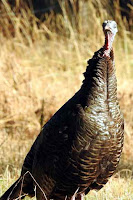
Most
of the West had turkeys and then they were nearly hunted to extinction
along with their natural habitat being reduced. It was time for an
intervention and that was begun as hunting was limited to seasons and
the birds were moved into areas, like Oregon, where they had never
been.
We
had long seen them around us but two years ago is the first time that
they began to raise their broods here where it's a natural habitat for
them with the oaks and meadow like pastures.
Some
think of them like domestic turkeys, but they are not. Domestication
takes a lot out of any animal. Wild turkeys have a wide variety of
sounds they make to call each other, fight, or just express enjoyment.
To hear them outside is one of the more enjoyable part of my life here
in Oregon.
Most
often, we see the toms and hens together with the chicks but they are
not monogamous birds. It's about the community. A tom may mate with
several females but the hens only with one. They lay about twelve eggs,
one egg a day for two weeks. The hens sit on the nest until the eggs
hatch after four weeks. She stays there to protect those babies from all
that would eat the eggs.
When
the poults hatch, they are up inside of a day. They must
walk to find food as this isn't like the birds that can feed their
young. The job of the flock is to get the young to food sources. Until
the chicks get their flying feathers, they are vulnerable on the ground
to snakes and other predators. Turkeys
can be very aggressive and don't have spurs on their legs for nothing.
One year, Ranch Boss watched a sad story as a hawk was attacking a chick
that appeared crippled. The hen fought with him but the battle was hers
to lose.
Something
many don't know is adult wild turkeys fly quite well. They roost in
trees as soon as their babies have enough feathers to fly. Ours here
roost about 40 or 50 feet up. To hear them take off for their big
branches is like a whirl of wind. They come down with less noise. The
sounds in the trees range from gobble gobble to tweets and almost
purring sounds.
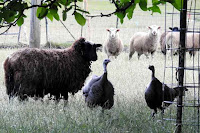
They
generally will not stay one place for long. Even though we put out some
grain for sheep and birds, they never linger but always move on. I
expect
them to not stay on the farm here although they get along quite well
with the sheep. Both like the grains from tall grasses and what drops
off the hay bales. It appears we have four flocks with varying ages of
chicks. Earlier as the chicks were growing, it seemed the toms hung with
the flock for protection. Now, they are hanging more together than with
the hens and chicks.
We
have taken a lot of photos but haven't had much luck in capturing the
sounds they make. They are very defensive and if you watch them in a
flock, some will be looking behind and some ahead for predators.
What
I have seen besides photos are a LOT of feathers. I don't know why
they drop so
many, but they seem to be most heavily below where they
roost. I am trying to figure out if I can use these in any productive
way. Someone told me it's illegal to keep any feathers, even from game birds. I need to do some research on this. The striped ones look like many Native American
headdresses, where they suggest eagle feathers. Some say their feathers
have spiritual significance.
This week, when
I had to deliver a message to Ranch Boss at the barns, walking down the gravel and dirt road, there were two
hens ahead of me, without their chicks. As Ranch Boss
approached from
the other barn side, the hens saw they had a problem. They ran toward
him, then looked back at me. I was standing still. I knew that soon
they'd have to choose to fly, something they prefer not doing. First
one, then the other took to the air, very cool to watch and part of the
joy of living with wildlife.
They
are hunted in Oregon in two seasons-- spring and fall. I guess it's a
popular sport, but nobody better try shooting the ones on our land. This
is a sanctuary. :) They are not as afraid of us anymore, but they still
run when we approach, which is good. Not all humans can be trusted.
All photos are from our Oregon home from June to August.


 There
are many ways to live in the desert. You can be in a walled community, a
condo, a mansion on a ridge, or in a small development on one of
Tucson's many ridges.
There
are many ways to live in the desert. You can be in a walled community, a
condo, a mansion on a ridge, or in a small development on one of
Tucson's many ridges.  Such
a ridge is where we found our dream, second home over twenty years ago.
I wanted desert around the house and a feel of an adobe (though it's
slump block). I wanted the denizens who live here to feel it was as it
always had been for them to come through-- and it is.
Such
a ridge is where we found our dream, second home over twenty years ago.
I wanted desert around the house and a feel of an adobe (though it's
slump block). I wanted the denizens who live here to feel it was as it
always had been for them to come through-- and it is.
 For
their safety, we do keep a small fenced yard for our cats to be out
when they wish but still protected from the predators (coyotes,
javelina, raccoons, and bobcats are most prevalent), who might find
plump cats a tasty meal. By law, we also have to fence the swimming pool
but the cats don't get access to that either for their safety-- unless
we are out there.
For
their safety, we do keep a small fenced yard for our cats to be out
when they wish but still protected from the predators (coyotes,
javelina, raccoons, and bobcats are most prevalent), who might find
plump cats a tasty meal. By law, we also have to fence the swimming pool
but the cats don't get access to that either for their safety-- unless
we are out there. of them as more scavengers. We adopted a desert cat when we first
arrived. He had no owners and showed up needing food and care. Every
time he saw the javelina through the glass doors, he'd growl. I thought
that strange but knew they could rip up a person's leg. Once a herd of
them killed our neighbor's dog, I better understood our cat's reaction.
He'd often be on our roof-- definitely a safe place for a fluffy black
cat as no hawk nearby could threaten him based on his size.
of them as more scavengers. We adopted a desert cat when we first
arrived. He had no owners and showed up needing food and care. Every
time he saw the javelina through the glass doors, he'd growl. I thought
that strange but knew they could rip up a person's leg. Once a herd of
them killed our neighbor's dog, I better understood our cat's reaction.
He'd often be on our roof-- definitely a safe place for a fluffy black
cat as no hawk nearby could threaten him based on his size.


