Showing posts with label U.S. Southwest. Show all posts

Saturday, February 26, 2011

LIONS AND TIGERS AND BEARS, OH MY! WESTERN ANIMALS

Chaparral, or Roadrunner
not a cartoon character
Lions and tigers and bears, oh, my! Animals often appear to menace our characters or at least to give color to our novels. As readers and writers, we want the animals in the novels we read to be realistic.
When we write or read about the Southwest, our characters often encounter annoying critters on four legs as well as those on two legs. I wanted to post some of these because I've had people from other areas ask what a parricular thing was--a chaparral, for instance. When I explained they were commonly called a roadrunner, she said, "Oh, I thought that was only in cartoons. You mean there really is a roadrunner?" Yes, there is, and in fact one lives in our orchard. Others doubt that a particular animal, the Mexican black panther, for example, actually makes it as far north as North Texas.  As an eyewitness, they do!

Wily Coyote, also real
Another creature we hear far more often than we see them is the coyote. As so-called civilization encroaches, coyotes become more aggressive. You may remember reading about a young Canadian author who was attacked and killed by a pack of coyotes while she was on a hike not that far from her home. In the area of North Central Texas in which I live, we've only seen lone coyotes. Usually sightings are early morning, but we hear them from their dens under the train track a half-mile and further away.

Glen Rose (Texas) Gray Wolf
Along the same avenue is the repopulation of wolves in Texas, as we learned from Jeanmarie's post. The Texas Gray Wolf became extinct in the 1960's, but wolves are now being reintroduced in natural areas. Ranchers are not happy about this, and I can understand their anger. On the other hand, I hate to see any species go extinct. But then, I'm one of those weird tree-huggers--NOT the militant type, just privately. And I wouldn't mind if things like fire ants and poisonous snakes and mosquitoes were extinct. Not a bit!

Javelina--does "Ugly" come to mind?

We have all heard of javelinas, especially if you're from Arkansas where the Razorback is the mascot of one of the universities. I always picture them as a red cartoon like the university symbol, but the real animal is ugly as mud and meaner than you can imagine. They roam in small packs or herds--whichever is the term for swine. One of the new developments is the plague of feral formerly domestic hogs destroying crops and pastures. These also are dangerous, and authorities encourage hunters to shoot the feral animals--being careful they're not targeting some farmer's swine.

Mexican Black Panther
Here's one animal I've been accused of making up. Years ago a friend was deer hunting on Thanksgiving weekend. Her deer stand was under a large tree, and she was sitting there freezing when leaves drifted down on her. She heard a loud noise, like a kitten purring, but magnified a hundred times. She looked up, and a black panther perched in the tree overhead. Needless to say, she panicked. Moving slowly, she climbed down from the stand and sidled away. As soon as she was in her pickup, she called Parks and Wildlife to report the sighting. The Ranger told her the animal was a Mexican black panter and she was lucky the cat had already feasted on a rancher's calf further down the creek. [*Note* I've included this in one of my works in progress. LOL] Last year, our neighbors lost their elderly dog to a black jaguar who looked like a black leopard. The coat was black with darker spots in the pattern of a leopard or jaguar.


Cougar, also called Mountain Lion
 Two years ago, our nearest neighbor, a woman rancher who raises black angus cattle, was training blackberry vines on the side of her farm tank. When she reached the top of the bank, she looked across the tank and met the gaze of a large cougar. She froze, and the cougar lowered into the grass and disappeared. She never saw where it went. Another friend who walks each morning stopped to admire a herd of deer grazing as sunlight hit the meadow. While she watched, a cougar took down one of the deer. Now she walks on her treadmill and/or later in the day. LOL

Red Fox--Don't let
cute fool you
Before we wised up and kept our cats permanently in the house, we had a lovely orange tabby named Tiger who had kittens on our patio. I was talking with her when a red fox sneaked up, grabbed a kitten, and took off into the orchard. Tiger screamed so loud I would have thought she was a cougar, and we both took off after the fox. Tiger lasted longer on the chase than I did, and those who know me won't be surprised at that. I run like a duck, a very slow duck. Until then, I had no idea kittens were vulnerable to foxes.


Black Bears are edging into East Texas

My eldest daughter lives in East Texas and is a Master Gardner who also works closely with the County Extension agents. Recently they have received warnings that black bears are moving into their area as the woods of Arkansas and Eastern Oklahoma are being cut. One more critter to contend with.
 
Bobcat
One day I took home from our church women's meeting a very nice lady who no longer drives. We sat in her drive finishing a conversation when a Bobcat walked by. Unsure I was really seeing a Bobcat, I asked her. She said the bobcat comes by about once a day. Her home borders a very wilderness-like canyon area so I suppose the bobcat felt unthreatened. He was not huge, really not much bigger than our large house cat, Sebastian, but I wouldn't have wanted the bobcat angry with me. Hmm, I wouldn't want twenty-pound Sebastian angry with me either. :/

Siberian Tiger grooming
As a side note, are you aware that there are more rescued tigers in captivity in Texas than there are in the wild? Sad but true. Some of the "rescue" places are humane and some are not. Most of the tigers are from people who acquired them illegally then had to turn them over or have them confiscated. Tigers, while cute little kittens, make huge pets that require a lot of food, space, and care. My friend Dee Stuart has written a great mystery novel about a veterinarian who rescues tigers and I'm eager for her to have it published. She did a lot of research, which is how I learned about the tigers. There are different species and coloration.

There are many other interesting animals in the Southwest, but I'll save them for another day or another person to post. Let me leave you with this photo that I love. I don't know who took the photo, but he has a much better camera than mine. Here's a red-winged blackbird hitching a ride on a red-tailed hawk.


Thursday, September 30, 2010

Westward Ho The Writers!


Modern ranchers
  No, this blog is not about wagon trains and cowboys. Sweethearts of the West is about romance and adventures set under western skies. It’s true that some of us write about the hardships of the Old West and the pioneers who settled here. Sweethearts of the West authors also write about 2010’s modern pioneers—powerful business executives, hairdressers, ranchers, newspaper reporters, FBI agents, detectives, and other characters that promise a wonderful reading experience. Our authors range from multi-award winners to newly published. Some of our books are funny, some suspenseful, and some tearjerkers, but they are all well-written novels which will pull you into their stories! They deal with our need to discover a fulfilling life, the very need that sent our ancestors heading West.

As one who writes both contemporary and historical romance, both sweet and sensual, I love the western spirit and all my books are set here. In fact, all my books take place in Texas. How great to look out at the horizon and not see buildings, but rolling prairie up to the mountains. I adore the West’s tall skies, open fields and woods near large cities, and the spirit that inhabits our people. Of course, I also like people East of the Mississippi. They include many relatives and good friends. Some of America’s most beautiful landscapes are there, too. In the three years we lived in central Florida, my Hero and I made many wonderful friends. Ah, but I confess my heart belongs under a tall western sky.
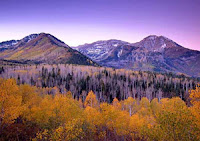
Utah Mountains' Purple Majesty
Check out each of our authors and our books. Our photos and links are on the sidebar. Our current books are on the slide show. We have intriguing events planned, theme months, guests, and more to keep you returning.

Please comment here often to let us know how you feel about our articles and our authors, and sign up as a follower on our sidebar. We respect our readers and hope to provide the best reads of your life!

Y'all come back now, y'hear?

Greetings and Welcome to Sweethearts of the West blog.
Caroline said it all, thank goodness, because I could not have done so well. She approached me about this group venture, and I readily joined up. For a long time, I’ve wished for a group blog consisting of authors who loved the West and wrote about it, too.

Couple on horseback
Somehow, I became her co-moderator, probably because I have that urge to take charge. I really shouldn’t do that, because in some cases—this one, for example—someone else just might know more than I! And Caroline and her sweet, gracious, patient husband have done a smashing job with the appearance and format of the site. She and I believe we are cousins, at least we pretend so, because we’re from the same area and we think and work alike. I could not have asked for a better partner.
I know you’ll be thrilled with our authors—I certainly am! Even though each of us writes in a different way and may prefer one category to another, we have one cohesive belief: we love to write about the west.
So, thank you for visiting. Leave a comment, be a Follower, anything…but most of all we hope you’ll return again and again to visit with the Sweethearts.
Celia Yeary-Romance...and a little bit 'o Texas  
http://www.celiayeary.blogspot.com http://www.celiayeary.com
New Releases
Texas Promise-eBook-Desert Breeze Publishing
Making the Turn-print & eBook-Wings ePress

Wednesday, September 15, 2010

Camels in the United States West

Only known surviving photo of
the U.S. Camel Corp
Since I live in, write about, and love Texas, you won’t be surprised to learn that today’s post involves Texas history. If you saw the movie years ago called "Hawmps!" then you already know that the U.S. Government experimented with the effectiveness of camels in the desert West. Although the movie is listed under "turkeys" in the movie guide, my family liked it. Yes, our tastes run to lighter, less serious subjects with happy endings. The movie was even loosely based on fact.


In 1855, the U.S. Congress, at the urging of Secretary of War Jefferson Davis, authorized the importation of camels and dromedaries to be used for military purposes and earmarked thirty thousand dollars for the experiment. Davis, a veteran of the war with Mexico, had seen considerable service in the Desert Southwest. Keenly aware of the role that camels had played over the centuries in the warfare of other nations, he believed that the strange beasts could be put to use in the United States as well.

Major Henry C. Wayne and Lieutenant David D. Porter departed for North Africa, where they were met by a third American, Gwinn Harris Heap, whose father had been the U.S. consul to Tunis for a number of years. They acquired thirty-three camels before departing for home in February 1856.


Camels and Dromedaries
were imported

The ocean voyage from the Mediterranean, through the Strait of Gibraltar, and across the Atlantic was  uneventful considering the fragile cargo. On May 14, 1856, the camels came ashore at Indianola, Texas. Ten acres of land had been set aside for them and a two-hundred-foot-long shed had been built to house them. Major Wayne decided first to acclimate the camels to the intense humidity of the Gulf Coast by letting them rest in a large corral.


Writing to Secretary of War Jefferson Davis, Navy Lieutenant Porter said, "We have lost on the voyage but one of those we purchased…and she died from no want of care, but because she was unable to produce her young one…We still have more than we started with, some young ones having been born on the passage, and are in fine condition. All the other camels I am happy to say have not received a scratch…They are looking a little shabby just now, most of them shedding their hair…but they are fat and in good health.

Three weeks later, the animals began first leg of the trip that would take them to San Antonio, Texas, on to El Paso, Albuquerque, and across the arid Southwest all the way to Fort Tejon, California. The camels performed extremely well. Capable of carrying loads of up to twelve hundred pounds—larger than a horse or mule could carry—the beasts lumbered along at a slow but steady pace.
The geat camel experiment eventually failed. With the advent of the Civil War, the personnel at Union garrisons in the Southwest scattered before the advancing Confederates. Some of the imported animals were set free and some were kept in captivity.

Hajid Ali's monument
A monument in Quartzite, Arizona pays tribute to chief camel driver, Hajid Ali, called Hi Jolly. After the camel experiment failed, he used some of the released camels to conduct a freight business. Later he married and worked in Quartzite. The monuement is at his last campsite. At his death, he believed small families of camels still roamed in remote areas of the Southwest.

The last known camel corp survivor died in a Los Angeles zoo in 1934. However, even today people occasionally tell tales of seeing lone camels in remote corners of the Southwest.


Note: Portions of this info was gleaned from an article in the book IT HAPPENED IN TEXAS, by James A. Crutchfield, 1996,Two Dot Press, Helena, Montana.

Caroline Clemmons is the author of historical and contemporary books set in the Southwest. http://www.carolineclemmons.com/