
Growing up, I discovered a love of pen and paper early. It was a really strange love for it in which I exulted in the actual smell of a new ream of paper or a box of pencil erasers just after it had been opened. At that time, I knew I enjoyed making up little stories for characters I liked to draw on paper, but I didn't quite understand my fascination with paper and other school supplies itself until I became a serious writer later in life. But back to those early days . . . My father was a 5th-grade teacher. Every summer I enjoyed going down to his classroom with him and setting up desks, getting school supplies ready (those were the days when the schools supplied everything), and putting up some nice bulletin boards. Everything had to be done just so, which was a little tedious, but it also showed me how much my dad cared about his students and wanted them to have the best year possible.
At that time, I also thought that I wanted to become a teacher when I grew up. I carried an ideal in my head of teaching writing and literature, mathematics, some art and music, and having a perfectly running classroom much like having a well-oiled machine. Little did I know how difficult it was to actually teach. Students could become unruly at times, and teachers often find themselves in the middle of their students' parents and their administrators' desires. It's a difficult profession made even more difficult by these outside factors as well as increasingly stringent expectations that come from state legislators as well. Even though my desire to teach school didn't last beyond earning my teaching degree (which I did in 1999), I still have a profound respect for teachers and all the pressures they have to deal with. I often think that I may have enjoyed being a teacher in the 1800s more.
But would I have, really? Teachers back then didn't have it any easier, though life was much different. Every morning the classroom had to be swept and a fire lit before the children arrived. Other janitorial duties were to be performed weekly. In rural communities, school often took place in one room, which sometimes was a church building or other building that was designated for multiple purposes. The teacher was expected to teach a range of age groups as well as a range of subjects that I'm not sure I would have done well at. There were no cars to drive up to the school building in. Everyone either walked or rode a horse to school, often in freezing temperatures. Since parents had to pay for their children's education, arrangements were made for the teacher to live with each family for a short time and rotate around in that fashion. Not every home provided decent accommodations.
Female teachers couldn't be married, and there were even strict guidelines for her social outings. She was expected to be a moral compass not only for her students, but for the entire community. Here is an example of the kind of conduct that was expected of a teacher.

Here is a puzzle that you might enjoy putting together which I created from a picture I took of what I believe is an older schoolhouse (or probably a rebuilt one) in a small town in Illinois when I visited the state in 2015.
https://www.jigsawplanet.com/?rc=play&pid=1aff4050681d
Also, the picture below depicts the inside of a replica of a one-room schoolhouse that exists at an environmental learning center in my area. This is a place that several students from various schools visited before COVID-19 on field trips to learn about animal habits, fossils, and more. I went with my youngest son on his field trip and we enjoyed learning about the footprints that various animals in our area leave on the ground. The children were able to use these rubber stamps to make animal prints on paper. What a terrific activity!


I really do appreciate all the hard work that teachers put into their profession. It is clearly not for the pay that they do it, but for the love of learning and love of the children.
In my current work in progress, Ariana Stover is a teacher in rural Oregon. She has been through some harrowing events in her younger years, but has overcome them admirably, and those events have shaped her character. When an unruly twelve-year-old boy's father abandons him, and motivated by those events from her younger years, Ariana volunteers to take the boy into her care and help him become a better contributing member of society. The sheriff of Hope Hollow, Ben Tolleson, isn't one to tolerate nonsense, however, and is keeping a close eye on the situation. He and Ariana butt heads for a while, but eventually they'll come to an agreement on the best way to handle Billy. One complication that neither of them foresees, however, is when Billy's much older half-brother steps into the picture. Will their uneasy truce disintegrate, or will Ben and Ariana's fledgling relationship come out stronger in the end?
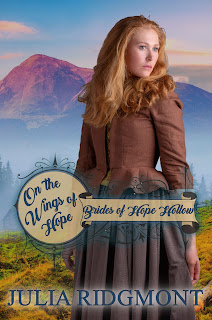
On the Wings of Hope is scheduled to release on February 12, 2021. Don't miss this exciting continuation in the Brides of Hope Hollow series! And if you didn't get a chance to read the previous books yet, they will be temporarily marked down during that week, so keep an eye out for some great deals!
Here's the preorder link for On the Wings of Hope: https://amzn.to/3b3iWbq
Reserve your copy today!


