Showing posts with label North Texas. Show all posts

Saturday, June 20, 2020

Crepe Myrtles, A Joy to Behold


Yes, it's crepe myrtle time! Called "June Roses" in Jamaica according to a dearly departed friend of mine, these beauties start blooming in May or June depending on the climate zone. They continue their colorful display well into autumn. I'm lucky to have several varieties growing in my back yard, all planted by my darling Hubby over the past twenty years.


The scientific name is lagerstroemia crape myrtle. The traditional Southern spelling is "Crepe Myrtle" (because the delicate flowers resemble crepe paper). However, across the US, it is more commonly found as "Crape Myrtle.” --According to Garden.com


I will go with the Southern version even though I had never heard of crepe myrtles before we moved to the Dallas-Fort Wort area decades ago. Apparently they aren't as well known by native-born yanks like me as is the iconic magnolia. It's a different story in North Texas. Here, they line boulevards, surround businesses and parking lots, and decorate private homes like mine.


Crepe Myrtles range in size from weepers only 2-3 feet tall, to dwarf shrubs 3-6 feet tall, to majestic 20 to 30-foot trees. Their flower clusters come in various shades of red, pink, purple and lavender, as well as white - like this huge specimen towering over the nearby storage shed. Not to mention the back of our house!


Native to China and Korea, crepe myrtles first came to America in the late 18th century, probably brought into Virginia from England, where they refused to bloom because it wasn't hot enough. They found southern temps more to their liking and spread across the South along with settlers. Exactly when they arrived in Texas I could not discover.


However, well-known North Texas horticulturalist Neil Sperry says crepe myrtles were popular with Texas gardeners in the 1920s and 30s. Texans were already breeding new varieties by then. Sperry says the popular 'Watermelon Red' color was developed at Munson's Nursery in Grayson County, near the border between Texas and Oklahoma. (Also where my dad grew up.)


Since then, the term 'Watermelon Red' has come to denote a number of old varieties with rose-to-hot-pink flowers. I have two dwarf bushes of this type.


Unfortunately, those early varieties were and still are susceptible to powdery mildew.


In 1959, the late horticulturist John Creech of Rhode Island read about a unique species of crepe myrtle growing on the remote Japanese Island of Yakushima. Creech went there, collected seeds from one such tree, and brought them home. The seedlings grown from those seeds were distributed to arboretums and botanical gardens across the South and Southwest. Several of those trees still live at the Texas AgriLife and Extension Center in Dallas.


Late botanist Don Egolf of the U.S. National Arboretum in Washington, D.C. succeeded in breeding the Japanese variety with the older one. This helped to eliminate the powdery mildew problem. The resulting “Indian tribe” hybrids were developed from the 1960s to the 1980s. They include such popular varieties as the white-flowered ‘Natchez’, the light pink ‘Muskogee’ and the hot pink ‘Tuscarora’.


These trees were not only powdery mildew resistant, but also had exfoliating bark in tones of tan, orange and brown, traits derived from the original Japanese parent tree. This makes for showy trunks. However, these hybrids did not exhibit the same intense flower colors as the older ones. (The Tuscarora looks pretty intense to me.)


This issue prompted Dr. Carl Whitcomb, a retired Oklahoma State University professor, to try breeding crepe myrtles with strong-colored flowers and disease resistance – without any hybridization. In 1985, on 65 acres in Stillwater, Oklahoma, he began planting thousands of seedlings from one parent plant per year.


After four years of evaluation, he chose one to five plants out of the 16,000 seedlings that showed the best colors and least powdery mildew. Those were used for further breeding. After generations of this method, in 1996, Whitcomb released ‘Dynamite,’ the first true-red crepe myrtle. It’s not pinkish or purplish red, but fire-engine red. Three years later, he came out with ‘Red Rocket.’


These trees are now the most sought-after crepe myrtles on the market. And I’m delighted to say I have one! It’s just starting to bloom. Soon, I’ll see a big, bright red bouquet on the hill behind my kitchen window.


Dr. Whitcomb has evaluated more than a half-million seedlings, yielding nine named varieties. He is now on his 18th generation of breeding and expects new colors in the future. “We’re just scratching the surface,” he says. “We’re starting to see more orange flowers, and we’re starting to see blue.”


Blue-flowered crepe myrtles? I actually just saw a dwarf ‘True Blue’ advertised online. OMG, I want one! But they are out of stock. Boo-hoo! Must contact the nursery and ask when they will be available. Can’t be too soon for this crepe myrtle lover!


Lyn Horner is a multi-published, award-winning author of western historical romance and paranormal romantic suspense novels, all spiced with sensual romance. She is a former fashion illustrator and art instructor who resides in Fort Worth, Texas – “Where the West Begins” - with her husband and two very spoiled cats. As well as crafting passionate love stories, Lyn enjoys reading, gardening, genealogy, visiting with family and friends, and cuddling her furry, four-legged babies.


Amazon Author Page: viewAuthor.at/LynHornerAmazon (universal link)  
Website:  Lyn Horner’s Corner 
Twitter   Facebook   Goodreads   Sweethearts of the West

Tuesday, November 10, 2015

SARAH HORTON COCKRELL, DALLAS' FIRST CAPITALIST


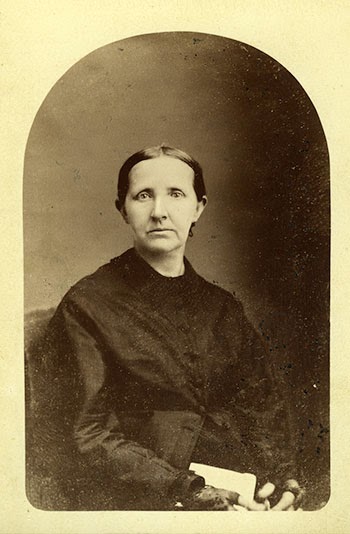
Sarah Horton Cockrell was a prominent business woman in Dallas, Texas as well as a wife, mother and daughter. For over four decades she played a pivotal roll in the development of the young town. 


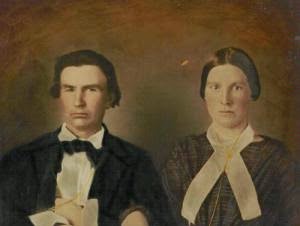
She was born in Virginia to Enoch and Martha Horton on January 13, 1819. In her early twenties, she moved to Dallas and, with her family, was among the earliest pioneers to come to Dallas County in 1844. On September 9, 1847, Sarah married businessman, Alexander Cockrell. They lived in a tent on Mountain Creek until they were able to purchase a headright along the Trinity River, the last remaining townsite in Dallas, from John Neely Bryan.


Sarah and Alexander had many business ventures which included brickmaking, construction, real estate, operating a sawmill and running the Trinity River ferry service, a part of the Bryan acquisition.  In 1855, she and her husband built a wooden bridge across the Trinity, but it collapsed due to flooding in 1858 after Alexander's death. Subsequently, she took over the family businesses with assistance from her son and son-in-law.

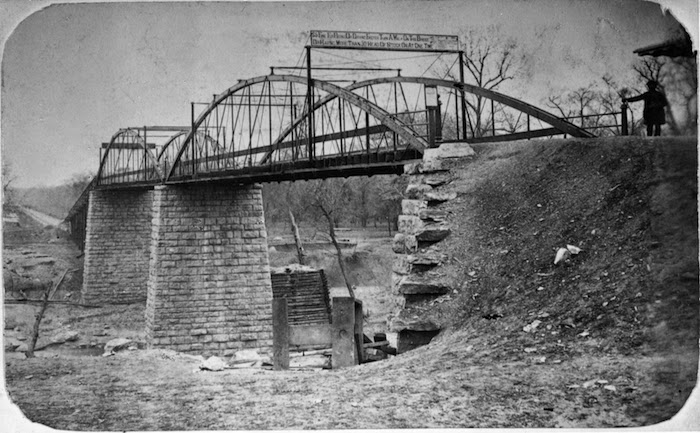
She continued to expand the business to establish her family as one of the more eminent in Dallas. Her enterprises spanned various industries including flour milling and multiple real estate ventures, and in 1870, Sarah formed the Dallas Bridge Company. It was at this time she constructed an iron suspension bridge over the Trinity River. This bridge is, perhaps, the most significant contribution to the development of Dallas.


In 1884, Sarah opened the Sarah Cockrell Addition, a private residential subdivision and the following year she constructed a three story office building. The First Methodist Church counts her as a founding member. Along with her sons, Sarah Cockrell owned an estimated twenty-five percent of downtown Dallas plus her other landholdings in Houston, Cleburne and Mineral Wells. She is often commended for being able to to profit in business, while maintaining the respect of society. When she died in 1892, her properties were so extensive that her will had to be published in pamphlet form.

Sarah Horton Cockrell will definitely be remembered as Dallas's first capitalist.

Wishing you a Happy Thanksgiving,
Carra

Tuesday, April 8, 2014

Reluctant Hero and Heroines

By Celia Yeary


The reluctant hero is typically portrayed either as an ordinary person thrust into extraordinary circumstances which require him to rise to heroism, or as a person with extraordinary abilities who nonetheless evinces a desire to avoid using those abilities for the benefit of others.
In either case, the reluctant hero does not initially seek adventure or the opportunity to do good.

In many stories, the reluctant hero is portrayed as having a period of doubt after his initial foray into heroism. This may be brought about by the negative consequences of his own heroic actions, or by the achievement of some position of personal safety - leaving the audience to wonder whether he will return to heroism at the moment when he is needed the most.

The movie High Noon is one of the best examples of a reluctant hero.  Will Kane (Gary Cooper) the longtime marshal of Hadleyville, New Mexico Territory, has just married pacifist Quaker Amy (Grace Kelly) and turned in his badge. He intends to become a storekeeper elsewhere. Suddenly, the town learns that Frank Miller—a criminal Kane brought to justice—is due to arrive on the noon train.

Miller had been sentenced to hang but was pardoned on a technicality. In court, he had vowed to get revenge on Kane and anyone else who got in the way. Miller's three gang members wait for him at the station.

Kane and his wife leave town, but fearing that the gang will hunt him down and be a danger to the townspeople, Kane turns back. He reclaims his badge and scours the town for help, even interrupting Sunday church services, with little success. During this time, Amy begs Kane to leave with her, but Kane has strong beliefs that he must defend the town...even alone.
Yes, he is a Reluctant Hero, but he stands his ground, finishes the job, turns in his badge again, and leaves with Amy.

But what about Amy? She does not leave as she threatened, and in the end grabs a gun to shoot a gang member who was in the process of trying to shoot Kane. The gang member grabs her as a hostage, but she fights him off, giving her husband a clear shot.
Once the gang members are dead, the town residents emerge to cheer for him. But Kane will have none of it. He throws his badge in the dirt with contempt, and rides out of town with his wife.

I see both Kane and Amy as reluctant heroes. Not one review site or blurb gives credit to Amy for being a strong heroine. It's all about Kane.

Amy foregoes her religious beliefs for a few moments, in order to save the life of the man she loves. Did she do that easily? Or quite reluctantly? I believe she had to grit her teeth and blank out her Quaker teachings in order to perform her deed. Absolutely, yes, she is reluctant. Just as reluctant as Kane, or more so.

I like reluctant heroes. In fact, I'd say more men...and women...are reluctant to act heroic than set out to be the hero.
In Texas Promise, Dalton King has not a heroic bone in his body. He can carry out difficult jobs as a Texas Ranger, but when it comes to protecting his wife from harm, he has to overcome his suspicions of her that she's deceived him. He is reluctant all the way, but in the end, does the right thing.

In Texas True, Sam Deleon has no intention of acting as a real husband to True Cameron. He  has other plans and believes he can accomplish his goals without falling in love with her. In fact, he doesn't even know what love is. But she teaches him, and in doing so, he opens his heart and his eyes and understands what he must do to makes things right.  To do that, he must act heroically, something he had no intention of doing.

In my newest release, Texas Dreamer, Lee King does not use his fists nor his gun to act the hero. His type of heroism is more subdued, but highly effective. He stands loyally beside his friend who is accused of trying to kill Lee; he uses the law to make a situation right; and he silently waits for Emilie to come to the correct conclusion concerning lies told about him. He never sees himself as a hero.
I should have titled this novel "The Quiet Man."

Texas Promise, Texas True, and Texas Dreamer can be found under  "Celia Yeary" on Amazon, Barnes and Nobel, Sony, iTunes, and Smashwords.
Thank you!
Celia Yeary-Romance...and a little bit 'o Texas