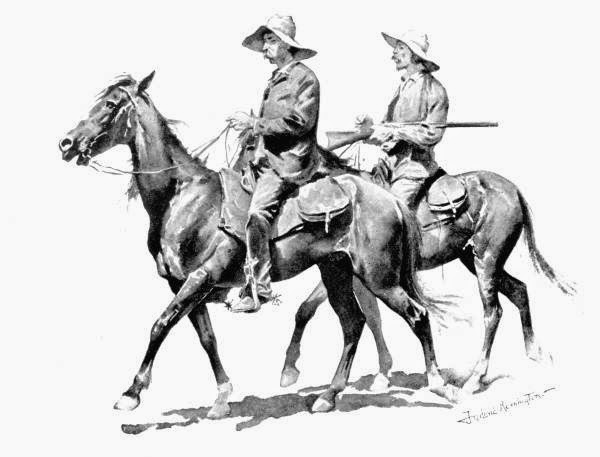
When it comes to our cowboy hero, we picture him wearing his most treasured possessions, his hat and his boots.
But how about the other garments the cowboy wears? Although less legendary, his other clothing was just as important, especially for their practical use.
For instance, the neckerchief, also called the bandana. The simple square of cotton was folded around the neck so that it could be pulled over the nose and mouth to mask trail dust. Not only to protect his neck from the blazing sun, the kerchief also could be used as a bandage, a tourniquet or to wipe the sweat off his brow.

The bandana originated in India and came from the Hindu word, bandhnu, describing a method of fabric dying. The 19th Century cowboy soon had made a fashion statement, the scarf worn in popular bright colors, preferably red and in printed designs of spots, calico and later, paisley.
His long-sleeved shirts were collarless, made of neutral colors of cotton for summer, wool for winter. Some had a heavier bib front panel for extra warmth. Not until the Wild West shows became popular, did the cowboy start wearing fancier colored, embroidered shirts.

An iconic piece that says “cowboy loud and clear,” is the vest. A cowboy spent much of his time in the saddle and found it difficult to reach into his pockets astride a horse. The vest with deep pockets was convenient for holding small items such as a knife, money, tobacco or a pocket watch attached on a chain.
Most of us western writers already know the history of Levi Strauss and his patented canvas work pants that provided the cowboy with a much sturdier pair of pants than the baggy woolen pants he’d worn before, and of course, it wasn’t long before the cotton blue fabric, denim became the work pants of choice.

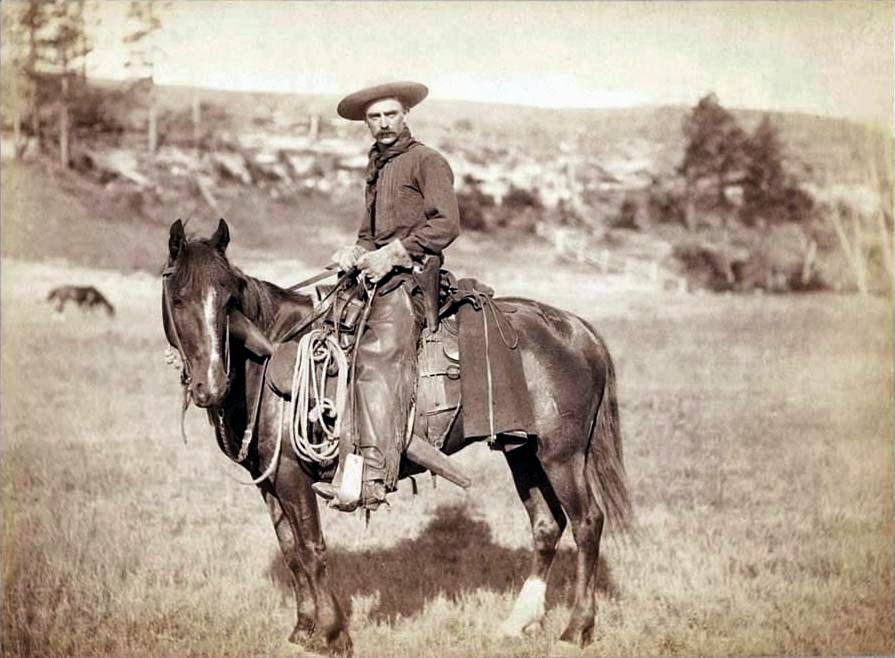
Another addition to the working cowboy’s gear is the seatless leather pants called chaps, derived from the Spanish word, chaperejos, meaning leather breeches. They protected his legs while riding the range full of dense brush and cactus as well as providing another layer of warmth in the winter. In the northern states, some wore goat hair pants. Wide chaps protected the flanks of the horse and the cowboy could put them on without taking off his boots; other styles were narrow and tight around the rider’s legs and were sometimes called leggings or shotguns.

Also worn on the trail by cowpokes to protect their clothing from the dust of cattle drives was the loose-fitting long duster coat. These duster coats usually had slits up the back for riding ease, but often had the capability to be buttoned closed. Legs straps were included to help keep the flaps in place and later versions included a detachable cape or hood to help fight against the elements. The improved fabric was usually light colored canvas or linen type cloth. Eventually, the duster needed to be improved as a reliable raincoat, thus the oilskin duster or slicker was born.

Spurs are one of the distinctive pieces of equipment that have been used by horsemen throughout the ages and certainly one of the most recognizable symbols of the western cowboy.
The very old word derives from Anglo-Saxon spura, to kick. The generalized sense of “anything that urges on, stimulus” is recorded in English from circa 1390.

In the days of chivalry, spurs and the metal from which they were made were a mark of rank. Hence the expression “to earn your spurs.” Today they are a standard piece of cowboy equipment and, as with most horse equipment, the design varied widely depending upon the region and the wearer.
Spurs are designed to be worn in pairs on the heels of riding boots for the purpose of directing a horse to move forward or laterally while riding. It is usually used to refine the riding aids (commands) and to back up the natural aids (the leg, seat, hands, and voice).
In the U.S. spur styles have changed through the years. In colonial days, the English style was popular, the spurs were light and conservative with a slight curve and small rowel. Straight shanked hunting spurs were also popular.
The regulation spur worn in the cavalry in 1882 was solid brass, slightly curved, with a small rowel, leather straps and brass buckle. The same type was popular during the Civil War. Early cavalry officer’s uniform required boots and spurs. They had a standard version, a dress version that was lighter, and an extremely light dance spur for social functions.
Many a cowboy liked wearing his spurs for show, adding “jingle bobs” near the rowel to create a jingling sound when he walked.


Gauntlet gloves were a necessity on the trail and cowboys often wore wrist cuffs to protect the wrist, forearm and shirtsleeve from injury or damage by ropes, branding irons, brush, wire fencing and other hazards.

Last but certainly not least….one more necessary item worn under it all….
Long Johns. Worn under the cowboy’s working clothing, long johns, or one piece underwear covered the body from neck to ankle and had a long buttoned opening down the front.
One may ask where such a garment got its name. A British etymologist and writer, postulated that the “john” in the item of apparel may be a reference to the late 19th Century famous heavyweight boxer, John L. Sullivan, who wore a similar-looking garment in the ring. This explanation, however, is uncertain and the word’s origin is ultimately unknown.
So, there you have our handsome cowboy dressed from head to toe!
Happy Trails To You!


.jpg)