Showing posts with label California history. Show all posts

Sunday, October 1, 2023

Formation of Tuolumne County, California by Zina Abbott


On February 18, 1850, Tuolumne County was established by the California Legislature as one of the original twenty-seven counties. It was given its name and divided into the six townships of Sonora, Mormon Camp, Jacksonville, Don Pedro’s Bar and Tuolumne City. It had it white American roots in the gold rush.
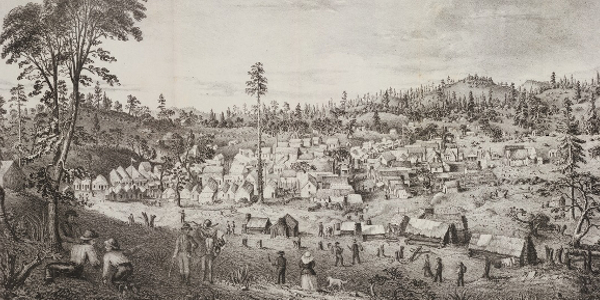
 

1852 Columbia, California

The name Tuolumne is of Me-Wuk, or Mi Wuk, (the predominant Native American tribe in the region) origin. It has been given different meanings, such as "Many Stone Houses," "The Land of Mountain Lions." and "Straight Up Steep," the later an interpretation of William Fuller, a native Indian Chief. Vallejo, in his report to the first Legislature, said that the word is “a corruption of the Indian word talmalamne which signifies “cluster of stone wigwams.” The name may mean “people who dwell in stone houses,” i.e., in caves.


This is interesting, since the Mi Wuk tended to live in cedar bark shelters.

1851 California mining map showing counties

Originally, it was much larger than it is now. When the state was organized in 1850, Tuolumne was. At the time, it was far larger than it is now.  It extended from the summit of the Coast Range on the west. It was south of San Joaquin County and extended eastward to the summit of the Sierra Nevada Range. It included all of what is now Tuolumne County, Stanislaus County, and parts of other counties.

At the first California Legislature meeting in 1848-1849, what became known as the town of Sonora, which had been named after the Mexican state of Sonora, became the county seat of Tuolumne County. At first, due to the large number of gold miners from Sonora, Mexico, who had come to work the region, it was known as Sonora Camp.  When Malcolm M. Stewart, who represented the San Joaquin district in the Assembly, went to that first meeting, he called the town “Stewart, formerly known as Sonorian Camp.”  The name was changed back to Sonora by petition and an amendment approved by the State Senate on April 18, 1850.  By May 1851, the city of Sonora was incorporated.

July 7, 1852, the first meeting of the Board of Supervisors of Tuolumne County was held.


June 1854, Stanislaus County broke off from Tuolumne County, and that county held its first elections. Tuolumne became much smaller in territory.


There is a Tuolumne City in Tuolumne County. However, it has never been the county seat.


It was not long before this county became known for its gold production, timber and lumber, and agricultural production.

Bret Hart Cabin and Hanging Tree in Big Oak Flat

The following is a list of early cities, towns, and communities in Tuolumne County. The names that are bolded are the ones in which I have set some of my books. Big Oak Flat, Chinese Camp, Columbia, Groveland, Jamestown, Long Barn, Mi Wuk Village, Moccasin, Pinecrest, Sonora, Soulsbyville, Standard, Strawberry, Tuolumne, Twain Harte.


Willow, my heroine in my latest release, 

A Watchman for Willow, 

came from a lumber camp in the east part of Tuolumne County to Sonora after her husband died. To find the book description and purchase options, please CLICK HERE


Sources:

https://scholarlycommons.pacific.edu/cgi/viewcontent.cgi?article=1945&context=uop_etds

The Early History of Tuolumne County California.pdf

https://archive.org/details/historyoftuolumn00lang/mode/2up

https://en.wikipedia.org/wiki/Tuolumne_County,_California

https://www.tchistory.org/TCHISTORY/TCTimelines_1851_1900.htm

https://tchistory.org/california-statehood-establishment-of-tuolumne-county/

https://geographic.org/streetview/usa/ca/tuolumne/index.html

https://www.counties.org/county-profile/tuolumne-county


Monday, May 24, 2021

ONE EYE, DEAD EYE, DEAD SURPRISE--CHARLEY PARKHURST by Marisa Masterson

 One-eyed Charley Parkhurst. This name became a legend in the West, especially in Northern California where this person settled and earned fame. But fame for doing what?

Pull up a chair and let me tell you 'bout old One-Eyed Charley!


Life in that orphanage back East was no picnic. Charley ran away from it at around the age of twelve. The God Lord smiled on him since he met Ebenezer Balch. Now Balch had a kind heart and a good way with horses. He taught Charley everything he knew about running a livery and caring for the animals.

Well, some years passed. Then it happened. They discovered gold in California. Men started flocking to the place. That gave Charley an itch for adventure. 


Charley made his way to Boston and boarded a ship, the R.B. Forbes, to take him to Panama. In Panama, he had to leave the ship and walk across land to reach the Pacific Ocean. Sure enough, the Lord was lookin' out for old Charley again. He met businessman John Morton there. The man owned a freighter outfit and needed drivers like Charley.

That Charley was one fine whip, as they called the drivers. In fact, he earned a special name--six-horse Charley. 'Course the other name came later when a horse kicked him in the eye, blinding it. From then on, folks mostly called him One-Eyed Charley.
You might be thinkin' that Dead Eye in the title was on account of Charley losin' that eye. That's not so. Outlaws learned to fear Charley Parkhurst. 

He carried a .44 caliber pistol and never hesitated to shoot anyone dead if the man tried to hold up Charley's stage. And he rarely missed what he aimed at with that gun or the coach gun. From twenty feet, he could cut the cigar out of a man's mouth if he aimed at it. Yes, he was that good.


All this would be enough to make Old Charley a legend. Funny thing is that Charley's legend grew after he died. All because of the surprise he had waitin' for folks.
After the cancer took Charley, the undertaker got him ready for burying. Only, the man couldn't help but notice that Charley was a woman. Charlotte.

Charley's obituary summed it up well.

On Sunday last, there died a person known as Charley Parkhurst, aged 67, who was well-known to old residents as a stage driver. He was, in early days, accounted one of the most expert manipulators of the reins who ever sat on the box of a coach. It was discovered when friendly hands were preparing him for his final rest, that Charley Parkhurst was unmistakably a well-developed woman! (Sacramento Daily Bee, December 1879)

Now don't that beat all!

Just consider this. Since Charley voted in an election for president, that makes her the first one in the United States to have the vote.

Latest Release...

Want adventure and romance? Please check out my latest release. From Minnesota to Wyoming, this couple will travel far before they can find their happily ever after...


Robbie MacTavish never thought to write away for a wife. After his wife’s death years earlier, he decided never to remarry. His aunt has other ideas and writes to a “friend of a friend”, Mrs. Ella Milton. When the bride fails to show, he is more relieved than disappointed. He needs to focus his attention on leading his family’s group of wagons to Wyoming.

When Veronica, his bride’s much older sister, appears and not Verity, Robbie suddenly grows much more interested in marrying. Will he be able to convince this woman that he needs only her as his wife while they race against time to find Verity?

Friday, April 30, 2021

La Grange, California and Gold in Stanislaus County by Zina Abbott

Gold was first discovered along the Tuolumne River in Stanislaus County, California, in about 1850 by a group of men from France. They named their camp French Bar since they found the gold on a sandbar in the middle of the river.


Historic Louie's Place
 

After a series of destructive floods along the river during 1851 and 1852, they moved about one mile upstream to get away from the flood plains. Their new community was founded in 1852. In 1856, the name of the town was changed to La Grange. One source says this was in honor of Lafayette's country home. Another source said it was in honor of General La Grange of France. (Joseph Burton Vasche) The name is French and means "the barn" or "the farm". The town prospered as both a mining and agricultural community.

Hammond and Bates Store

By 1854, there were over 100 buildings in La Grange. For a time Bret Harte taught school here.

La Grange Stagecoach Stop-iron doors typical of 1850s  

Historic La Grange School
 

La Grange became the county seat of Stanislaus County in 1856. Aside from its French population, the community included a significant Chinatown in its early years. At its height, the community had thousands of residents, but it was a largely lawless town. As the gold mining declined, so did the population. In 1862, Knights Ferry became the county seat.

Kingen Hotel
 

On June 3, 1869, John Muir departed Le Grange (French Bar) with a sheep herder and a flock of sheep and headed for the headwaters of the Merced and Tuolumne rivers. He writes the folloiwing in his book "My First Summer in the Sierra". In chapter one, Muir describes leaving French bar and moving with the flock into the hills near Coulterville. "This morning provisions, camp-kettles, blankets, plant-press, etc., were packed on two horses, the flock headed for the tawny foothills, and away we sauntered in a cloud of dust: Mr. Delaney, bony and tall, with sharply hacked profile like Don Quixote, leading the pack-horses, Billy, the proud shepherd, a Chinaman and a Digger Indian to assist in driving for the first few days in the brushy foothills, and myself with notebook tied to my belt. The home ranch from which we set out is on the south side of the Tuolumne River near French Bar, where the foothills of metamorphic gold-bearing slates dip below the stratified deposits of the Central Valley". In Many ways, this experience moves him so much, that he writes eloquently of the Yosemite area. His books are read by Americans including President Theodore Roosevelt. Muir becomes the face of a new conservation movement to save the Yosemite and creation of Yosemite National Park. [Source: "My First Summer In The Sierra", by John Muir - HOUGHTON MIFFLIN COMPANY 1917]

Tuolumne Gold Dredge west of La Grange
 

By 1880, mining had ceased with the exception of gold dredgers which continued to operate until the early 1950s. The dredging field extends westward from the town of La Grange along the Tuolumne River for nine miles. This district also includes a dredging field two miles to the south, on an older river channel, and surface "diggings" to the north.


The above is a photograph of the Tuolumne Gold Dredge, also known as the "Gray Goose", in La Grange, California, taken in 1980 just before it was shipped to the Alaska gold fields.

St. Paul's Catholic Church
 

La Grange is now a registered California Historical Landmark historic district. Today, a post office, a supermarket, an elementary school (as of fall, 2015, after a brief stint as a charter school, the public school was closed), and a High School (Don Pedro High School) still operate in La Grange. Also functioning is the oldest church in Stanislaus County, St. Louis Roman Catholic Church, with a cemetery containing tombstones dating to the mid-1800s. As of 2008 it has a population of 345.

What was a common occurrence in California counties held true for Stanislaus County. Its first county seat was Adamsville, a community along the Tuolumne River near where it joins the San Joaquin River, but it was shortly moved to La Grange in the eastern part of the county—the gold fields. The county seat was next moved a little farther west to Knights Ferry, also near where gold was found in Stanislaus county. In 1871, it was moved away from the gold-rich foothills to the brand new railroad town of Modesto in the valley. By then, the focus had turned from gold to agriculture. Modesto is still the county seat today.

In 1869, the year in which my novel, Cole, is set, both La Grange and Knights Ferry were active and well-known towns. Modesto did not exist. However, a secondary plot in this book is the struggle over who will be the power behind the railroad coming to this part of California.

To find the book description and purchase link for Cole, book 8 in the Cupids and Cowboys series, please CLICK HERE.


Sources:

La Grange Historical Plaque, State Department of Parks and Recreation in cooperation with Morada Parlor No. 199, Native Daughters of the Golden West, October 13, 1984

Display regarding La Grange and Gold Mining in Stanislaus County at McHenry Museum, Stanislaus County, California

https://westernmininghistory.com/towns/california/la_grange/

http://www.stancounty.com/board/unincorporated-cities/la-grange.shtm

Wikipedia, La Grange, California