
I would like
to preface my blog by first expressing my heartfelt sympathy for the Las Vegas victims
and their families affected by the evil and incomprehensible shooting that
occurred last Sunday in Las Vegas.
As those who
read my post last month would know, my husband & I moved to Henderson, NV
(in Las Vegas, Clark County) in July, so I had written a brief history about
Las Vegas. This month, I had drafted a follow up post about the history of
gambling in the Old West. However, in respect for everyone affected by the
tragedy, I decided to put off posting a topic that referred to Las Vegas until
next month.
With such a short time to write another article, I’m posting a previous
article on western music. Hopefully appropriate, considering people were
enjoying the concert in Las Vegas featuring country/western music. That said,
it reminds me to enjoy life and not let anyone, terrorist or psychopath, force
me to live in fear.
Praying for
less hate, more love,
Cheri
After
writing a blog on two of our most legendary singing cowboys, Gene Autry
and Roy Rogers, I thought I would research more in depth the origin of cowboy
music, as well as the history of other classic western music. Like a lot of western
writers, I love today's country music. Many of the songs reflect the sound and
romance of songs and ballads, many written and sung over 150 years ago.
The birth of the American cowboy as we
know him emerged with the advent of long-distance drives to move cattle to
northern markets after the Civil War. These itinerant livestock herders
included men from all walks of life and nationalities. For entertainment, they
sang the songs from their native cultures and homelands, and these songs were
often reshaped to fit the new landscape. “The Ocean Burial”—originally written
in 1839 by Bostonian Edwin Chapin—and its lyric “O! bury me not in the deep,
deep sea,” eventually became “The Dying Cowboy” with “Oh, bury me not on the
lone prairie.” Other music was influenced by Celtic, slave, and parlor songs.
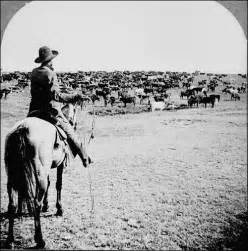
Between 1870 and 1890, probably 10 million
longhorn cattle traveled from Texas to Kansas and other northern markets. A
group of cowboys rode with each herd of from 2,000 to 5,000 cattle to push them
up the trail by day and herd them after dark. Any unusual noise after the
cattle were asleep might send them into a wild and destructive stampede. To
drown those disturbing noises, the cowboys crooned or yodeled to the cattle.
From these cattle calls grew some of the trail songs descriptive of cowboy
life. So long as the cattle could hear a familiar voice singing some lullaby,
they had no fear of the howl of a wolf, the scream of a panther, or any of the
other sudden noises of the night. What the men sometimes called
"dogie" songs soothed the cattle to sleep.
Like the song, "Git Along Little Dogies."
Whoopee ti yi yo, git along little dogies
It's your misfortune and none of my own
Whoopie ti yi yo, git along little dogies
You know that Wyoming will be your new home.
It's your misfortune and none of my own
Whoopie ti yi yo, git along little dogies
You know that Wyoming will be your new home.
"Home
on the Range" is a
classic western folk song, sometimes called the "unofficial anthem"
of the American West. The lyrics were originally written by Dr. Brewster Higley
of Kansas in a poem entitled, "My Western Home" in the early 1870's.
In 1947, it became the state song of the U.S. state of Kansas. The song was
eventually adopted by ranchers, cowboys, and other western settlers and spread
across the U.S. in various forms. Members of the Western Writers of America
chose it as one of the top 10 Western songs of all time.
"Red
River Valley" is
another folk song and cowboy music standard, although of controversial origins
that has gone by different names, depending on where it has been sung. It also
is listed on of the top 10 Western songs by the members of the Western Writers
of America. Do any of you remember the lyrics?
From this valley they say you are going.
We will miss your bright eyes and sweet smile,
For they say you are taking the sunshine
That has brightened our pathway a while.
So come sit by my side if you love me.
Do not hasten to bid me adieu.
Just remember the Red River Valley,
And the cowboy that has loved you so true.
The first and greatest collector of western
songs was John A. Lomax. His songbook published in 1910, Cowboy Songs and Other Frontier
Ballads, introduced the country to music of the American West and
helped propel the cowboy to iconic status.
Even though the songwriter, Stephen Collins
Foster (July 4, 1826 - January 13, 1864) was primarily known for his parlor and
minstrel music, many of his songs were chosen among the top 100 Western songs
by the members of the Western Writers of America. Named "the father of
American music", he wrote over 200 songs, among his best-known are "Oh! Susanna", a minstrel song
first published in 1848, "Camptown Races"," Old Folks at
Home", "My Old Kentucky Home", an anti-slavery ballad composed
and published in 1853, "Jeanie with the Light Brown Hair", "Old
Black Joe", and "Beautiful Dreamer".
Many of his compositions remain popular more
than 150 years after he wrote them. His compositions are thought to be
autobiographical. He has been identified as "the most famous songwriter of
the nineteenth century", and may be the most recognizable American
composer in other countries.

Foster
was such a talent, sadly his life ended way too soon. In 1857, economic difficulties led him to sell all
rights to his future songs for just under $2,000. Near the end of his brief
life, he lived alone in New York City and suffered from alcoholism. In 1864, at
age 37, he died in Bellevue Hospital. He had been taken to the hospital after
suffering from a protracted fever which left him so weak that he collapsed and
hit his head on a washbasin.
Delving
into the history of such memorable music and songs, I found it fascinating to
read about them and surprised that I actually remembered some of their lyrics.
I hope you enjoyed reading about a few of these classics. Of course, there are
hundreds more, so many written and published during both the good times and hard
times of our nation's history.
You
can check out more Top Western Songs listed with the Western Writers of America
at their web site: www.western100.com

