Showing posts with label Train travel. Show all posts

Thursday, April 16, 2020

How Quickly Times Changed!!


I’m currently writing my first “modern” book set in 1881. It’s such a thrilling time period! Until now, my most “modern” time period was the 1850s. It’s shocking how much technology changed in those twenty to thirty years! What a thrill it would have been to live then. But trying to keep up would have been a challenge and makes for interesting character development for some. A great time period for a historical writer <grin>

For example, in my current manuscript, my heroine is answering the newly invented telephone for the hero’s industrial company. His company is involved in running the wires on the streets for the newly developed electricity. And heroine’s mother hates all this modernizing and didn’t want the wires coming to her house. Thankfully, her husband insisted that for the future property value of their house, they had to at least have the wires run while the company was working on their street. My heroine tries to reason with her mother by asking how she would like to be without the indoor plumbing that they now take for granted but had only been run through their city in the last thirty or so years.

These are things that we take for granted nowadays, but it’s fascinating to think about how some
might have resisted these “newfangled gadgets”!

Even transportation! When I was writing my Proxy Brides books, I had to keep researching just how far West the train would have gotten in the year I wanted. Connecting the East and West coasts by train travel changed everything! And in the twenty-five years between my eras, train travel times shrunk exponentially. When they first connected the coasts, it took two weeks or more to make the trip which was still extremely fast compared to travelling by ox pulled wagons, but by the 1880s it only takes a few days!

Fortunes were gained and lost even more quickly with the advancement of technology. Those who could adapt, thrived. Those who could not, lost out. This is a thrilling time period for historical authors. I personally read and write for the escapism of it. Because of that, all my books have an extreme. Usually extreme wealth – the hero is a duke or an earl or a wealthy land owner or struck it rich with the gold rush. I think the 1880s will allow for many extremes as so many were learning and discovering new and improved things.


If you want to stay abreast of when this particular book releases, please sign up for my newsletter or join my Facebook group.

In the meantime, please enjoy one of my Proxy Brides books, A Bride for Ransom:

They find themselves married...but can they be a family?

Ransom is just looking for a mother for his orphaned niece. The fact that she’s from Boston is a bonus. Their arrangement allows him to get out of town.

Hannah needs a husband. Her new name will protect her siblings. The fact that he lives in the back of beyond gives them a place to hide. She hadn’t counted on him being so appealing.


But what happens when they realize how very permanent their proxy marriage truly is?

Available from Amazon, included in your KU subscription.

Tuesday, February 14, 2017

A Touch of Texas Irish—A Contest—My Research


As always, for me the research for this novel was fun. The story begins in Ireland, and my husband and I were fortunate enough to tour parts of Ireland several years ago. So, while writing my heroine's flight from Ireland, I had a good picture in my mind of the town and port of Kinsale, Ireland where she boarded a freighter bound for Boston, Massachusetts.

I knew nothing about Boston, so spent hours researching the port, the docks, and the neighborhoods where Irish Catholics lived. At the time, Boston was a Protestant town and didn't want Catholics in their neighborhoods. During the migration of Catholics from Ireland, many traveled to Boston as well as New York and other cities. I didn't know Boston's port was so extensive.

I spent a great deal of time researching rail travel, time schedules, and routes. The train didn't travel all the way to Fort Stockton so the hero and heroine had to board a stagecoach in Monahans. It was a rough ride compared to the train. I've researched stage travel for several other books so didn't need to spend much time on this topic.

I lived in Fort Stockton, Texas for several years, but did have to research the area for the time period of 1890. The fort had been closed, so the town lost much of its trade. The store by Comanche Springs was a stopping place for travelers.

Contest:  For the release of A Touch of Texas Irish, I'm giving away a James Avery charm bracelet with a clover heart charm. To enter, go to my website or blog and use the form to sign up for my newsletter. I will enter you into the contest. If you already receive my newsletter, email me at linda@lindalaroque.com and request that I add you to the contest list. I will be checking emails to make sure they're valid and don't time out before a newsletter can download.

Unfortunately, the winner must be in the U.S. A winner outside the US will receive an E copy of this book and a selection of others and another winner will be selected for the bracelet.

Blurb:

Aileen Lynch flees Ireland to escape a forced marriage, but in Boston she marries a frontier doctor needing a mother for his son, and they board a train bound for Texas.

Doctor Samuel Walker attends a medical conference in Boston, and at a colleague's entreaty, marries a young Irish woman to save her from a forced abusive marriage.

While Aileen strives to earn Sam's affection, the frontier doctor vows never to risk Aileen's safety or his heart—he'll not father a child and watch Aileen die.

Excerpt:

Aileen stepped from the washroom wearing her robe with only her chemise underneath. She wanted to be able to dress quickly if need be. Her traveling costume was folded and stored in her portmanteau. It would slide under their bed in case she needed it in a hurry. Sam waited for her right outside the door and walked her to their berth. The porter already had the seats folded down and the bed made. The couple that sat across from them was settled in the bunk above.
Sam held the curtain for her while she crawled across the mattress. He removed his clothes and laid them across the foot of their bed. He slipped under the covers in his drawers. Suddenly shy, Aileen clutched the robe closer to her body.
He untied her robe. "You can't sleep in that. You'll get too hot and become tangled when you try to turn over." She had to admit the car was rather warm. Sam mentioned something about a hot air furnace. "Come on, give it here." He took the robe and tossed it to the end of the bunk. When she'd settled under the covers, he slipped an arm under her head and pulled her close. Her heart thundered in her chest. Surely he'd not make love to her here. She'd die of embarrassment. "Good night, Aileen."
"Night." She released a sigh of relief, but felt a nagging disappointment. The thought of such an activity in these close confines brought forth a giggle.
"What's funny?"
"Sleeping this close to other people is so odd. Lydia is the only person I've ever shared a bed with." And now I'm sharing a bedroom with close to two-dozen people. Sam's heart thrummed away under her ear, and the faint aroma of his aftershave tickled her nostrils. She fidgeted trying to decide what to do with her free arm. The obvious remedy would be to throw it across Sam's chest, but she didn't want him to think her brazen. Finally, he made the decision for her. He took her arm, placed it across his middle, and stroked it with a gentle motion. She closed her eyes, enjoying the closeness and his touch.
"You settled...comfortable?"
 "Yes, thank you. Goodnight, Sam."
He squeezed her with his strong arms in response. She listened to the sounds around her—snoring, coughing, and the occasional passing of gas. Not having slept in such close confines before, the intimate sounds were foreign to her. Though Sam didn't love her, lying wrapped in his embrace, she experienced security for the first time since her mother's passing. A tear leaked from her eye, and she wiped it away. No looking back, Aileen. Mother wanted you to be happy. Aileen would make that happen.
A Touch of Texas Irish is now available for pre-order. The release date is March 8th. Copies are available at—
Amazon
I have a new release, an anthology about love and modes of travel. It is available
https://www....amazon.com.au/dp/B01MUX2M8F

Tuesday, June 14, 2016

Railroad Time


Reference:  Into the Modern Age:  The Adoption of Standard Time
critical enquiry.org/wo/2012/11/30/into-the-modern-age-the-adoption-of-standard-time

When conducting research on travel by train for my current WIP, A Touch of Irish Texas, I became bogged down in train schedules, distances between cities, and the amount of time it took to travel those distances. What a mess. It was discouraging for someone not familiar with time in the 1880s and 90s and who needed to get characters on a train in Boston bound for Monahans, Texas. So, here's what I learned. 

We've had mechanical time pieces for a long time, even as far back as the ancient world, however, the  time was never exact. Accuracy wasn't of such importance back in our earlier history as l  ife wasn't based on a time schedule. In areas where cities had public clocks, they were usually based on local mean time which was determined by the position of the sun at noon, "since each degree of longitudinal movement around the globe represents a difference of roughly 4 minutes on a solar-based time system. Under solar time, if was noon in Boston, it was 11:24 in Charleston, South Carolina, 11:36 in Washington, DC, 11:48 in New York City, and so forth."

On December 11, 1847, the United Kingdom adopted a single time zone. Railways in that country switched from local mean time to GMT (Greenwich Mean Time). "The UK had the advantage of covering only 8 degrees of longitude, so only one time zone was required." Communities the farthest away only needed to change their clocks one-half hour forward or backward. "By 1855, most of the country's public clocks were set to GMT."

The US had a much larger problem as it's territory stretched across 57 degrees of longitude and unlike the UK, the US lacked a well-known central city on which to base any national system of timekeeping.

Though railroads were not the prime motivating force behind adopting of a standard time, they did have problems. Timetables were based on known travel time and distance between stations which often led to accidents and delays. In the 1850s, schedules were managed with new technology—the telegraph—which allowed updates to be forwarded or notice of disabled trains.

In 1852, a writer for an industry journal recommended that New York City's time be adopted as "the first [or sole] meridian of railroad time." The concept didn't receive further discussion. "It was not until 1869, when Charles F Dowd presented a plan at a New York convention of trunk line (railway) operators, that some momentum toward adoption of a national railroad time began." He emphasized how confusing the time schedules could be for travelers. He proposed that Washington DC's local mean time be adopted to manage all national railroad travel. Each city could continue to use their local mean time for other purposes. The railroads lost interest and "felt any inconvenience and confusion to travelers wasn't their problem to solve."


Astronomers needed a universal time system for coordinating celestial observations. In 1875 Cleveland Abbe wrote of his difficulties when attempting to coordinate observations of an aurora borealis on April 7, 1874. He had recruited 100 observers in an attempt to determine the aurora's altitude about the earth. "The experiment failed because, as Abbe stated, 'the errors of the Observers' clocks and watches, and even of the standards of time used by them are generally not stated...so that the uncertainty of this vitally important matter will be found to throw obscurity upon some interesting features.'"

In 1880, Abbe corresponded with Stanford Fleming, a Canadian railway engineer who expressed the need for a universal world time. The two men called  for an international convention to discuss the issue which troubled not only the railroads but other forms of trade such as steamships and other companies.

Discussion continued, papers were written, but no real progress was made until April 1883 when William F Allen wrote an article for the General Time Convention. "He stated that "We should settle this question among ourselves, and not entrust it to the invite wisdom of the...State legislatures."

"Meetings in 1883 formalized the system of meridians, then know as Standard Railway Time, each exactly one hour apart, that formed the basis for Standard Time. By happy coincidence, the proposed eastern meridian of Allen's system coincided within 6 seconds of GMT, which was 5 hours away. This reinforced Allen's belief that Greenwich time should be adopted as a world standard."


The new system was formally implemented on November 18, 1883 and almost universally adopted with a year. "New Yorkers set their clocks back four minutes, Chicagoans stopped theirs for nine minutes. Those in Philadelphia, New Orleans, and Denver did nothing since they were located at the base meridian for their time zone."


"In 1918, the US formally adopted Standard Time and abolished all local timekeeping."

Thank you for stopping by Sweethearts of the West. Please leave a comment and I promise to respond. Next month I'm blogging about "Buying a Watch in 1880."

Happy Reading and Writing!

Linda
www.lindalaroque.com

Friday, January 20, 2012

GUEST LYN HORNER SHARES HER LOVE OF TEXAS

By Caroline Clemmons

Jeanmarie Hamilton had surgery this week, so please help me welcome Lyn Horner who is graciously allowing me to repost and earlier interview with her from my own blog. To show her appreciation for her readers, one lucky person who leaves a comment today will win downloads of both of Lyn's books!

Author Lyn Horner
Lyn, please tell us about growing up.


Lyn: I’m an only child. Born in San Francisco, I was raised in Minnesota, my mother’s home state. My father was a Texan and it’s from him that I inherited my love of the Old West. I’m married to my high school sweetheart. We have two grown children, six grandkids and a passel of cats.


Caroline: I love cats, but only have two. I notice that you also have a memoir titled SIX CATS IN MY KITCHEN. Would you like to give us a small peek at that book before we go on to DARLIN' DRUID?


Lyn: Thank you. I invite you to try my memoir, SIX CATS IN MY KITCHEN. Six special cats are the headline-grabbing stars, but I touch upon subjects such as grieving the loss of loved ones, living with a disability, and coping with major life changes.


Quoting reviewer Todd Fonseca, “Through her prose, Horner’s love of life, cats, and wonderfully engaging humor comes through in this high energy memoir. Reading Horner’s story is like chatting with a best friend over coffee on a Sunday afternoon – few things in life are better.”


Caroline: Your book sounds inviting. Who are your favorite authors and favorite genres?


Lyn: Diana Gabaldon is my favorite author. I adore her Outlander series. I also like Linda Howard and Iris Johansen. As you might guess, my favorite genres are historical romance (especially Scottish, Irish and western romance) and contemporary romantic suspense.


Caroline: We share a love of the same genres. Isn't Diana Gabaldon a lovely person as well as a great writer? How many books do you read a month? What are you reading now?


Lyn: I don’t read as much as I used to because I’m busy writing. Such a burden!  Even so, I read five or six books a month. Right now I’m re-reading KINSMAN'S OATH by Susan Krinard. When I find books I like, I often read them again and again.

Lynn's Memoirs
and her 6 cats
Caroline: So do I, and each time I get something new from them. When you’re not writing, what’s your favorite way to relax and recharge? I know you love your cats, but do you have any hobbies?


Lyn: Let’s see, I love to read of course, and I love movies. Some of my favorites are the "Lord of The Rings" trilogy, "Avatar," "Gladiator," "Last of the Mohicans," and "Red River" (the original black and white version with John Wayne and Montgomery Clift.) Gardening is my only outdoor hobby.


Caroline: At our house we're very grateful for Netflix so we can watch our favorite movies and TV series. Describe yourself in three or four words.


Lyn: Determined, imaginative and somewhat reclusive.


Caroline: Would you like to share any guilty pleasures that feed your muse?


Lyn: Dark chocolate, Celtic music and steamy hot baths. Oh, and an occasional margarita.


Caroline: You and I have a great deal in common! How long have you been writing?


Lyn: I’ve always enjoyed writing, but from the time my folks gave me a rudimentary oil painting kit, I set my mind on becoming an artist. I got my bachelor of fine arts and worked as an illustrator and art instructor for several years. Then I had two children, we moved, forcing me to quit work, and I found myself isolated at home with two small kids. To save my sanity I began to write as a hobby. That was well over twenty years ago. The ups and downs since then could fill a book.


Caroline: Writing does have a lot of ups and downs that mirror life. Where do you prefer to write? Do you need quiet, music, solitude? PC or laptop?


Lyn: I work on a laptop. My favorite places to write are in my recliner or on our bed with books and research notes spread around me. If I’m writing a blog or answering interview questions I can do it with the TV on, music playing, or my husband talking to me. But if I’m working on a book, I need quiet. Solitude is best.


Caroline: Are you a plotter or a panzer?


Lyn: I’m a plotter. I use stickum notes to work out major plot points, then develop a loose outline. It undergoes changes as a book progresses, but having a plan keeps me on course toward my goal.


Caroline: Same here. What on earth did we do before Post-It notes? Do you use real events or persons in your stories or as an inspiration for stories?


Lyn: I am very often inspired by real events in my western historicals. For example, I use the Chicago Fire and our country’s first transcontinental railroad in DARLIN' DRUID. Most of my characters are purely fictitious, although I did include the real commander of Camp Douglas, Utah, as a peripheral character in DD.


Caroline: Tell us about your writing schedule. Do you set goals? Do you write daily?


Lyn: I set goals but don’t always meet them. I write nearly every day, starting by 6:30 or 7 a.m. First I check email, comment on some writing forums, and maybe write a blog. When all the “fun stuff” is done, I go to work on my current project. With interruptions for household chores, it’s more of the same until late evening, sometimes into the wee hours of morning.


Caroline: I'm so not a morning person and tend to be more creative late at night. What do you hope your writing brings to readers?


Lyn: Most of all, I hope to give readers a rollicking good adventure that draws them in and won’t let go of them until the very last word.


Caroline: What long-term plans do you have for your career?


Lyn: I will continue to write my stories and publish them as ebooks. If I’m lucky enough to build a loyal following of readers, I will be proud and grateful. Beyond that I’ll take one day at a time.


Caroline: Well said! Would you like to tell us what you’re working on now?


Also now available
Lyn: Sure. I’ve just finished writing book II in my Texas Druids series. Titled DASHING DRUID. This is the story of Tye Devlin and Lil Crawford, troubled souls who find both comfort and conflict in each other’s arms. Like his sister Jessie, the heroine of DARLIN' DRUID, Tye possesses a psychic gift inherited from Druid ancestors. He can experience other people’s feelings – he’s empathic in modern terms – an ability that may save those he loves or get him killed. Now I'm at work on book three in the series, DEAREST DRUID.


Caroline: What advice would you give to unpublished authors?


Lyn: Learn your craft, research settings and time periods carefully, and write the best book you can. Join a critique group and edit, edit, edit! Be persistent. Don’t let rejection letters stop you. Keep writing, keep submitting, and consider publishing your own eBooks. They are now outselling all forms of print books.


Caroline: Tell us about the first in this series. In any series, even if they're stand alone books, I like to begin with the first book. 


Lyn: If psychics live among us, if they existed in ages past, is it possible such gifted beings also inhabited the American Old West? They do in my Texas Druids trilogy. Meet the Devlins, whose hidden talents lead them across prairies and mountains, into the land of cowboys and Indians, with consequences not even a Druid seer could predict.


Set in 1872, DARLIN’ DRUID is a blend of epic adventure, stormy romance and family strife, peppered by flashes of Druid magic. Jessie Devlin, daughter of Irish immigrants and survivor of the Great Chicago Fire, is descended from the “Old Ones,” her mother’s name for their ancient Druid ancestors. Gifted with visions of the future, Jessie dreams again and again of an unknown man who saves her from death. A prophetic vision convinces her the man is real and sends her west in search of him. But will her quest lead her to love or into a deadly trap?


Caroline: You've hooked me! I do believe in psychic abilities and several people in my family are psychics of one type or another.


Lyn: Here's the excerpt:


A woman’s shriek rent the air, interrupting his ruminations and jerking him to attention. The sound had come from inside the depot.


“What the devil?” he muttered. Cutting a path between startled travelers, he shoved open the door and stepped into the building. The stuffy interior reeked of tobacco and sweaty bodies. Finding a gap in the crowd, David caught sight of a red-faced young corporal. The trooper bobbed and weaved, arms raised to fend off blows being rained upon him by a woman in a brown poke bonnet. Her weapon was a heavy looking black reticule.


“Scoundrel! I’ll teach ye some manners, I will!” she vowed in a furious Irish brogue. Swinging wildly, she sent the corporal’s blue cap flying.


“Take it easy, lady!” he cried. “I didn’t mean no harm.”


Wondering what offense the man had committed, David shouldered his way through the crowd until he stood directly behind the woman. Slim and a head shorter than himself, she wore a calico gown, the same drab color as her bonnet. Some settler’s wife, he assumed. But where was her husband?


“No harm, indeed! Stand still, ye heathen, and take what’s comin’ to ye,” she ranted. As she spoke, the yellow-haired corporal spotted David’s uniform and threw him a desperate look.


Feeling duty-bound to step in, David cleared his throat loudly and said, “Excuse me, ma’am, but perhaps that’s enough. The corporal might be needed in one piece when he gets back to his post.” His remark drew laughter from several bystanders.


The woman snorted angrily. “Indeed? Well, I don’t give a fig whether the lout is in one piece or twenty!” So saying, she landed a solid whack on the corporal’s noggin that made him yelp.


“Get ’im, darlin’!” a man in the crowd shouted, egging her on.


Afraid the young soldier might retaliate, David reached out to grasp the woman’s arms, stopping her in mid-swing. “Ma’am, if you’ll just settle down . . . .”


“Let me go!” she shrilled, attempting to wrench free.


He should have complied with her demand, but some primitive instinct made him slip an arm around her and haul her back against him. A sweet scent of lilacs and woman washed over him, and he instantly grew aware of her feminine curves.


She gasped indignantly. “How dare ye? Bithiúnach! Muclach! Take your filthy hands off me.”


Glad he didn’t understand Irish, David cursed under his breath when she rammed her heel into his shin. It didn’t hurt much thanks to his leather boots; nor did the small fists pounding on his arms. But her frantic twisting sent the wrong signal to his male parts.


“Calm down, you little wildcat!” he growled. Releasing her, he stepped back before he humiliated himself.


Whirling around, the woman drew back her arm as if to slap him, only to freeze when their eyes met. A choked sound escaped her lips and the angry color drained from her cheeks. Seeing her sway, David grasped her shoulders to steady her. Her hands clutched his forearms as he returned her wide-eyed stare.


Her eyes were sapphire blue, so dazzling that he had trouble breaking their hold upon him. When he did, he noticed how young she looked – eighteen or twenty, he guessed – and what a beauty she was.


His gaze wandered over her smooth, creamy cheeks and dainty nose then lingered on her pink parted lips. Forcing himself to look elsewhere, he noted the dark auburn curls framing her brow. Her ugly bonnet hid the rest of her hair, but he bet it would look like silk when she let it down.


Then he noticed how rapidly her breasts rose and fell, and desire surged through him, swift and strong. He felt a loco urge to pull her into his arms and kiss her. Reluctantly dragging his gaze back to her sapphire eyes, he wondered what had come over her. A moment ago, she’d been mad as a hornet. Now she stared at him as if she were seeing a ghost.


Dazed by the sight of him, Jessie wondered vaguely if she was having one of her visions. Her gaze kept returning to his gray-green eyes. Crowned by dark brows with an eerily familiar slant, they matched those she’d so often seen in her dreams. Could this tall, uniformed stranger be the man she had left home to find? She hadn’t expected her quest to bear fruit so soon. And the longer she studied his sun-bronzed, square-jawed face, arrow-straight nose and unyielding mouth, the more she doubted he was the one.


Those rakish features were hard, not gentle, and his hauntingly familiar eyes did not caress her like the ones in her dreams. Instead, they devoured her, making her stomach flutter and her heart race. When he boldly stared at her breasts, they tingled as if he were actually touching them. Stunned by her reaction, she inhaled sharply, catching the scent of shaving soap and virile male. She wondered if he would kiss her.


Caroline: Intriguing excerpt to add to the blurb. I'm sure they've made readers want to read the book. Where can readers find DARLIN' DRUID?


Lyn:
Amazon http://www.amazon.com/dp/B004ASNDES


Barnes and Noble: http://search.barnesandnoble.com/books/product.aspx?ean=2940012184290


Caroline: Anything else you’d like readers to know?


Lyn: See my vision of my book:


Caroline: How can readers learn more about you?


Lyn: My home page: http://texasdruids.com//


Blog site: http://texasdruids.blogspot.com/


Facebook: http://www.facebook.com/pages/Lyn-Horner/161787403863487


Thank you, Lyn, for sharing a new type of western historical with us today. Continued good luck with your writing career!


Thanks to you, readers, for stopping by.


Saturday, March 26, 2011

ALL ABOARD . . . FOR RAIL TRAVEL!


Santa Fe Poster publicizes travel
via Atcheson, Topeka and
the Santa Fe Line

 Rail travel’s hypnotic rhythm, unique smells, and the sense of adventure stir the imagination.

I love trains and have fond memories of travel from Southern California to visit my grandmother in Oklahoma and back home several times between ages three to six. Later after my family had returned to Texas, I made two trips as a teen from Lubbock, Texas to California to visit relatives there. Wonderful memories reappear when I think of the Santa Fe Chief.

Do you have memories encompassing "riding the rails"? Did you have a sleeping compartment or sit up all the way as my family did?

No matter what your trip involved, a few basic facts can offer enlightenment to the advent of personal travel by train. Choosing which facts to relate and which photos to share is a problem. Because I love trains so much and have used them in my western historicals, I have a LOT of information. I've visited train museums, called them, and written. Most of the photos are black and white, and some of my favorites are too dark to scan and use, but I'll share some with you.

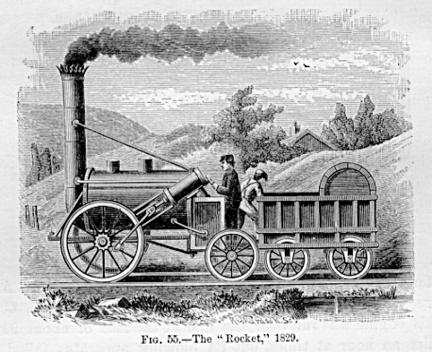
The first commercial rail cars were in England in—believe it or not—1630--and were drawn by horses over wooden rails to transport coal. By the mid 1700’s, iron rails had replaced wood. The first steam-powered land vehicle built by Frenchman Nicholas-Joseph Cugnot in 1769 laid the foundation for future locomotives.
 
The Rocket, 1829, could
pull 30 passengers 30 mph


In the United States, Congress had invested heavily in the Eerie Canal and other waterways and resisted the idea of railroads. Public opinion eventually won. In 1827, the Baltimore and Ohio Railroad was the first railroad charter granted in the United States. By 1852, its three hundred miles of track made this the longest railroad in the world. In 1862, President Abraham Lincoln signed the provision for a nationwide rail line. Once the transcontinental rail lines were completed in 1869, America was opened to settlers from all over the world. At first used only for transporting goods, passenger travel soon developed.


In 1831 the DeWitt Clinton hauled 5 stagecoach bodies
at 25 miles per hour on the Mohawk and Hudson
Railroad from Albany to Schenectady--imagine the soot!


A wide variety of facilities awaited passengers. On some lines, the coaches were little more than rough structures that offered no comfort. Wooden benches with high backs—many times without a cushion of any kind—tortured passengers on a long journey. Still, it probably was no worse than riding in a wagon. At least the train made the trip faster. Other lines had coaches with padded bench seats, and still others with movable armchairs. Toilets sometimes were no more than a curtained off chamber pot offering minimal privacy.

1873 Steam locomotive

 Summer forced passengers to choose between tolerating soot, smoke and dust with the windows open, or sweltering with windows closed. In winter, passengers near the potbellied stove roasted while those at the other end of the car froze. Hmmm, sounds like the floor furnace of the house in which I grew up.  <G> Sometimes cars were reserved for women and their escorts and no males traveling without family were allowed in these coaches. Often as not, all travelers jumbled together.

               Sleeping Aboard!

1890 Pullman car

Soon lines developed luxury cars designed to mimic fine hotel lobbies. A major advance occurred when George M. Pullman began his line of luxury cars called Pullman Palace Cars. His company developed hotel cars, sleeping cars, club cars, dining cars, and drawing room cars.

According to George Deeming, Curator of the Railroad Museum of Pennsylvania, these coaches required high fees similar to luxury hotels and were not available to the masses. An early sleeping car had been built in 1838, the Chambersburg, for use between Chambersburg and Harrisburg, PA. The first Pullman sleeping car appeared in 1859 at only forty feet long. It was a reconstructed wooden day coach with metal wheels and a low, flat roof. A tall man was likely to bump his head. It had ten upper and ten lower berths with mattresses and blankets, but no sheets. A one-person toilet stood at one end. Two small wood-burning stoves furnished heat and candles provided light.


Note curtains at side
to be pulled at night


In 1865, the first Pullman sleeping car came into service. It featured the first upper berth that folded out of sight for daytime, heated air from a hot air furnace under the floor, upper deck window ventilation, and roomier wash rooms. This car had black walnut interior with inlay or mirrors between windows. In another ten years, the length had increased to seventy feet with even more elaborate wood interior and luxurious plush seats.

Jack Lemmon in berth with
girls, Tony Curtis looking up.

Pullman coaches offered privacy with curtained off sleeping quarters or wood paneled compartments, and separate toilets for men and women. At left is a scene from the hilarious movie "Some Like It Hot" which shows Jack Lemmon and friends in his berth while Tony Curtis looks on. Perhaps this isn't relavent to my post, but I like it. Hey, it does show life on a Pullman Palace Sleeping Car.


    DINING AWAY OR ABOARD?


Caption under station name says
"Scoot for the train when gong sounds"


At first trains stopped for passengers to debark and eat or even to spend the night in a hotel, as depicted in stories of the Harvey Girls and Harvey Hotels. Time always pressed diners and the traveler had no control over what food was available. Some dining places—due to necessity for speed—served poorly prepared rations. A few sites deliberately cheated travelers with slovenly hygiene and half-cooked food.

Harvey Girls had
strict rules
Others, such as Harvey, maintained high standards. At a dining stop, passengers rushed off the train for a hasty meal, then rushed back on board when the gong sounded. Travelers were forced to gulp and run if they were lucky enough to beat the crowd and get served. When I rode with my mom, vendors also came through selling sandwiches and drinks for those who couldn't afford the dining car. Eating in the dining car was arranged by cars and the porter would tell you what your "gong" would be: one or two gongs. Very efficient.


Note eleaborate marquetry in sloped ceiling panels,
linens on tables, china plates, and uniformed server.


The advent of the dining car meant passengers could eat a proper meal on board, provided they had the cash. The first dining car, the Delmonico, came into service in 1868 on the Chicago & Alton line. Within ten years, they were on most lines. In 1878, a full meal cost seventy-five cents, at a time when a common laborer made less than that for an entire day’s work. The meals were six courses and sumptuous. Pullman dining cars marketed luxury. Fine tablecloths had PPCC woven into the cloth, for Pullman Palace Car Corporation. Uniformed servers delivered well-prepared food to tables set with fine china, crystal and silver. Some cars had fresh flowers in built-in silver vases at each table.

                   Special Cars


Backlist reprint
now available
Shipping also changed, with railroad cars providing speed and more protection for cargo than horse or mule drawn wagons. For a fee, rail cars could be temporarily or permanently customized for specific products. In the Kansas, Texas & Pacific Railroad Museum in Dennison, Texas, books intended for railroad employees detail modifying and repair of shipping cars for a variety of purposes, such as the hero Drake Kincaid ordered in my book THE MOST UNSUITABLE WIFE, now available on Smashwords  at http://tinyurl.com/4r8ulu4 and Kindle at http://tinyurl.com/4mbo9mx  

Backlist reprint
now available
The Great Western Railway constructed a bridge across Niagara Falls to link the United States and Canada in 1855. It was not until 1882 that a bridge crossed the expanse of the Mississippi River at Memphis. Prior to that date, trains departing West from Memphis were ferried, one or two cars at a time, across the Mississippi, as is used in my book THE MOST UNSUITABLE HUSBAND, also now available at Smashwords and Kindle at the same links as above.


Parker County Peaches Ready For Consumers
In 1869 the first refrigerated rail car appeared and soon allowed the transport of fresh produce and meats. In my area, thousands of peaches were shipped to Chicago on refrigerated cars. Consumers were able to receive many varieties of fresh produce not available in their area.


Drive to rail line instead
of trail drive to market
 One of the significant changes brought about by the railroad in the West was elimination of the great cattle drives to the Midwest or Northern markets. Centralized rail shipping allowed ranchers to ship from locations near home. This relates directly to those of us who write western historicals with ranchers and cowboys.


Soldiers riding Pullman Palace car
after ending strike in 1894
 After the Civil War, train robberies occurred, particularly West of the Mississippi River. Former soldiers carried out many of these, some returning home and others looking for an easy income. Usually no one was injured, but watches, wallets, money and jewelry were collected from the passengers. Sometimes robbers forced passengers to drink liquor or sing as added aggravation.

Towns grew and flourished along the railroad. Those communities bypassed by the line often withered and disappeared. Competitions arose between communities to attract the railroad, often with bitter result. At times, towns offered bonuses to the railroad officers if the rail line came through their town.

For those fortunate enough to live near a rail line, products never before seen became available. Railroads brought easier travel, dependable shipping, and availability of goods to change America forever. Moreover, railroads opened up the West for settlers.