|
Harvey D. Parker (sculptor John D. Perry, 1874)
Courtesy Museum of Fine Arts, Boston |
When 20-year-old farm boy Harvey D. Parker arrived in Boston from Maine in 1825, the young man had only $1 in his pocket. Even in those days, the sum wasn’t enough to sustain him for more than a day, so Parker took the first job he could find: caring for a horse and cow at a salary of $8 per month. A series of other subsistence jobs followed, until he found one that set him on a career path from which he’d earn a fortune.
While working as a coachman for a wealthy socialite, he frequently ate his noon meal in a dingy basement tavern. In 1832, he bought the tavern for $432 and renamed it Parker’s Restaurant. Excellent food served by an attentive staff soon made the place a popular dining spot for the city’s newspapermen, lawyers, and businessmen.
 |
| Parker's hotel, ca. 1900 |
By 1847, the restaurant was one of the busiest and most well-regarded in the city. In 1854, Parker and a partner bought a boarding house that once had been a grand mansion. They razed the structure and built an ornate, five-story brick-and-stone hotel on the site. The elegant hotel, named simply Parker’s, opened with great fanfare on April 22, 1854, and quickly became
the establishment for upper-crust travelers. Notable guests included Henry Wadsworth Longfellow, Ralph Waldo Emerson, Oliver Wendell Holmes Sr., and Charles Dickens. John Wilkes Booth stayed at Parker’s only days before he assassinated President Abraham Lincoln.
 |
| Parker's dining room, ca. 1910 |
At the time, the few existing hotels (most travelers took lodging in taverns or boarding houses) operated on “the European plan,” which included meals in the cost of a room. Meals were served family-style at given hours; if a lodger missed the hour, he went without food.
Parker’s hotel introduced a new concept: Rooms and meals were priced separately. Guests were offered menus appropriate to the time of day and ate virtually anytime they pleased. The upscale food was prepared by a kitchen staff and served in a grand dining room, where members of the public were invited to dine at their convenience, too.
The restaurant also introduced dishes that remain popular today, including Parker House rolls and Massachusetts’s state dessert, Boston cream pie. According to legend, the rolls resulted when an angry chef tossed unfinished dough into the oven, accidentally creating a bread diners demanded ever after.
Today, the Parker House is part of the Omni Hotels chain of high-end lodging establishments. Omni chose to maintain the original property’s lux décor, for the most part. The walls remain burnished American oak; lobbies, bars, and the restaurant resonate with the deep colors of yesteryear; massive crystal chandeliers sparkle in the public areas, and elevator doors are overlaid with a patina of burnished bronze.
 |
My most recent batch of Parker House rolls. I was in a hurry,
so I didn't fold them.
They were delicious, nonetheless. |
Recipes for the hotel’s signature dishes remain unchanged, as well. Understandably, the Parker House doesn’t reveal its culinary secrets, but reportedly the recipes haven’t changed. Recipes for Parker House rolls began appearing in cookbooks in the 1880s; Fanny Farmer revealed what she claimed to be the original in her 1896
Boston Cooking-School Cook Book.
Here it is, with baking instructions for modern kitchens:
Parker House Rolls
1¾ cup scalded milk
¼ cup lukewarm water
2 Tbsps. active dry yeast
1 cup butter, melted and cooled to room temperature
1/2 cup sugar
2 teaspoons salt
1 large egg
6 cups all-purpose flour
1. Dissolve yeast in water.
2. In large bowl, combine 1/2 cup butter, sugar, and salt.
3. Stir in water/yeast mixture, milk, and egg.
4. Add 3 cups flour and beat thoroughly. The mixture should resemble a thick batter. Cover and let rise until at least double.
5. Stir down sponge, then stir in enough flour to make a soft dough (about another 2½ cups).
6. Turn dough onto lightly floured surface and knead until smooth and elastic, about 10 minutes, working in more flour (about ½ cup) while kneading.
7. Shape dough into a ball and place in large, lightly greased bowl, turning so that top of dough is greased. Cover with towel; let rise in warm place (80 to 85 degrees F.) until doubled, about 1½ hours. (Dough is doubled when 2 fingers pressed into dough leave a dent.)
8. Punch down dough by pushing the center of dough with fist, then pushing edges of dough into center. Turn dough onto lightly floured surface; knead lightly to make smooth ball, cover with bowl for 15 minutes to let dough rest.
9. Preheat oven to 400 degrees F.
10. In 17¼-inch by 11½-inch roasting pan, melt remaining ½ cup butter over low heat; tilt pan so melted butter coats entire bottom.
11. On lightly floured surface with floured rolling pin, roll dough ½ inch thick.
12. Cut dough into circles with floured 2¾-inch round cutter. (Note: The dough may be cut into rectangles instead of circles.) Holding dough circle by the edge, dip both sides into melted butter pan; fold in half.
13. Arrange folded dough in rows in pan used to melt the butter. Each roll should nearly touch its neighbors. Cover pan with towel; let dough rise in warm place until doubled, about 40 minutes.
14. Bake rolls for 15 to 18 minutes until browned.
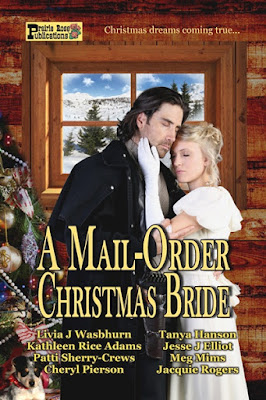
The heroine in my latest story briefly works in a dingy cafe on the wrong side of the tracks in Fort Worth, Texas. That's a big step down from her previous life as a pampered socialite. “A Long Way from St. Louis” appears with stories from seven other authors in Prairie Rose Publications’ new holiday anthology,
A Mail-Order Christmas Bride.
A Long Way from St. Louis
Cast out by St. Louis society after her husband leaves her for another, Elizabeth Adair goes west to marry a wealthy Texas rancher. Burning with anger over the deceit of a groom who is neither wealthy nor Texan, she refuses to wed and ends up on the backstreets of Fort Worth.
Ten years after Elizabeth’s father ran him out of St. Louis, Brendan Sheppard’s memory still sizzles with the rich man’s contempt. Riffraff. Alley trash. Son of an Irish drunkard. Yet, desire for a beautiful, unattainable girl continues to blaze in his heart.
When the debutante and the ne’er-do-well collide a long way from St. Louis, they’ll either douse an old flame…or forge a new love.
A Texan to the bone, Kathleen Rice Adams spends her days chasing news stories and her nights and weekends shooting it out with Wild West desperados. Leave the upstanding, law-abiding heroes to other folks. In Kathleen’s stories, even the good guys wear black hats.
Her short story “
The Second-Best Ranger in Texas” won the coveted
2015 Peacemaker Award for Best Western Short Fiction. Her novel
Prodigal Gun is the only novel-length western historical romance ever nominated for a Peacemaker.
Visit Kathleen’s hideout on the web at
KathleenRiceAdams.com.
Merry Christmas to y'all! I wish you peace, goodwill, and lots of love and laughter. May the holiday spirit live in your heart all year long.
In the spirit of the season, I'll give an ebook version of A Mail-Order Christmas Bride to one commenter who answers this question: What's your favorite holiday food?