Wednesday, May 22, 2024

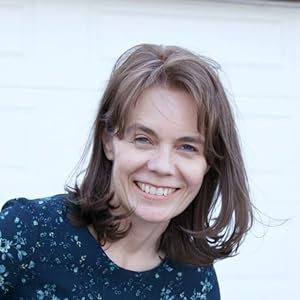
Kate Condie - Writer Interview

Post (C) Doris McCraw

aka Angela Raines


Kate Condie via Amazon Author Page

A fascinating and enlightening interview with Kate Condie. Fans will enjoy her background and new readers can look forward to some great stories.


Do you write for the market or yourself?

I definitely want to sell books, so I try to keep the market in mind, but I would say I write more for myself. I put too much time into my stories to write ones I’m not completely in love with. How grueling would that be?!

I think where I try to use the market would be in my blurbs and titles. I like to use what I call “Trope-y titles”. It’s exactly what it sounds like; I list things like “Cowboy” or “Bandit” in the title. This way when someone is looking for a cowboy romance, they can clearly see mine is a great option.

Same for my blurb, I call out the parts of my book that are trending at the moment. A blurb can be changed rather easily, but a genuine book cannot.

What life experiences influenced your writing?

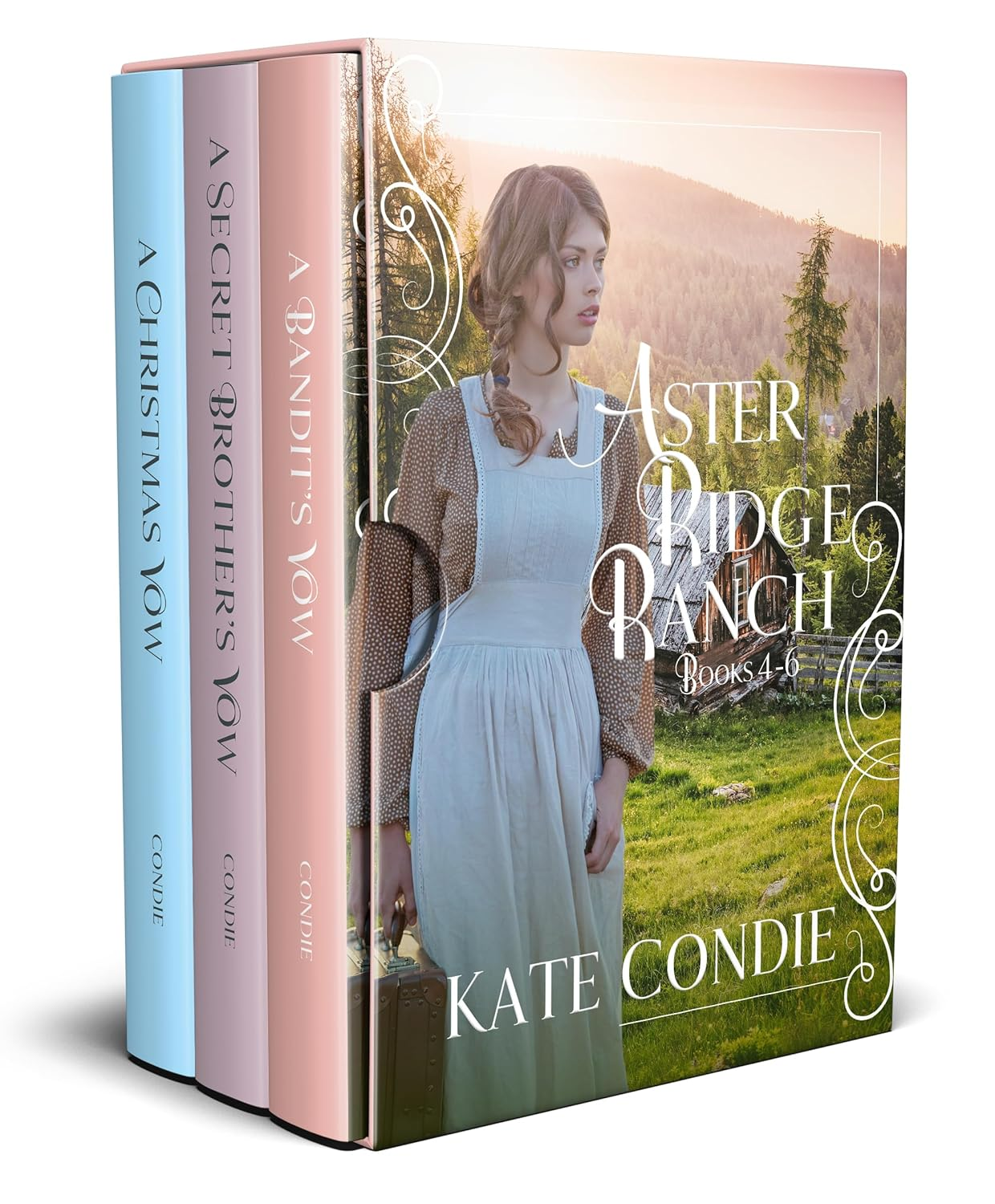
My grandparents have this cabin in Wyoming. It’s a few miles away from a ghost town called Kirwin. Throughout my life, I’ve taken many trips to that town and read the signs telling about the town’s mining history. I read about how the town’s remoteness required many miners to mail-order brides. I just HAD to figure out a scenario that would be severe enough that a woman would agree to be a mail-order bride. I decided she’d have to literally be facing death to agree to a marriage sight unseen. By the time I started writing my book “A Winter’s Vow,” I had already worked out most of the bride’s situation and personality. The story just flew from my fingertips. It is still the easiest book I’ve ever written. I think the story was just in me for so long begging to be released

Amazon

Where did you get the idea for your latest release?
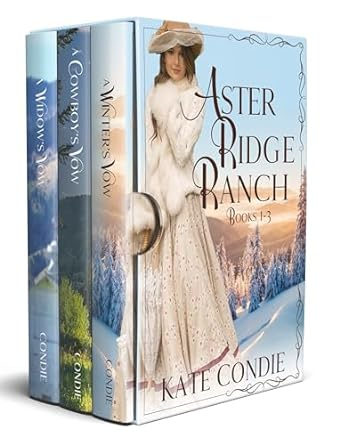
I often work backward in my idea process. In the case of my latest release, I had this idea to send a family of brothers west. I wanted the first book to conclude at the start of the trail, which meant they would have to be a couple with history, but I also wanted enough content for an entire book so that history had to be disrupted in some way.

I toyed with the idea that the female main character would have forgotten their love in an amnesia type of scenario, so the male character would have to win her heart all over again. He would already be all in, and she would logically know that this man is good for her, all she needs is to FEEL the love that used to be there.

I thought, what if they were more than just in love? What if they were engaged, and she’d forgotten everything? Heartbreaking! I ran with that for a bit, but I wanted more. So I thought, what if they were married? But remember, I’m writing in the past, and back then a woman was literally her husband’s property.

So I came up with the idea that theirs was a secret marriage and she lost her memory before anyone else learned what they’d done. So our hero would be the only person in the book to know the truth. And he’d be disinclined to “trap” her with the information until he was sure she wanted to be married to him again. He wants a woman at his side because she loves him, not because she belongs to him.

So there we have “To Win His Wife”, a husband trying to win a woman who already is his wife.

Amazon

Care to share your writing routine?

My day-to-day routine is waking up before my kids and writing every morning. If I have a deadline I’m trying to meet, I sometimes do a 6-hour workday on Saturday while my husband takes the kids somewhere.

As far as the writing process goes, I consider myself more of a pantster, at least in regards to the plot. I write character-heavy books and before I write, I have a good idea of who my characters are; their past, their wounds, their secret dreams. As I write, their needs or personalities influence the direction the story takes. Meaning, that the trouble they get into is either self-inflicted or author-inflicted to induce growth.

I love it when I get an idea and try to plug it into my manuscript, but I can’t because I know the character would never do that thing. Those are the times when I know I’ve got a well-fleshed-out character.

 Do you research while writing or before?

When I first started writing, I tried to write a historical book and got too caught up in the research to write much of anything. So I went back to contemporary romance. It was only when I decided to write a historical romance about an area and history I was already familiar with that I had the confidence to write until the end.

Now, I do some research before I start writing, but I am no historian. I’m a Google-as-needed author. If I have an idea that needs historical details, I’ll read a website or two to get a feel for the events and attitudes, but then I close that tab and get going on the writing part.

To me, a story is about the characters’ growth. A reader isn’t there to see what happens to the land after a tornado hits it, they’re there to see what the people do after their lives have literally been turned upside down. I don’t think human emotions have changed all that much (if at all) since the beginning of time. They say write what you know, so I prefer to focus on the human experience.

That being said, I read to escape and I think being transported to another time in history is icing on the cake. Also, I adore learning about history through fiction, so I am deeply grateful for the authors who share their knowledge of history through well-researched novels.
Amazon

What advice would you give to those who dream of writing, or what advice would you give your younger self?

It’s never too late to chase your dreams. When I was in college and deciding on a major, I was far too pragmatic to pursue art as a career. I never would have pictured myself as a writer.

I believe there are seasons in life and it’s okay if the timing wasn’t right before, or even if it isn’t quite right at the moment. Life is long (in a good way!) and as long as we’re deliberate, we can accomplish the things that are important to us.

What books or authors inspired you?

I am from Southern Oregon and when a friend told me about a book series written in Northern California, I was excited to read it. I’d visited the area loads of times and it was so fun to picture familiar places as I read. The series was Virgin River by Robyn Carr. The only downside (for me) was that there was too much heat for my preference. I kept thinking, “I could write this without the sex.” I think all of us writers are cocky like that at some point.

I started writing and realized just how difficult it is. But after a few manuscripts, I found my groove. I wrote a few contemporary romances, similar to Carr’s, but clean. Then I tried my hand at historical romance and discovered that’s where my heart is.

Thank you, Kate, for sharing your writing journey and process. Fans and new readers alike can learn a lot.

Until Next Time: Stay safe, Stay happy, and Stay healthy. 


Doris


Tuesday, May 7, 2024

Walk-a-Heaps- Infantry Soldiers of the Frontier Wars by Zina Abbott


In the old Western movies, and even among the Western novels, including romances, the cavalry are the glory guys. On their trusty steeds, they come riding to the rescue, guns blazing. Most unfamiliar with the weapons used by various military groups think they shot rifles. 

By the end of the American Civil War, repeating long guns had been invented. One tended to be rifles--longer barrels which allowed for greater accuracy at longer distances. The other was carbines--shorter barrels which could more easily be handled, aimed, and fired while riding on an equine. Cavalry carried carbines.

The truth was, the infantry were the mainstay of the U.S. Army during the frontier Indian Wars era. 


Cavalry soldiers in campaign dress

What distinguished them from the cavalry was, they fought with the longer-barreled rifles, not carbines. Rifles were unwieldy weapons when fired from horseback. However, when the soldiers on the ground fired rifles, they were able to shoot targets at a greater distance and with far more accurately than any soldier--mounted or on the ground--firing a carbine.

An example was the Rosebud Campaign in 1876. When the cavalry fled one ridge because the Natives threatened to overwhelm them, they were forced across a ravine held by the enemy. It was the infantry soldiers with the accuracy provided by their long rifle barrels, who were positioned on the destination ridge, who prevented a greater loss of cavalry life than would have happened otherwise.

Infantry soldiers in campaign dress
 

Some infantrymen, like the soldier on the horse in the above image, were mounted infantry. They rode horses or mules to get from point A to point B. However, because they carried and fought with the longer barreled, more unwieldy rifles, they dismounted and shot while on the ground. Infantry soldiers also often traveled in wagons or ambulances when crossing long distances.

Infantry soldiers carrying full campaign gear

Mostly, infantry soldiers walked. They were required to carry everything they might need for severals days of survival on their bodies. Because of this, the Plains Tribes called the infantry soldiers Walk-a-Heaps. (or Walks-a-Heap / Walk-a-Heap)

One might think that cavalry soldiers could cover more ground more quickly. If covering a longer distance, the cavalry mounts required extra fodder over and above what they could graze on the Great Plains. Also, the horses needed to be rested. Often, although cavalry units could out-distance infantry soldiers in the short-term, well-seasoned companies of infantry soldiers marching on foot often caught up with, and maybe passed, cavalry troops.


Infantry soldiers in campaign dress

Here is an image of infantrymen and their gear. The kneeling soldier looks most like Asher Henderson, my hero in Florence's Good Deed, in both appearance and attitude when confronting conflict.


I have written western romance novels with cavalry officers as heroes. However, for both Elise and Florence's Good Deed (and a future book, yet unrevealed), I chose infantry soldiers. To find the book description and purchase options for Florence's Good Deed, please CLICK HERE


In my most recent book, Lucy, released today, the main characters also did a lot of walking a heap across the plains and deserts of the California Trail, the Central Overland Route, and the Central Overland Trail.

To find the book description and purchase options for Lucy, which is Book 46 in the Prairie Roses Collection, please CLICK HERE

Monday, April 22, 2024

Author Interviews - Kristy McCaffrey

 Post (C) Doris McCraw

aka Angela Raines

This is the beginning of what I hope will become a way for readers to connect with some of their favorite authors. Simple interviews to give us an insight into the mind and process of writers. 

First up is an author whose 'Wings of the West' series should be on everyone's - To Be Read List 

Amazon
Check out the special edition Hardcover of this book

Interview with Kristy McCaffrey


Thanks so much, Doris, for the chance to chat with these fun interview questions.


How did I decide to write for publication?

      I’d written for myself since I was a little girl, but when I finally finished my first novel, I was curious to see if I could get published. I was 33 years old. I was able to work with a small press for several years before going independent. I learned a lot back then and while the drive for publication certainly involved financial reasons, it also pushed my work to the next level. I’m the type of person that needs a goal to stay motivated.

 Do you write for the market or yourself?

      In the beginning, it was nearly 100% for myself, but as I grew my writing business it became necessary to assess market conditions if I wanted to remain doing this. Today, it’s a combination of both.

 My writing routine:

      I’m not a morning person, so I find it a challenge to be creative as soon as I wake up. I usually read and/or do puzzles (crosswords as well as the daily Wordle) while eating breakfast, and then I do admin stuff. After lunch, I write for 2-3 hours. If I’m behind on either the writing or business stuff, I’ll work for a few hours after dinner then watch TV with my husband.

Amazon

Do you research while writing or before?

      Before, during, and throughout revisions. I never stop really. I’m an information junkie. It’s an asset at times, but also a negative. As I’ve gotten more books under my belt, I’ve become more selective about this process and don’t lose myself as much in it anymore.

 Do you “interview” your characters before you write their story?

      No. I like to build story and character at the same time. This isn’t an ideal process, however, because it generally involves a big rewrite after the first draft (because I’ve finally gotten to know my characters). But it’s the way my brain likes to work, so I’ve given up fighting it.

 Do you like to write short or longer stories?

      I’ve written both. I like the compressed process of shorter stories, but nothing beats the complexity of a longer book.

Amazon

 Where did you get the idea for your latest release?

      I keep track of older story ideas, and this was one of them. THE NIGHTHAWK is Book 10 in my Wings of the West series, but when I was brainstorming I needed an idea quick (I was setting up a pre-order at the end of the previous book and I was out of time). So I repurposed a plot I’d developed over fifteen years ago and had never used.

 What advice would you give to those who dream of writing, or what advice would you give your younger self?

      Start writing. Keep writing. Read widely. Take criticism with discernment. Learn to pick yourself up after receiving criticism. Don’t let setbacks run the show. Surround yourself with authors better than you and pay attention. Be nimble and pivot when needed.

Check out Kristy's Author Page

Thank you Kristy for sharing your story and writing with readers. THE NIGHTHAWK is up for pre-order now on Amazon. Don't wait! And be sure to follow her so you don't miss out on new releases.

Until Next Time: Stay safe, Stay happy, and Stay healthy. 


Doris


Friday, March 22, 2024

"Dreams" by H. H.

Post by Doris McCraw

aka Angela Raines

It is no secret I love poetry. Not just reading but also writing it. In my journey with Helen Hunt Jackson, I've had the privilege to read and recite her poetry. She inspired my journey of three years of writing Haiku and posting it with a photo. I eventually published a book of Haiku and Helen is the reason.

One analysis is that the poem is satirical in nature. I can see that, but for me, it is about our actions and how they affect what we dream. Her last line: 'we forever choose what we will dream!' reinforces that idea. 

Below is the poem. How do you see it?

Dreams

Helen Hunt Jackson

Mysterious shapes, with wands of joy and pain,

Which seize us unaware in helpless sleep,

And lead us to the houses where we keep

Our secrets hid, well barred by every chain

That we can forge and bind: the crime whose stain

Is slowly fading ’neath the tears we weep;

Dead bliss which, dead, can make our pulses leap—

Oh, cruelty! To make these live again!

They say that death is sleep, and heaven’s rest

Ends earth’s short day, as, on the last faint gleam

Of sun, our nights shut down, and we are blest.

Let this, then, be of heaven’s joy the test,

The proof if heaven be, or only seem,

That we forever choose what we will dream!


Much like poetry, the words we write may have special meaning to us, but our readers might see or feel something else. For me, that is the joy of writing, touching the emotions of the reader. It is my goal that they finish and have a sense of being a part of the story they've just read. 

How do you see your writing?

Amazon - Kindle Edition

For anyone interested, I have a monthly substack newsletter: Thoughts and Tips on History if you wish to read or subscribe.

Until Next Time: Stay safe, Stay happy, and Stay healthy. 


Doris


Thursday, March 7, 2024

Carpetbags and Portmanteaus by Zina Abbott


Originally, as people traveled, they carried knapsacks, bindles and other loose bags as they walked or rode horses. However, as travel and migration patterns expanded, people needed a means to pack a larger quantity of their belongings—something more portable than carrying large items in a wagon or cart.

By 1596, the Oxford English dictionary added the word “luggage.” The word meant “denoting inconveniently heavy baggage” and came from the verb “lug.” However, it was not until the 19th century that travel became prevalent enough that new means of carrying personal belongings—particularly on trains—began to make their debut.

In my most recent book, my heroine does ship some heavier things ahead using a small travel trunk instead of a shipping crate. However, she needed to be able to carry most of her belongings by herself in containers durable enough for travel, and suitable enough to protect her clothes and other items. She chose two.

1860s style carpetbag

The first item was a carpetbag—considered essential for any discerning female traveler.


 Made from carpet material, they came in a variety of colors from subdued to flamboyant. 

1850s carpetbag used by traveler from New Z


Some, made of leather, actually more closely resembled small portmanteaus.


In fact, carpetbags were widely used throughout the nineteenth century due to their relatively lighter weight, their durability, their relatively lower cost, their flexibility—which allowed its owner to stuff an unimaginable amount of clothing and personal items inside—and its ability to be locked, which provided a small measure of security from casual snoopers.


The second item she chose was a portmanteau. Similar to what many today think of as a suitcase, a portmanteau is defined as a large trunk or suitcase, typically made of stiff leather and opening into two equal parts. One did not lay it flat on one side and pull the top half up, as in suitcases developed at a later time. One set the bottom on a surface and pulled the two side halves open at the top—more like to today’s duffle bags.

Here is another definition from  Raymond Malewitz, Oregon State Associate Professor of American Literatures: “A portmanteau is an old-fashioned suitcase with a hinge in the middle that can hold equal amounts of luggage in its two storage compartments.”


Is a portmanteau the same as a valise? A valise is defined as “a small piece of luggage, usually made of leather, that can be carried by hand, used to hold clothing, toilet articles, etc.; suitcase; traveling bag.” Often, valises were cylindrical in shape. Although they could be carried by hand, they were originally designed to be carried behind the saddle of a horse. The operative word here is “small.” Generally, a valise was not as large as a portmanteau.

To see an example of a cylindrical valise from earlier times, please CLICK HERE


Here is an excerpt from Jocelyn’s Wedding Dilemma:

             Jocelyn jostled her carpetbag and the portmanteau outside—the portmanteau being wretchedly heavy due to her having packed her lap desk. She noticed the eastern sky already turning a faint gray. Still too dark to see clearly, she hoped her eyes adjusted enough to the dim light so she did not trip over her feet. Setting her baggage on the back stoop, she faced the house as she noiselessly eased the door closed.

            “Miss Wolcott? What are you doing out so early?”

            Upon hearing Homer’s soft voice behind her, Jocelyn jerked upright and grabbed the handrail on one side of the stoop to keep her balance. Licking her lips, she slowly turned and descended until she stood on the ground. “I was unaware you started your day this early, Mr. Cottingham.”

            “I seldom leave our apartment so soon. Mrs. Cottingham started boiling water for tea. However, she’s out of biscuits—the kind you call cookies. She sent me to the kitchen for the supper rolls left from last night plus a jar of jam to get us by until time for our breakfast.”

            “I see.” Jocelyn’s stomach rumbled. That does sound good. “Please don’t let me keep you. I’ll….um…”

            “It appears you plan to travel somewhere, Miss.” Homer studied the carpetbag and portmanteau.

            “Yes. I decided on a surprise visit to…family.” Jocelyn bit her lip. She knew her words were deceitful, yet not exactly a lie. At least, in a week or ten days, they would be truth.


Jocelyn’s Wedding Dilemma is now available for sale and at no additional cost with Kindle Unlimited. To find the book description and purchase options, please CLICK HERE


Sources:

https://liberalarts.oregonstate.edu/wlf/what-portmanteau

https://www.mimimatthews.com/2019/04/28/have-carpet-bag-will-travel/

Le Moniteur de la Mode, 1876, No. 1348 Toilettes de Mme Morison, RP-P-2009-3650

https://www.travelandleisure.com/style/travel-bags/history-of-suitcase

https://www.hussarsaddlery.com/valises-and-portmanteauss