Showing posts with label sewing machines. Show all posts

Friday, September 16, 2022

The Thread of a Story - by Jo-Ann Roberts


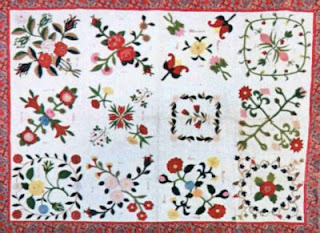
When I began blogging for Sweethearts of the West, I chose a topic that had been close to my heart for more years than I'm willing to divulge...quilting.

It is easy to sit at my machine, find a color of thread that coordinates with the fabric (however, I usually use a light grey thread when constructing the squares as it is easy to rip out when I make a mistake!) then begin sewing. And when I run out, a quick trip to my local quilt shop, Jo-Ann's or Michaels solves my dilemma.

My current historical WIP is part of a series with quilting as its theme (shh, it's still a secret!) so it got me thinking. How did women get thread, where did they get it, and when was it available to the average housewife, seamstress, or milliner?


And thus, the research began...

Forms of very early sewing thread were made of thin strips of animal hide. This was used to sew together larger pieces of hide and fur for clothing, blankets and shelter. There is proof throughout history of some form of threading used even when cavemen were in charge of the planet. As civilizations moved forward, thread did also and eventually it evolved to including the spinning and dyeing of thread.

There are three basic types of thread, and they are based on their origin, Thread is animal, plant, or synthetic depending on its make up. Silk thread is touted as the best because it is strong, very elastic, and fine in diameter. Silk is interwoven into a lot of regular threads for added strength. Pure silk thread use is done in finer clothing.

However, since the heroine in my story resides in a small Kansas town in 1871, I imagined she'd only use cotton thread, the least expensive in her quilting.
                                                                                                                                                      Thread is made of a series of plies--or cords, twisted together. The plying and twisting creates a stronger unit than the original strands alone. A ply is two or more strands of cotton twisted together. A cord is two or more plies twisted together. The earliest form of cotton thread was three-ply thread--three single strands of fiber twisted together.

Manufactured cotton thread was available to the hand sewers in the U.S. and Europe in 1800. At first, they were sold in hanks as some yarns still are. Thread came on wooden spools beginning in 1820. Like the soda bottles of today., the spools could be returned for a deposit, to be refilled. Mass production put an end to the deposits since the spools could be produced so cheaply.


Historians credit James and Patrick Clark, mill owners in Paisley, Scotland with developing the first cotton thread. When silk and flax became scarce during the Napoleonic wars, they were forced to find a suitable replacement with which to create their famous (and profitable) Paisley shawls.


Eventually, some Clark family members moved to the U.S. and began their own thread companies, including George Clark and William Clark, grandsons of James who opened a cotton thread mill in New Jersey.


George Clark perfected six-cord thread for use on sewing machines. He called it "O.N.T." for "Our New Thread," combining fineness with strength as well as being inexpensive.

In 1815, another prominent Scottish manufacturer, James Coats, began making thread. His sons, James and Peter formed J&P Coats, Co., introducing thread to the U.S. around 1820. By 1869, they began manufacturing sewing thread in Pawtucket Rhode Island. It was here where they developed a unique spool shape with smooth curves.

The emergence of the sewing machine in the 1840s further escalated the need for a better-quality thread. Three-ply was too uneven, and six-ply was too thick. Silk and linen threads were either too thick or too weak for use with the machine. Three-ply silk was too expensive. 

Improved cotton seemed the only option.

At the beginning of the 20th century, mercerization was developed to make a stronger, smoother cotton thread. It is a process of immersing cotton thread in a solution of caustic soda, resulting in a stronger, more lustrous that also accepted dye more readily.

Polyester thread became available in 1942, and cotton-wrapped polyester in the late 1960s.

Other Thread Manufacturers

Belding & Corticelli, a silk thread manufacturing enterprise was started by the Belding brothers in Michigan. From their home the produced spools of silk thread which traveling salesmen marketed door to door.  Sales of silk thread dwindled during the Great Depression, forcing the company to close its door the next year.
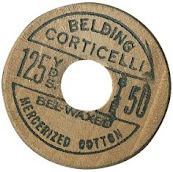
Max Pollack & Co. operated a silk mill in Mansfield, CT from 1900 - 1904. Textile companies of all kinds located in this area of Connecticut.


Rice's Silk Mill

Built in 1876 to house a woolen mill, this multi-section brick building was purchased in 1887 by William Bainbridge Rice, who established his silk-processing operation here. The premises were expanded in 1895 after Rice acquired a New Jersey silkworks and moved its equipment here. The Rice Company was one of Pittsfield's largest businesses at the turn of the 20th century. It produced a number of highly specialized materials, including silk cords for parachutes which they later also made out of nylon. The company was particularly known for its braided silk cord.

This has a local connection for me as I was born and raised in Pittsfield!

Lucky for us quilters, sewers, seamstresses, and those whose talent with needle and thread, thread--cotton thread, in particular--has evolved over the last 250 years and has been supplanted by other fibers.

So, whenever Noelle Prentiss (my heroine) threads a needle and joins fabrics together to make a quilt, she'll be continuing the tradition of those who came before and after her by carrying on the thread of the story.

A Welcome to Autumn Party from the Authors of the Love Train Series

You are cordially invited to welcome in Autumn from the authors of the Love Train Series on Thursday, September 22nd, from 8:00 a.m. - 5:00 p.m. Pacific Time.  Join us for fun, games, and giveaways! One winner will be chosen to receive a $100 Amazon gift card!


Friday, March 10, 2017

A PECULIAR BIT OF TRIVIA


A Peculiar Bit of Trivia                By E. Ayers


A little glitch getting to the blog, but thanks to Caroline, I made it, and I'm so excited to be here. When Caroline Clemmons and Celia Yeary asked me to become a permanent part of the Sweethearts of the West, I was thrilled. Writing historical westerns is…let's just say I have a quirky mind and I think it shows in what I write. I write historical westerns with a love story tucked in it. Surely, you will discover that as you read my posts and my books, and I hope you will do both!
As a child, the dictionary and the encyclopaedia were my friends. Homework took me
forever! I never could spell, so if I asked how do you spell… The answer was the same - look it up. I think my parents figured if I looked everything up, I'd eventually learn to spell. (Thank goodness for today's spellcheckers. Between my inability to spell and my fingers getting tangled on the keyboard, I'd be in so much trouble.) But back then, I'd look up a word and read every word on that page. (No wonder it took me so long to do homework.) Plus, I loved those ink drawings. If there were none on the page I was reading, I’d read until I found one. (I had a great vocabulary, but I couldn't spell!) And when I was really bored, I'd read the encyclopaedia. Well one thing leads to another and my mind would take off, sending me to look up other things.
In school, I was taught it's not how much you know, but often how fast can you find the answer. That premise is becoming obsolete with the computer and Internet search engines. But the Dewey Decimal System was like a neon lure to my young fertile mind. It was as though the entire world's database of knowledge was in those card files. I soon discovered that knowledge was fun. To this day, I love knowing how stuff works. Why did gold form here and diamonds there? How does steam turn motors? Who figured out you could burn coal? Who figured out oysters were edible? And how did they get that center in the dessert?
As an adult, I continued with my strange desire to know about things and often experimented in the kitchen with such things as yeast. I wanted to know if I could grow it from scratch. My garden became organic, because I couldn't afford chemicals and I didn't want to use them. Lack of garden space had me looking up information on companion plantings. Today, I know how to create yeast from scratch. I've made my own candles and soaps - not out of need, but because I thought it was fun learning how-to. Those are the tidbits I pull on as I write.
And when I do stop to research something, I often wind up discovering something else. Will I ever need to know about staplers for my writing? Probably not, but it's stored in my head, in case I do. Except by then, I’ll forget his name, because I'm terrible with names, so I’ll have to do another search. It was a search for information about early sewing machines for home use that sent me down the path of looking at safety pins.
***
Walter Hunt was one of those men who stand out in history for the oddest reasons. Some say he was a genius, while others claim he lacked business sense. He was definitely a colorful character in our American history for he was an inventor. He had the ability to see a need for things and to
create them. A sewing machine, a streetcar bell, a snowplow, a repeating rifle, and several more items were all his designs. But what is he best known for? The lowly little safety pin! The reason he became famous was he sold his patent for that coiled bit of wire to a man that Hunt owed $15. The man graciously bought the patent for $400 and went on to become a millionaire. (History is unclear as to the exact amount of money exchanged. Was the sale price $415 dollars or $385?) So what was in use before Walter's Hunt invention that keep fingers safe from pricks?
Go way back in history a few thousand years and there was the straight pin. They didn't have buttons as fasteners for clothing back then. Buttons were only decorations. In fact, it would take until the thirteenth century AD before buttons and buttonholes were used for securing clothing tightly to the body. (I wonder who decided that you could take a decorative button, push it though a slit in the material, and it would hold? And why did it take them so darn long to figure that out?)
It was in the fourteenth century BC that clasp-like things appeared. They were used mostly to keep clothes closed, especially cloaks. (Try saying clasps keep clothes closed, especially cloaks really fast three times.) Often the clasps were coiled things that swirled into fabric. But eventually they began to resemble a violin bow or bow saw in shape. They kept clothing closed and became decorative items.
So up until Walter Hunt decided to play with some wire, there was a little spring-loaded or a
U.S. Patent Office - inventor Walter Hunt
hinged pin used for brooches. The sharp point merely slipped under a flat plate. Well, I can image that that poky point slipped out frequently and stabbed the wearer. So Walter Hunt's little patent on the safety pin changed history.
And it wasn't until Samuel Slocum came along in the 1800's and invented a machine that would make pins with heads did we finally have what we now know as straight pins used in sewing. (He’s the one who invented the stapler.) Slocum didn't invent the pin with the head, that was William Lockwood in 1772, Slocum merely figured out how to make them quickly and cheaply.
So what do all these odd facts have to do with the West? Lots and nothing. It meant women could stop tying diapers on their babies and use a safety pin. (Although mothers would have to wait a bit before they had a locking cap on that pin.) And those women who quilted had a pin that wouldn't vanish into the fabric as they worked. It was a fascinating time in history because of manufacturing and all the advancements. These things trickled into society and made life easier. But not every woman had them.
To add a bit of humor into the mix, pin money meant they had an extra penny or two left in the budget to buy pins or some other "extravagant" item. Think purchasing power or the flow of money out of the budget. Egg money came from selling eggs giving an income or money coming into the household budget. Yes, nest egg is the result of saving egg money.
And as for that mousetrap? They've been around for hundred's of years. But that simple snap trap hasn't. We have to wait until 1894 when William C. Hooker invented the spring-loaded snap trap that is close to what is in use today.
It's all a bit convoluted, but it does affect our stories. So what starts as a simple decision to check the facts on something small, sends us down strange paths. Did you know that the kilt pin was never used to pin both pieces of fabric together? When will I ever need that piece of trivia? Aye, maybe when Hamish Campbell decides to settle Creed's Crossing, Wyoming. Or maybe not. I don't want to think about his kilt flapping in the Wyoming breeze!