Showing posts with label Lotta Crabtree. Show all posts

Wednesday, November 2, 2016

Miss Lotta -- San Francisco's Favorite

By Paisley Kirkpatrick
The miners in the Sierra of Northern California were used to the loneliness, dirt, and disappointments that came with the search for Gold. Gold of another sort appeared in 1853 to ease this routine and her name was Lotta Crabtree. From her beginning as a six year old until her retirement at the age of 45, she became one of the wealthiest and most beloved American entertainers of the late 19th century.
The tiny, red-haired, six-year-old jigged and danced to their clapping hands, while they showered her with nuggets and coins which her mother hastily collected in her apron.
Born Charlotte Mignon Crabtree in 1847 in New York City to John Ashworth Crabtree, a bookseller and Mary Ann (Livesey) Crabtree, an upholsterer, both of English stock, Like so many others, her father dreamed of finding a fortune in the gold fields in California. They packed up and left New York in 1851.
Lotta's exposure to the life of the theater and its inhabitants started early while they resided in San Francisco. She began traveling to mining camps where she became famous for singing ballads and dancing for the miners. The family moved back to San Francisco In 1856. Lotta started touring the Sacramento and San Joaquin Valleys. She added a banjo to her repertoire and frequently performed in the city’s variety halls and various amusement parks. By 1859 she became known as Miss Lotta, the San Francisco Favorite.
Occasionally Lotta suffered from stage fright. Her mother, who once performed on the stage, coaxed her out of her fear. Mary Ann wasn't only a typical stage mother, but also a shrewd business woman. Because she didn't trust banks nor paper money, Mary Ann carried all of Lotta’s earnings -- consisting of gold nuggets and coins -- in a large leather grip. When this became too heavy, she transferred the earnings to a steamer trunk.
Considering how vast the amount of money and other valuables they carried around, it's amazing they were never robbed.

Sunday, March 20, 2016

Divas in Pink Tights


Divas in Pink Tights


This article first appeared on http://cowboykisses.blogspot.com/ in 2014. It has been modified slightly since then.
 
Have you read The Gentle Tamers, Women of the Old Wild West by Dee Brown? It’s a marvelous testament to how women endured and flourished on the western frontier. Some of the accounts are grim, others inspiring, but one chapter is a bit lighter in tone. Titled “Pink Tights and Red Velvet Skirts,” it shines a spotlight on female entertainers who trod the boards in San Francisco, Virginia City, Denver and far flung mining camps.

The chapter opens with this declaration by historian Hubert Howe Bancroft: “The mere appearance of a woman sufficed in early days to insure success.” Even if the performer was untrained, had a cracked voice and was far from beautiful, she could strut off the stage amid a shower of silver and gold.

 
California Theater, San Francisco ca. 1870
{PD-US} published in the US before 1923 and public domain in the US.
 
During the decade between the first California gold strike and the Civil War, theaters flourished, especially in San Francisco, but also in just about every mining town. They might be fancy playhouses or canvas tents. In a land where men far outnumbered women, it didn’t matter.

Caroline Chapman, c. 1857
Photo from the Columbia Gazette; published in the US before 1923; public domain
When an actress with real talent came along, she was idolized by her male audience. One such woman was Caroline Chapman. Born illegitimately into a famous theatrical family, Caroline performed with her father, William Chapman. After their first performance in San Francisco, the pair were showered with buckskin bags of gold dust. Dubbed “our Caroline” by her adoring audience, she drew mobs of followers. When she and her father arrived in Sonora to christen a new theater with She Stoops to Conquer, they were met and escorted by a thousand miners. The Chapmans would perform anywhere, even on the sawed off trunk of a huge tree in one case.
Lola Montez, ca. 1847
{PD-US} published in the US before 1923 and public domain in the US
The most glamorous, seductive and scandalous western diva was Lola Montez. More akin to a burlesque queen than an actress – according to Dee Brown – she “. . . burst upon San Francisco like a bombshell, making excellent copy for the newspapers with stories of her many marriages and her claim that she was the illegitimate daughter of Lord Byron.” She dressed like Byron in black jackets with big rolling collars, and strolled the streets with two leashed greyhounds and a parrot on her shoulder.  Lola’s sensational spider dance made her famous. She purposely spread stories of her sinfulness, and these tales have perpetuated her legend in western lore.

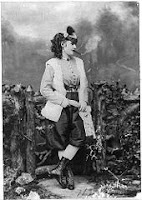
Lotta Crabtree, ca. 1847
{PD-US} published in the US before 1923 and public domain in the US
Petite, talented Lotta Crabtree took the stage as a shy little girl. A protégé of sorts of Lola Montez, she danced and sang her way through the mining camps with her mother and eventually landed on the San Francisco scene. She took the “West’s theatrical center” by storm. Headlines read: “Miss Lotta, the San Francisco Favorite,” “La Petite Lotta, the Celebrated Danseuse and Vocalist,” and “Miss Lotta the Unapproachable.” Brown attributes Lotta’s lasting success to her innocence. She remained above scandal and suspicion, the perennial princess for thirty-five years and amassed a fortune, which her mother carefully hoarded. When Lotta died in 1924, she was worth over four million dollars. All of it went to charity.

Dee Brown goes into much greater detail about performers and the history of theater in the West. And this is only one chapter in his amazing book.
 
Find all of Lyn's books on Amazon: http://amzn.to/Y3aotC
 
Get acquainted with Lyn on these sites: 

Saturday, April 2, 2011

Early Entertainers and Theaters of the West

Everyone likes to be entertained. The arrival of a theatrical troupe or a famous personality has always been exciting, and the early days of the West were no exception. Entertainers were always a welcome sight, especially in the mining towns and camps of the Mother Lode where the audience was mostly masculine. The miners wanted pleasing performers, and they were happy to reward them.

The early entertainers were a hardy group. They traveled long, uncomfortable miles over rugged mountains, dangerous trails, and arid deserts to see the glitter of gold and to achieve fame.

Once the actors and actresses reached their destination, they often had to perform under primitive conditions. There were no dressing rooms or sanitary facilities. Many times their stage would be the floor of a blacksmith’s shop with a wagon canvas for a curtain. They would appear in a tent, schoolroom, or a saloon. The orchestra was usually a flute, violin, and guitar played by musicians who had never read a note.

They offered medicine shows, drama, and variety. There were special rooms with cheap decorations, where the patrons could meet an actress for a price. Many times a miner would pay $100 for a seat and toss more gold on the floor when the show was over.

In Virginia City, the Queen of the Comstock, the first theater, opened in 1860. It was called the Howard Street Theater and ladies were not admitted. Business was good so Maguire’s Opera House opened its doors in 1863. It was an opulent establishment. The auditorium was carpeted, ornate crystal chandeliers hung from the ceiling, spectators were seated upon gilt chairs and there were velvet railings for the boxes. The enthusiastic audiences were wealthy, but not necessarily elite. They came for entertainment and had the money to pay for it. The shows ranged from Adah Isaacs Menken in the “Mezeppa” to minstrels and dog fights.

Born Charlotte Mignon Crabtree in New York City to British immigrants,
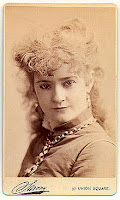
Lotta Crabtree would go on to become one of the wealthiest and most beloved American entertainers of the late 19th century. From her beginnings as a 6-year-old until her retirement at the age of 45, she entertained and was named "The Nation's Darling".