Showing posts with label Leadville Colorado. Show all posts

Wednesday, August 22, 2018

Kate Claxton and the Tabor Opera House

Part two of a sporadic history of women actors who traveled the West, specifically Colorado.

Kate Claxton was an actor, theater company owner, and another of those the public loved to read about. She toured the West for the first time in the early 1880s. They also say the town of Claxton, Georgia was named for her.
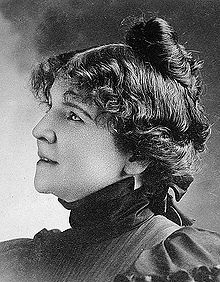
Image result for kate claxton actress
Kate Claxton from Wikipedia
Kate was born August 24, 1848 in Summerville, New Jersey. Her grandfather, a  minister, had as a young man also made a living on the stage. Her maiden name was either Cone or Cohen. She was married twice. Her first marriage was to Isadore Lyon, which ended in 1878. Her second marriage was to fellow actor Charles A. Stevenson. That marriage also ended in divorce in 1911. There is some question as to how many children Kate had, but it is known her son, Harold Stevenson committed suicide in 1904.

Kate came to fame with her performance as a blind young woman in the play "Two Orphans", but gained her notoriety when the Brooklyn Theater, where she was performing in the above mentioned play, caught fire. One account recalls it this way:

"On the evening of Tuesday December 6th 1876 when The Two Orphans was in course of performance at the Brooklyn Theater and was rapidly nearing its close, the scenery took fire. The audience began to be alarmed and Miss Kate Claxton fearing the fatal effect of a panic stricken rush the door came down to the foot lights and cried, "Be quiet. We are between you and the fire the front door is open and the passages are clear." She said this while the stage was a burning mass and it was not until the spectators were seized with fear and it began to be from the building that Miss Claxton and the other actors with her on the stage at the time thought of flight themselves and then it was only by means of a private passage under the auditorium that they were able to escape."  

All totalled almost 300 people perished in the fire and numerous others were injured. All nine hundred seats of the theater had been sold. The fire was made worse because there were no fire escapes and only a small staircase from the balcony to the ground floor.

Kate continued to be plague with fire or fire related incidents during the early part of her career. It was so bad that Harper's Weekly even ran a cartoon. Many news reports were in poor taste, as evidenced by the following:

A hotel in St. Paul Minnesota, was burned on Monday morning. What is remarkable about this affair is that Kate Claxton and Troupe had engaged rooms in it for Tuesday. In ensuring hotels the insurance company should insert a proviso in the policies to the effect that Kate should not be allowed to lodge therein.
Colorado Weekly Chieftain May 10, 1877

Kate had started her own theater company in 1876. The news report of that event is well worth reading, if only for the language.


Feminine management.

Kate Claxton has leased the Lyceum Theatre in New York and will open it in September with the full company a first class artistes. No woman has undertaken the management of a theater in New York since the death of Laura Keene, although her success in her best days might have justified others in trying. With the exception of Mrs. John Drew, miss Claxton will now, since the death of Mrs. Conway, the only woman manager in the country. Miss Claxton is said to be a woman of business parts, and she certainly demonstrated her tact in the responses she made to the questions of the lawyers during the proceedings in her bankruptcy case before recorder Fitch on Monday. Even that venerable gentlemen and Willem Trohan was compelled to smile at her dexterous replies, and ejaculate now and then with a nod of the head — "good, very good."
Daily Denver Tribune, July 16, 1878

Image result for images of tabor opera house leadville colorado 1881
Tabor Opera House, Leadville, CO 1881- Western History
During the first season of the Tabor Opera House in Leadville, Kate Claxton's shows were some of the only ones to have an enthusiastic response. Her 1881 performance of "Two Orphans" was a hit. Kate also played Colorado Springs, Pueblo and other Colorado towns. The following appeared in the Leadville Daily Herald at the time of her performance in 1881:

Kate Claxton.
Standing room only was announced at the early hour last evening, at the Tabor opera house, every seat in the house having been filled before the rise of the curtain — an unusual thing in Leadville. A lack of space precludes any extended notice of Miss Claxton's rendition of "froufrou," but suffice it to say that the lady demonstrated the fact that she is talented, and Louise in the "two orphans" is not the only character in which she excels. Her conception of "froufrou" is admirable and, last evening, elicited much favorable comment. She was ably supported come, Miss Dolly Pike and Miss Ewers are not and Gilbert were especially distinguishing themselves.

This evening "the snow flower" will be given for the first time in Leadville. The piece admits an excellent scenic effects, which effects are done by the mechanical portion of the company. Nearly the entire house is already sold, cause probably by the character of the peace and the first appearance of Mr. Stephenson. Leadville Daily Herald, April 21, 1881


Kate had bought the rights to "Two Orphans" and performed in it until the early 1900s. She sold the rights to D.W. Griffith,  who made the 1921 silent film "Orphans of the Storm" with the Gish sisters, based on the play. After the death of her son, she discontinued acting. 

Kate died on May 5, 1924 in New York City, New York. She had a long a prosperous career and delighted audiences throughout the West and the rest of the country. A woman worth remembering.


Doris Gardner-McCraw -
Author, Speaker, Historian-specializing in
Colorado and Women's History
Member of National League of American Pen Women,
Women Writing the West,
Pikes Peak Posse of the Westerners

Angela Raines - author: Where Love & History Meet
For a list of Angela Raines Books: Here 
Photo and Poem: Click Here 
Angela Raines FaceBook: Click Here


Wednesday, February 20, 2013

A Romance That Scandalized the Nation


The romance between Elizabeth “Baby” Doe and Horace Tabor was one of the most famous and scandalous affairs in 1880s Colorado. Originally from Oshkosh, Wisconsin, Elizabeth Bonduel McCourt was born in 1854. Twenty-four years her senior, Horace Tabor was a silver mining tycoon in Leadville, Colorado, where they met.

One of fourteen children, Elizabeth was the daughter of Irish parents. Her father owned a clothing and custom tailoring store in Oshkosh. The family lived well until fire destroyed the town in July 1874 and again the following April. The McCourts lost their business and home as a result.

Young Elizabeth was a beauty. Five-foot-four, with reddish golden hair, bright blue eyes and a flashing smile, she gained the nickname “Belle of Oshkosh.” Far from shy, she enjoyed male attention and dreamed of becoming a famous actress.

Elizabeth married a handsome young man named Harvey Doe on June 27, 1877. That same day, they boarded a train for Central City, Colorado, where Harvey was to operate the Fourth of July gold mine for his father. In the rowdy mining town, Elizabeth soon earned the name “Baby Doe” because of her sweet, innocent looks.

Unfortunately, Harvey was not a capable mine manager, and he soon took to drinking. Elizabeth realized he would never fulfill her dreams of riches. Their finances grew precarious and they often quarreled. After she became pregnant, Harvey accused her of having an affair and abandoned her. Left to her own devices, Baby Doe frequented a variety hall called the Shoo-Fly, where she heard about the fabulous silver strikes around Leadville and silver king, Horace Tabor.

Elizabeth’s baby son was still-born on July 13, 1879. She briefly tried to make a go of her marriage when Harvey returned, but it was no use. She visited Leadville and liking the “Cloud City’s” air of prosperity, she divorced Harvey and moved to Leadville in the spring of 1880.

By then, Horace A. W. (“Haw”) Tabor had lived in the Leadville area for a number of years. Originally from New England, he and his wife Augusta came west in 1859, hoping to strike it rich in Colorado’s first gold rush. Failing at that, they opened a store Ora. Discoveries of silver in nearby Leadville prompted the Tabors to move there in 1878. Tabor was soon elected mayor.

Horace’s generosity led him to grubstake many prospectors. In spring, 1878, he backed partners August Rische and George Hook, with an agreement that he would be a one-third partner in any strike they made. The two Germans staked a claim on Fryer Hill, naming it the Little Pittsburgh. They sank a shaft and soon struck soft, black silver-lead ore. Tabor went to work with his partners, leaving Augusta to run the family store. By July the three partners were raking in $50,000 a month. Before long, Hook and Rische sold out. Tabor and two new partners consolidated claims and incorporated for twenty million dollars.

Haw Tabor’s wealth and fame grew. Elected Lieutenant Governor of Colorado in 1878, he served in that post until January, 1884. In Leadville, he organized the town’s first bank, funded the Tabor Hose Company (a fire house, equipment and crew,) built the Tabor Opera House and other properties. He also invested heavily in Denver, where Augusta preferred to live. The two did not get along well. She was straight-laced, while he enjoyed the high life. He loved to gamble and had an eye for the ladies.

The first time Baby Doe met Horace Tabor, she was sitting by herself eating oysters in the Saddle Rock Café. A performance at the nearby Tabor Opera House ended and shortly thereafter Horace Tabor walked into the café with his theater manager, Bill Bush. Both men immediately noticed Baby, and she recognized Tabor. In a little book titled Silver Queen The Fabulous Story of Baby Doe Tabor by Caroline Bancroft, Tabor is described: “He was over six feet tall with large regular features and a drooping mustache. Dark in coloring, at this time his hair had begun to recede a bit on his forehead and was turning grey at the temples. Always very well and conspicuously dressed, his personality seemed to fill any room he stepped into.”

Baby is quoted as thinking, “That’s the kind of man I could love. A man who loves life and lives to the full!” Moments later she was invited to join him and Bush at their table. Tabor soon set Baby Doe up in plush hotel suites in Leadville and Denver. Augusta refused to grant Horace a divorce, so he tried to obtain one on his own in Durango, Colorado, but it wasn’t legal. Despite this, he secretly married Baby in St. Louis, Missouri, in September 1882.

Horace managed to obtain a legal divorce in January 1883. Within weeks he was appointed by the Colorado Legislature to serve thirty days as a United States senator, filling a temporary vacancy. On March 1, 1883, he legally married Baby Doe at the Willard Hotel in Washington, DC. The room was lavishly decorated and the bride wore a dress and accessories costing $7,000, a huge sum in those days. President Chester A. Arthur, senators and congressmen attended the wedding. However, their wives refused to attend due to the couple’s illicit affair.

After the ceremony, the Catholic priest learned both the bride and groom were divorced and he refused to sign the marriage license. The marriage caused a national scandal. The Tabors were banned from society in Washington and in Colorado. No matter how much money Horace spent and how grand the house he bought for Baby, no women ever called on her or invited her to their homes.

Despite this shunning, Baby and Horace were happy, and they ecstatically greeted their first daughter on July 13, 1884. They named her Elizabeth Bonduel Lily. Later, they had a second daughter, Rosemary Silver Dollar Echo. Meanwhile, Horace’s political hopes waned. He ran for Colorado governor and was defeated three times. Then, in 1893, the Sherman Silver Purchase Act was repealed, destroying his fortune, forcing him to sell off most of his holdings.

Thanks to friends, Horace was named Denver Postmaster in January 1898, a post he held until his death the following year. Legend says that on his deathbed he told Baby to hang on to the Matchless Mine. Unfortunately, the once fabulous mine was now worthless. Baby spent her last thirty years in poverty, living in a one room cabin, the former tool shed of the Matchless, growing old and “mad” according to some who knew her.

Baby Doe Tabor was found dead in her cabin on March 7, 1935. She lay stretched out on the floor, looking as if she'd awaited death. Her rise to riches and tragic end inspired the opera The Ballad of Baby Doe. The libretto was written by John Latouche, who closely followed the scenario set out in Caroline Bancroft’s book.

Footnote
In 1995, an Associated Press article in the Sarasota Herald-Tribune ran this headline:Old wedding gown remains museum’s most popular exhibit. Click on the headline to see Baby Doe's gown.

I will give away a Kindle copy of Dashing Druid, book II in my Texas Druids trilogy to one commenter. Please include your email address if you want to be entered in the drawing.

Colorado silver mining plays an important role in Dashing Druid. In the following excerpt, Tye Devlin is remembering a scary scene.


“Lord save us!” he muttered as a mighty swing of Tom’s pick sent chunks of ore flying. The rocks struck the stone floor and clattered down the inclined stope they were working.

“Timbering takes time,” the burly Cornishman argued, swinging again. “I want to see if we’ve struck anything first. Come on, put more muscle into it. Our lease runs out in two weeks. Do you want to uncover a rich vein just in time for the company to collect all the profits? The greedy devils rake in enough off our broken backs as it is.”

“I’ll grant ye that, but I’d rather walk away empty-handed than not a’tall.”

“Not I! I mean to walk away with my pockets lined with silver. And what’s happened to ye, bucko? Have ye forgotten the dreams that brought ye west? Where’s the daring lad I once saved from breaking his neck?” Tom chided as more rocks flew.

“He’s right here, ye big ox. And he’s seen too many men die in these infernal pits to be taking fool chances.”

Perched on a ladder, Tye gouged out a patch of loose rock, using a more cautious approach than his friend. Ten or twelve feet across, the ore face was nearly equal that in height. While he worked the upper right half, Tom worked the left, standing on a second ladder.

Tom laughed. “Quit fretting. I’ve crawled around mine tunnels since I was a boy of ten. I know what I’m doing. Besides, we have your famous luck o’ the Irish to protect us, don’t we?”

“Lucky, am I? After gophering the hills for two years without finding a thing, I hardly think –” A loud cracking sound cut him off.

“Tom!” he bellowed, seeing the ceiling start to give way above the other man’s head.

Other places you can find me
