Showing posts with label Ciara Gold. Show all posts

Wednesday, August 6, 2014

A Western Fashion Statement


A look at western wear through the Ages

File:Flightconchords.jpg
From Wikimedia
I get tickled sometimes when I see a historical western author describe a western cowboy shirt on their hero, especially when they start talking about decorative yokes and such. The western shirt as we know it won’t come into play until the early 1900s when westerns became a popular theme for the newly developing film technology. In fact we have Jack Arnold Weil to thank for “the look” that most cowboys sport.

Prior to Weil’s designs, the pioneer didn’t always have the luxury of choice in regards to fabrics. Before the railroad system made it easier to obtain cottons and wools, most frontier folks had to make do with animal skins. Fashion relied on the blending of cultures by way of trading posts that offered a unique sampling of goods. The proprietors would often trade with folks from wagon trains and thus had a wide array of goods for sale as these travelers would barter items from their country of origin for more practical staples.

Needless to say, western wear evolved out of a need for comfort and durability. The signature yoke showed up in the early 1900s to make the shoulder area sturdier. In addition, shirt tails became longer so they wouldn’t pull out when riding a horse.

Jack Arnold Weil founded the Denver-based western clothing manufacturer, Rockmount Ranch Wear. His goal was to create an identity for working ranchers through fashion. At the time, the film industry was making serious strides in gaining public adoration. Many of his western designs were worn by the stars who portrayed western characters. Wild West Shows and dime novels also perpetuated America’s fascination with the west.

Along with the fashion statement associated with the west, he was the first to put snaps on his shirts and he invented the bolo tie.

"The West is not a place, it is a state of mind." ~ Jack Arnold Weil.

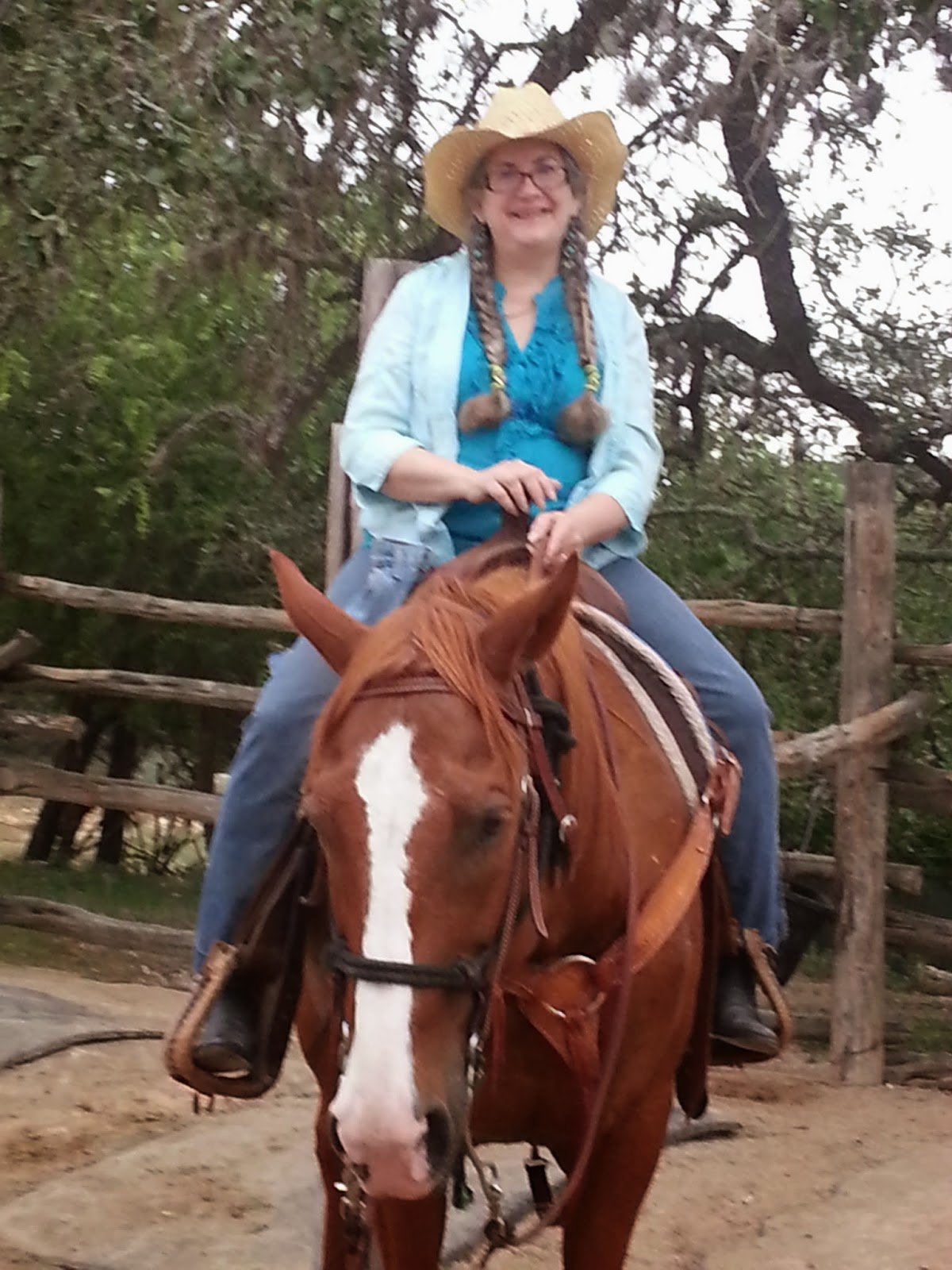
The popularity of anything “western” continued to grow and in the 1940s, Dude ranches became a favorite vacationing spot. I actually had the great fortune to spend a weekend at the Silver Spur Guest Ranch in Bandera, TX. I loved every moment. The staff made us all feel special and were very patient with those of us who could be labeled “city slickers.”  I signed up for the early morning trail ride which I was a little nervous about. When I was twelve, I was on a trail ride in which the horse decided to run off with me. I held on for dear life and bounced past the rest of the riders. I remember one of the workers coming after me and getting the horse under control but still the fear has always been with me. But not this time. This time the wranglers teaching us what to do and what not to do were very patient and thorough. I climbed onto the horse like I knew what I was doing and had a most enjoyable ride (even if I did keep leaning to the left a bit in the saddle).

And though I didn’t have on my “yoked” cowboy shirt, I did remember to wear my cowboy hat and boots. Yay me!

Sunday, July 6, 2014

Fort Davis - Protecting Early West Texas


I always thought it strange that my folks spent their honeymoon at the Davis Mountains in Texas, but then maybe not. We took our family on a road trip in 2005 that took us to that part of the world.
Troopers established a post in 1854 on the eastern side of the Davis Mountains. These men bravely defended this part of West Texas from Apache and Comanche attack. In 1861, confederate troops occupied this area until Union forces took over in the summer of 1862. The fort was abandoned soon after and gathered dust until 1867, when the U.S. Calvary returned and began construction on the various buildings that would secure Fort Davis a more permanent place in West Texas.
By 1869, most of the buildings necessary for fort life had been constructed. The men manning the fort saw to the safety of freighters, mail wagons, travelers and settlers from Apache and Comanche attack on the San Antonio-El Paso Road. Some of the more famous inhabitants of the fort were the Buffalo soldiers (the 24th and 25th U.S. Infantry and the 9th and 10th U.S. Cavalry which were all black regiments).
Life for a soldier wasn’t easy and they adhered to a strict routine. Reveille sounded at 5:30 AM and the day was spent grooming horses and training for battle. As their horses were a main part of Calvary life, stable call was announced twice a day. The day ended at 5:15 PM followed by supper at 6:00 PM. Not only was life inside the fort rather tedious a boring, but many troopers had to combat a language barrier with other troopers. Enlisted men and even troopers came from a variety of backgrounds. Many were immigrants who didn’t have full command of the English language. Some were criminals seeking a place to hide or serving time in the military instead of time in jail.
An enlisted man’s starting pay was $13 a month. Examples of commissary prices in 1885 included: flour at 7¢/lb, sardines at 25¢/lb, cigars at 3¢ and sugar at 25¢/lb.
Fort Davis continued as a military post until it was abandoned in 1891 having served its usefulness. The town of Fort Davis continued, though. In the 1880s, the town became an important ranching center. Jeff Davis County was established in 1887 with Fort Davis as the county seat. The town population suffered a blow once the fort was abandoned and businessmen tried various schemes to revitalize the area. One such dream was to make it a western movie center but the Great Depression saw an end to that plan. In 1946, the property was bought by David A. Simmons of Houston, former president of the American Bar Association.  His hope was to restore the fort and turn it into a resort for tourists. He died before seeing his dream bear fruit but in September, 1961, Fort Davis National Historic Site opened its doors for all to enjoy. 

Friday, September 6, 2013

A wee bit of entertainment - Stereoscopes


Entertainment in the old west took on many forms. I remember my grandmother telling stories of her entire family gathering to play musical instruments and sing. There were the occasional dances and perhaps some were able to take in a play now and then, but for the most part, their brief evening entertainment consisted of conversing. The men folk might enjoy a cigar or cigarette on the front porch while the women folk crocheted, knitted or embroidered. Needless to say, without the Internet, TV, and ipods, our forefathers had to be more creative with their use of any free time they might enjoy.
 
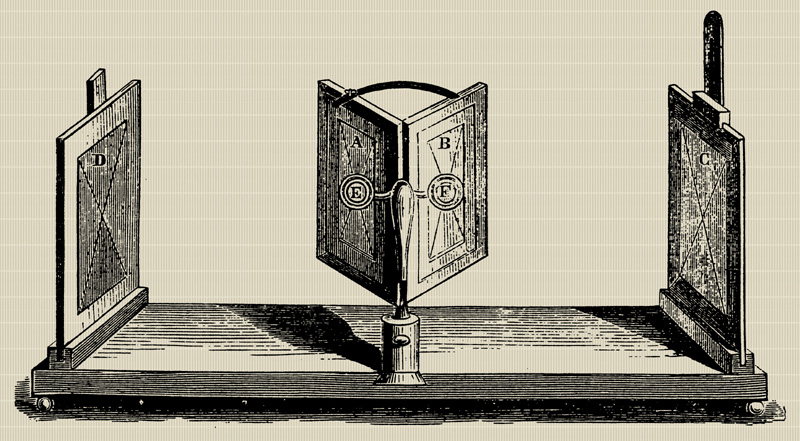
File:Charles Wheatstone-mirror stereoscope XIXc.jpg
Steroscope
Viewing images in 3D have been around since 1838 when Sir Charles Wheatstone invented the stereoscope. His utilized mirrors set at 45 degree angles and because photographs weren’t around yet, his also used drawings.

Various inventors made improvements along the way but at the 1851 Great Exhibition held in Hyde Park, London, a picture of Queen Victoria was displayed using a stereoscope and the item became an overnight success. I would imagine it was a fun form of entertainment and a lovely topic of conversation for families.

But in 1861, an American streamlined a more practical version. Oliver Wendell Holmes was best known for his writing and his work in the medical field. He advocated reform with regards infections being spread from patient to patient by doctors who did no clean their hands properly. His contribution to the design of the stereoscope became popular among fellow Americans and is often called the “Mexican Stereoscope”.  

My mother always called it a stereopticon, but this is considered a misnomer. Me? I call it ingenious. I used to love playing with the apparatus when I was younger. My mother's is vintage 1906 and of Oliver Holmes’ design.
 

Please enjoy a scene from Once Jilted:

Her eyebrows rose over wide eyes. “You want me to stay in your tent?”

“Aye.”

"Will you be moving your things soon?" She stood, wiping her wet hands on her apron.

"Nay." He quirked a brow and lifted the corner of his mouth in a smirk. "Nay, I’ll just come get things as I need them. Otherwise, you’re to be making yourself at home."

"But where will you sleep?"

"Beneath the heavens." He smiled. "I’ve always enjoyed sleeping outside with nothing more than a blanket of stars."

"I think I’ll feel like an intruder."

"Well now, I’m noot givin’ you permission to snoop in me personal belongings, mind you."

A becoming blush stole over her features, and she quickly masked her pink features by stepping behind the drying clothes to hang more wet things on the line. Had the lass already done just that? Snooped through his things?

"Of course not, but there are some items that are in clear view."

"Like?"

She smiled. "I couldn’t help but admire the picture viewer."

"Ah. That’s a stereoscope, a present from me last employer." A fond memory entered his thoughts as he reminisced about the bridge they’d built in Missouri. "Joe took me under his wing and taught me a lot about the Burr-arch truss system. As for the man, he was quite the traveler. That particular stereoscope came from England."

"Are—are there more pictures for it?"

The eagerness on her face was so adorable, he laughed. "I’ll fish them out for you when I have a wee bit of time."

"Thank you."

"Well, I haven’t found them yet, lass." He stared at the puddles made by her wash water then at her soggy hem.

"No—thank you for letting me stay here, for giving me a job." She snapped another clothespin onto the corner of his long underwear, lifting off the ground just enough to show him a bit of shin.

His skin warmed. "No thanks be necessary."


Thursday, June 6, 2013

Brilliant Old West Lawyer - Temple Lea Houston


Two years ago, at a DAR (Daughters of American Republic) luncheon, I had the pleasure of listening to a very engaging speaker on the life of Temple Lea Houston. I’ve grown up hearing about the exploits of his father, Sam Houston. I even lived in Huntsville for a short time and spent many pleasant hours touring Sam Houston’s home, but I hadn’t ever given much thought to the man’s children.

Amazing since Temple Houston turned out to be such an important figure in Texas/Oklahoma history himself. He was the youngest of eight children and was the only one born during Sam Houston’s reign as the Governor of Texas. Unfortunately, he was orphaned at age 7 and was sent to live with an older sister in Georgetown, Texas. In all likelihood, he may have known my forefathers as they were prominent citizens of Georgetown themselves during this time.

But Temple was destined for great things and left home at 13 to join a cattle drive. Later, after working as a page for the US Senate in Washington, D. C., he developed a love for law and enrolled in TAMU in 1877 (100 years prior to my own enrollment in that same university). At age 21, he was the youngest to pass the bar and open his own law practice in the state of Texas.

While becoming a lawyer was indeed quite an accomplishment, it was his theatrics in the courtroom that earned him a memorable place in Texas and Oklahoma history. The man could deliver a speech that enthralled listeners, but he had no problem punctuating his points with extra drama. Once, to prove a point, he shot two Colt 45s filled with blanks at a stunned jury. The jury found the defendant guilty but because “they scattered and mingled with the crowd” when Houston shot off his colts, he was granted a mistrial. The next time around, the man was acquitted.

In 1894, Temple moved his family to Woodward in Oklahoma territory where he served as legal counsel for the railroad. A very skilled marksman, he got into a fight with the brother of outlaw, Al Jennings. He shot and killed the brother and was tried and acquitted for the man’s death on the grounds of self defense.   

His most famous defense was called the “soiled dove plea” in which he managed to have a prostitute released from charges of plying her trade after the jury deliberated only ten minutes. The speaker I saw acted out the speech with all the passion and elocution Temple Houston must have employed, and I could see why the jury would be so swayed.  

I wish I’d known about this colorful figure at the time I wrote Julia’s Golden Eagle.  His background would have provided a lot of ideas for drafting that scene. Not only does Jake have to go through a court trial for murder, but later, he discovers his own passion for the law and decides to attend law school.

Excerpt:

The prosecution had called all their witnesses. The judge declared a break for lunch, and Jake was escorted back to his cell. He hoped Bob could find Miss Julia Stanton before the trial commenced again. If not, he might face the end of a rope or worse, life imprisonment at the State Penitentiary in Huntsville.
He shuddered. He’d prefer a hangman’s noose to imprisonment again. Even after five years, the horrors of that Yankee hellhole still haunted him. He’d lie awake at night and wonder why God had spared his miserable life while all around him, men lay dying. Closing his eyes against the traumatic memories, he waited quietly for the trial to continue.
“You don’t seem too concerned about the trial.”
Jake opened one eye then the other. A man of medium height with flaming red hair leaned casually against the wall facing Jake’s cell. He gazed at Jake with an intensity that was almost frightening. His jeans were creased and worn where the tie down for a gun would have been. The sheriff must have confiscated his weapon.
“’Peers to me like you’re not doing so well at that trial. In fact, you’ll be lucky to get twenty years. My guess is a life sentence.”
Jake closed his eyes again; ignoring the taunts the man threw his way. Outwardly, he maintained a detached attitude. In truth, fear gnawed at his insides. He prayed to God in hopes God had not forgotten him. With an afternoon of testimony still left, Julia Stanton would come to his rescue. She had to.
And then there was his brother, Tabor. He had his lawyer send out several telegrams expecting at least one to find its way to his brother. These thoughts gave him a measure of hope, but realistically, he knew his days were numbered. A black curtain of despair blanketed his mood. A stay in prison would surely kill him as easily as the noose, only the death would be long and drawn out.
Movement caused Jake to snap his eyes open. “Enjoying the show, mister?”
The man, dressed all in black as if he were the grim reaper himself, sauntered closer to the bars. His visitor had the audacity to grin. “As a matter of fact, I am. Thanks.”
“I get the feeling, you didn’t come all the way over here to gloat. What do you want?” Jake asked, his emotions strangely under control.
“Believe it or not, Mr. Nolan, I want the same thing as you.”
“A million dollars and a sassy lady?”
“You’re not a very likeable fellow, are you? Never mind. I guess facing charges of murder when you aren’t guilty has left you slightly bitter and a tad resentful.”
Available for Kindle
That got Jake’s attention. He uncurled his body and sat up on the cot.
He kept his features carefully schooled. “All right, I’m listening. I’m your captive audience.”
“A real comedian. I can’t save you from this trial, but I want the real culprit. I want the real killer brought to justice. I need to know what you know and what you think you don’t know. I need you to recall even the slightest detail of that night. Try to remember trivial things.”
“What’s in it for me?” Jake leaned against the rough, stone wall.

              “A clear conscience when you meet your maker.”

Monday, May 6, 2013

Lost gold legends from the Civil War

By Ciara Gold
I'm so excited to have been invited to participate in this blog. Since this is my first post, I'll begin with a very short introduction. I write historical western romances but I also write fantasy, time-travels and sci-fi romances. Right now, I've been focusing most of my energy on my first love; historical westerns. Being a native Texan, there's just something comforting in the genre.
When I first started writing Texas Forged, my first thought was to have the hero and his half brothers be involved with a missing confederate gold shipment. Thus began my research into this possibility. I stumbled upon a story that would have been great to incorporate if I could have made the dates match up right. Alas, I abandoned the idea and went a different direction with my bad-boy hero.
However, the story is still interesting enough to make note of here about The Lost Legend of Keel Mountain. I don’t want to rewrite the story as it’s told so well at the link provided, but legends of this nature always provide fodder for story ideas.  Somewhere at the base of Keel Mountain in Alabama there could be hidden gold.
Unfortunately, the location didn’t work well with my story line so I continued to hunt for stories of lost gold and came across another interesting tale.  Supposedly there are buried gold ingots somewhere in the Elk-Cameron County area of Pennsylvania.  A very young lieutenant in the Union Army was given an important mission; to see to the delivery of a wagon load of gold bullion. He was given a wagon with a false bottom, an escort of 8 soldiers and orders to avoid the enemy as he travelled from Wheeling, West Virginia to Washington, DC.
File:Mountain road 5.jpg
Blue Knob (Pennsylvania)
Somehow in the course of trying to stay hidden from enemy eyes, he took the caravan through the very remote regions of Pennsylvania. In Ridgeway, their reception was rather hostile. Then they headed toward St. Mary’s. There, the lieutenant took ill. He’d been fighting bouts of fever throughout the journey but this time, his fever caused him to blurt out the purpose of his mission. Until this point, he was the only one in the group that knew of the gold. Their civilian guide took over as the lieutenant was too ill. They left St. Mary’s for Driftwood and that was the last anyone heard of the caravan until the guide showed up a month later with a fantastical tale of the loss of every man on the convoy and the loss of the cargo.
The guide was questioned extensively but the gold was never found. To this day, many believe $1,500,000 in gold still remains lost in the mountains of Pennsylvania.  Read the full story here.
Again, I couldn’t make the time frame for this story work with mine so I eventually made up my own tale of stolen loot.  As horrid as the Civil War was for both sides, it has given writers a wealth of intrigue to pull from. For those of us writing historical westerns around the 1870s, it's a great way to give our heroes and heroines a background rich in angst.
During the war, the hero in Texas Forged steals from his father, a man who won't claim the relationship. Years later, he still feels guilt for the crime. Eventually, circumstances force him to make things right and he goes in search of the buried loot only to come face to face with a past he'd rather forget.
Please enjoy an excerpt from Texas Forged:
“Care to explain this?”
Galin Walker took the rumpled, thirteen-year-old wanted poster and stared at an image that was both familiar and foreign.
“Looks just like you.” Deputy Nate Brisco rocked back and forth on his dusty boots. “Well, minus the scar on your forehead.”
Galin studied the drawing with an impassive face, but inside, volcanic heat rivaling the high temperatures in his forge threatened to consume his every breath. The likeness on the worn placard captured the stupidity and cocky confidence of youth. His hand shook ever so slightly when he handed the paper back to Nate. “You need a pair of those new-fangled eyeglasses the mercantile’s been advertisin’.”
The law official presented an imposing figure with his Colt strapped low on his hip and his brass badge polished to a shine. Galin swiped his forehead with a damp rag and waited for the man to pull out his cuffs.
“Found it wedged against the side of the new saloon. A few years old but…”
Was it Galin’s imagination, or had the smithy grown hotter? He tugged at the collar of his chambray shirt and licked the salty moisture from his lips. “But?”
Nate shook his head and tapped the thick paper. “Man on the poster has your last name. Know anything about him? Relative perhaps?”
He peered at the rumpled sheet, fear rushing through his veins like a river during a flood. “Lots of folks own that handle.” Why the hell was that document surfacing now?
“True.” Nate spit a wad of tobacco onto the dirt floor and used the toe of his worn boot to cover the evidence of his bad habit. “Didn’t I hear you say you were from Alabama?”
“Along with about a fourth of the town’s population, I reckon.” Would the law official buy that nonchalant bullshit?
“I sincerely doubt many Alabamians found their way here. In fact, I only know of one ornery cuss, and that’s you. Regardless, the face sure bears a resemblance to your ugly mug.”

The knot around Galin’s intestines tightened. “If you think I’m the person they’re lookin’ for, just arrest me and get it done with.” Maybe it was time to stop looking over his shoulder.