

Lately, my daily exercise routine has taken a back seat to severe leg pain brought on by a problem in my spine. I've had MRIs, medication, hot and cold packs, and now, physical therapy.
All of which led me to wonder as I go through my exercise routine at home, did women in the 19th century engage in any type of exercise at home? I mean in addition to the myriads of chores they had to perform every day just to keep themselves and their families functioning.
To my surprise, after digging and uncovering several early exercise manuals, women were, indeed, encouraged to exercise at home, petticoats and all. They revealed a lot about 19th-century culture and attitudes on health and women.
The 19th century saw an evolution in attitudes and opinions on how middle and upper-class women should be spending their time. On the one hand, parents, preachers, public figures, and newspapers of the day were quick to criticize women for anything perceived as silly or idle. And on the other hand, pastimes were highly prized.
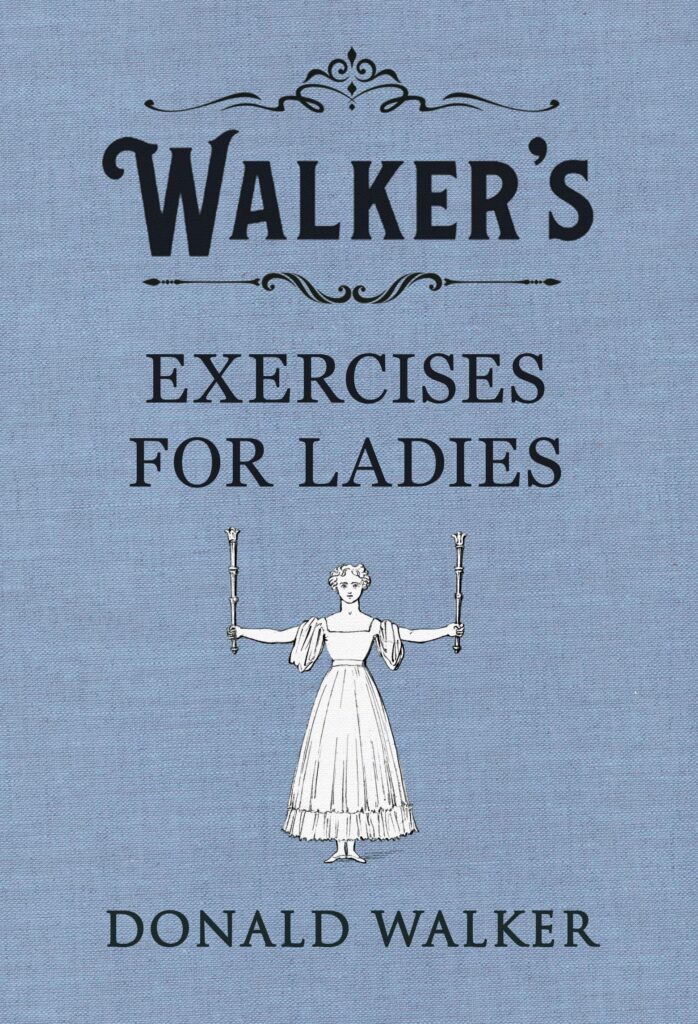
Walkers Exercises for Ladies is one of the earlier exercise manuals from the 19th century. Published in the 1830s, Donald Walker sought to rid the world of sedentary ladies and present options for exercise that were both intentional and appealing to women. One of the reasons is that when left to their own devices, they could hardly be trusted to pursue activities with any health benefits!
"The only exercises, indeed, to which, in their hours of relaxation, young ladies have access, are in general only a few insignificant games, or amusements extremely limited...for exercise indulged in without any regulation might produce real inconveniences, which a system composed of select exercises, suited to the age and strength of the pupil, does not produce.”
The American Woman’s Home, published in 1869, shows exactly the type of double-bind women could be put in, for it criticized exercise for exercise's sake at the same time that it encouraged women to get plenty of movement and be mindful of their physical health:
“…it is far better to trust useful domestic exercises at home than to send a young person out to walk for the mere purpose of exercise. Young girls can seldom be made to realize the value of health, and the need for exercise to secure it, to feel much interest in walking abroad when they have no other object."
There were also many references to dancing in the 19th-century manuals on exercise. Again, opinions varied. We may think today that dancing in the 19th century was an innocent activity that people, couldn’t get enough of, yet there were actually a lot of skeptics.
A treatise written in 1868 by Catherine Beecher, included long chapters on proper exercise and looking after one’s health. But one activity Miss Beecher would not provide her stamp of approval to was dancing:
“The writer was once inclined to the common opinion, that dancing was harmless, and might be properly regulated; and she allowed a fair trial to be made, under her auspices, by its advocates. The result was, a full conviction, that it secured no good effect, which could not be better gained another way..."
However, it seems that all experts of the time could agree on one thing: calisthenics was where it was at. Derived from two Greek words meaning “strength” and “beauty,” the stationary strength exercises would dominate the fitness world for over a hundred years and still remain present today.


Catherine Beecher herself is credited with being one of the first influencers to popularize calisthenics. And while Walker’s book pre-dates her 1856 Physiology and Calisthenics, the latter appears to have taken off much more with the general public.
Here are a few examples of 19th-century ideas on calisthenics:
- They bring every part of the system into action.
- Expand the chest.
- Bring down the shoulders.
- Make the form erect.
- Give grace to motion.
- Increase muscular strength.
- Give a light elastic step in walking.
- Restore the distorted or weakened members of the system.
- Prevent tight lacing.
- Promote cheerfulness.
- Render the mind more active.
- They are conducive to general health.
Sounds like the same reasons we exercise to stay fit. However, I'm not sure about #9...tight lacing? Every day I give thanks to whoever invented elastic waist pants!
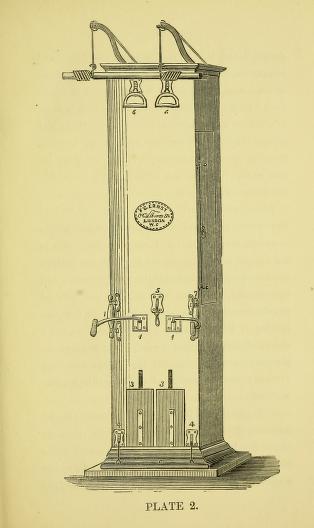
Published in 1861, The Portable Gymnasium was about how to use an exercise machine that actually looks quite a bit like the ones still used today, and certainly with the same functionality.
The author, Gustav Ernst, openly and enthusiastically states in the intro that the machine is meant to be used just as much by women as by men. He also states that while it may be an expense, the machine is a practical investment considering the cost of public gyms (this also surprised me) and the inconvenience of leaving the house:
“In an economical point of view, where there are several members in a family, repay itself in less than six months, if the expenses incurred by using a public Gymnasium are considered...such salutary amusement as may rank with the useful occupation when unfavorable weather or other circumstances preclude out-door exercise.”


Still, those in favor of calisthenics and more strenuous exercise for women faced detractors
To gentle and proper exercise for youthful females at school, no objection can be urged…. But when you come to teach grown-up women – wives, mothers, and aught we know grandmothers…how to handle a pike and jump over a dinner table – it is possible that the gymnastical part of education may be carried too far.… For our parts, we would rather that their ‘muscular powers’ were never brought into ‘full action’…. They are so delightful as they are, that we would not for the world run any risk of spoiling, or even altering them. (12)
By the late 19th century, other forms of exercise, including tennis and bicycling, became open to women, although there continued to be people who regarded vigorous physical activity as unsuitable for ladies.

https://www.amazon.com/Olivias-Odyssey-Westward-Hearts-Mail-Orders-ebook/dp/B0D488ZQPF
Amazon: https://www.amazon.com/author/jo-annroberts
Website: https://www.jo-annrobertsauthor.com/
Newsletter: https://www.jo-annrobertsauthor.com/newslettersignup
FB
Page: https://www.facebook.com/jrobertsauthor/


