Showing posts with label early railroads. Show all posts

Saturday, July 30, 2022

Bridging the Rivers by Zina Abbott


In my current work in progress, my heroine, Brunhilde, is a German immigrant who, in 1873, travels to St. Louis, Missouri, in the United States. By then, steamships replaced most sailing vessels, which cut down travel time across the Atlantic Ocean. As for the port of entry, I chose New Orleans for several reasons. One was, ships carrying cargo like cotton and tobacco brought passengers from Europe on the return voyage in order not to lose money. That was a more logical departure port for those commodities. Also, St. Louis, which had a large German-speaking population, was right up the Mississippi River from New Orleans.
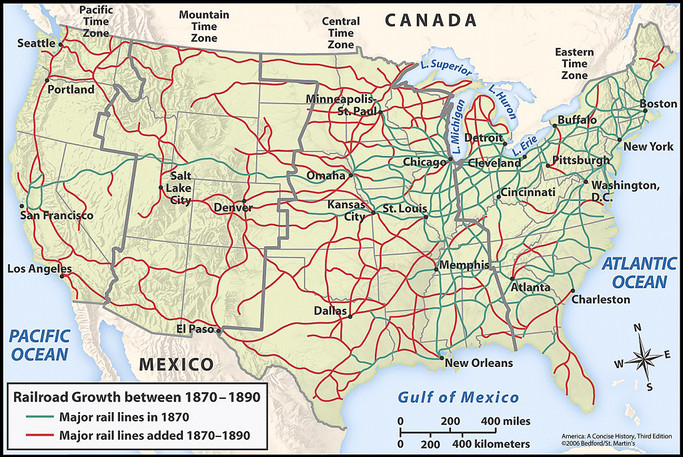
1870-90 Railroad Map

The question I faced was, in 1873, what was the most logical form of transportation between the two cities? Was it train travel, or was it still river boat? A look at the railroad map for 1870-90s showed there were railroads that traveled north, but the more established lines ran east of the Mississippi. Since that was such a wide river to cross, I next checked to see if a railroad bridge crossed the river near St. Louis.


Work on the Eads Bridge, a combined road and railway bridge over the Mississippi River began in 1867. It connected the cities of St. Louis, Missouri and East St. Louis, Illinois. The bridge is named for its designer and builder, James Buchanan Eads. It was the first bridge across the Mississippi south of the Missouri River. Earlier bridges were located north of the Missouri, where the Mississippi is smaller. None of the earlier bridges survive, which means that the Eads Bridge is also the oldest bridge on the river.

Eads Bridge photo taken in 2012 from  LaClede's Landing
 

The west end of the bridge is located on the St. Louis riverfront near Laclede’s Landing, which now is in the historic district and was the northern part of the original settlement founded by the Frenchman, Pierre Laclede. Even today, it had cobblestone streets and vintage brick-and-cast-iron warehouses dating from 1850s. That sounded like a good place for a steamboat to land to disgorge passengers and freight. 

Eads Bridge 1875 drawing by Camille N. Dry- note river traffic

Since the Eads Bridge was not complete until 1874, a year after my immigrant heroine and her family arrived. Based on that information, I wrote the story so the family traveled by steamboat up the Mississippi.

Brunhilde and her family stayed with her stepfather’s oldest brother, who had been a part of the German community in St. Louis since he and his young family arrived in 1848 after a failed revolution in Germany. The second oldest also brought his family. After his first wife died, he remarried. However, when he heard that the new Transcontinental Railroad was being built with its eastern terminus in Omaha, Nebraska, he moved his family to the large German community there. His second wife’s parents, also German immigrants, both died before his wife’s grandmother, Oma Bergmann. This brother, knowing his newly arrived youngest brother has an older stepdaughter, begged her to come and care for the elderly woman who had driven off every caretaker in Omaha he hired. 

For Brunhilde, this means more travel. Should my heroine board another steamboat and travel up the Missouri River to Omaha—a prospect she does not favor after making the trip from New Orleans? Or, should she travel by train, which would take her from the east border of the state to the west? Before I could decide that, I needed to know if, in 1873, there was a bridge across the wide, muddy, and unpredictable Missouri River.

Omaha Union Station

The Transcontinental Railroad was a big project, the planning of which started in 1862 during the Civil War. Actual construction did not start until after. However, in order to complete the dream of connecting the country by rail from the Atlantic Ocean to the Pacific Ocean, it became necessary to have railroad bridges across the large rivers that drained into the Gulf of Mexico.


The Chicago and North Western Railway reached Council Bluffs in 1867. To make the connection across the river, for a time, the Union Pacific tried to run freight trains across the frozen river during the winter. Also, the Union Pacific Transfer company maintained a ferry service from 1866 to 1872.

For an interesting early photograph of a train crossing the river, please CLICK HERE. 

In 1869 the transcontinental railroad was completed. However, that was not satisfactory to the U.P.R.R stockholders, who, in  1871, declared: “The want of a bridge over the Missouri River, at Omaha to connect the eastern railroads with the Union Pacific, has been one of the most annoying incidents connected with the trip to California.”
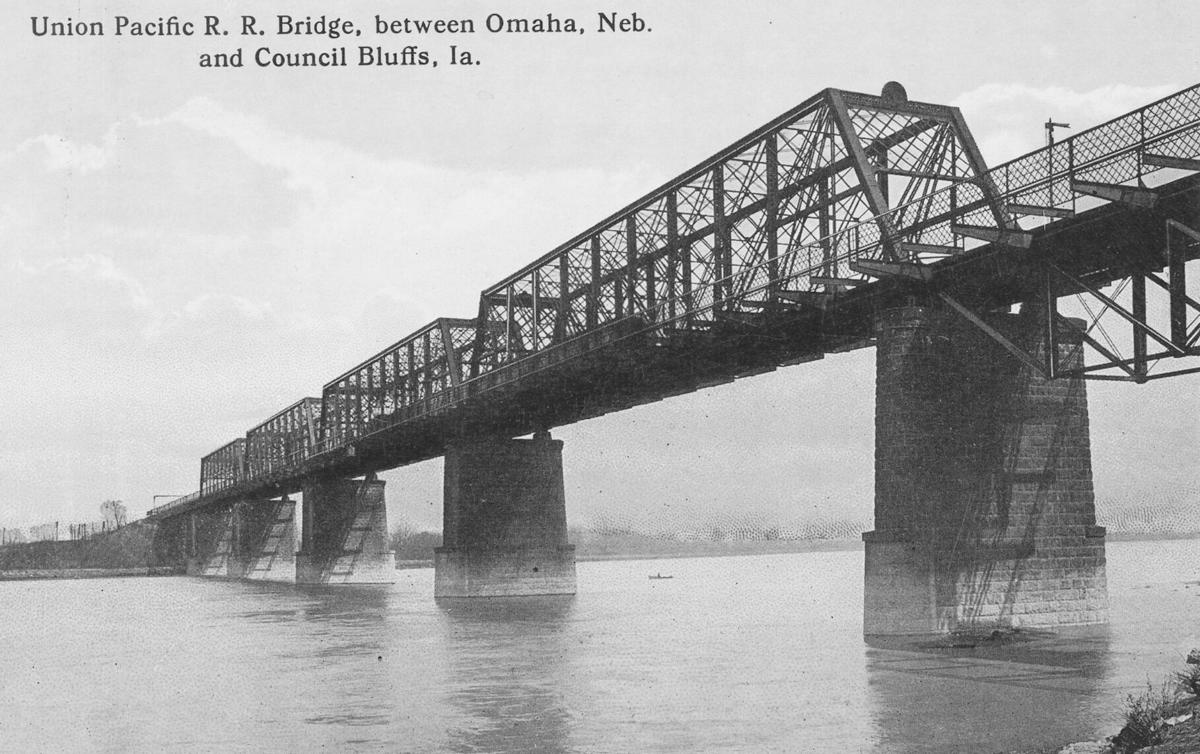

The bridge required 11 spans, 250 feet each. The deck was 50 feet above high water and rested upon one abutment and eleven iron piers, all in place and the larger part already sunk from 60 to 72 feet in the sand, and resting in the bed-rock. 


The new single-track railway bridge was completed in 1872. It cost $1.75 million, which is about $39.6 million in today’s money. It opened on March 27, 1872, a little over a year before my heroine arrived in the United States.

Bridge to Omaha, Nebraska, in 1872

In 1877, a tornado weakened the two easternmost spans, requiring them to be replaced with a wooden trestle. However, that was after the timeframe of my story. My heroine, who ended up being escorted by her step-cousin, who was only a few years older that she was, took the train. They crossed the 1872 bridge to reach Omaha.



The book for which I needed to know this information is Bee Sting Cake by Brunhilde, Book 12 in the Old Timey Holiday Kitchen series. It is currently on pre-order. To find the book description and pre-order link, please CLICK HERE.


Sources:

https://en.wikipedia.org/wiki/Eads_Bridge

https://en.wikipedia.org/wiki/Laclede%27s_Landing,_St._Louis

https://en.wikipedia.org/wiki/Merchants_Bridge

https://blairhistory.com/archive/early-railroads/

https://www.councilbluffslibrary.org/archive/items/show/2406

https://en.wikipedia.org/wiki/Union_Pacific_Missouri_River_Bridge

Saturday, July 31, 2021

I’ve Been Working in the Station by Zina Abbott


I started this series on railroad employees with the “I’ve Been Working on the Railroad” post. To find the link, please CLICK HERE.

Today, I will be focusing more on those who worked at the train depots in the 19th century.

Fort Edward Station


Station Master/Depot Agent
Oversees operations connected with railroad building adjacent to tracks, where passengers and freight may be located.


Baggage Handler or Clerk
The baggage handlers duties were to load and unload baggage from inbound and outbound trains. They were responsible for tagging baggage, loading, unloading and routing baggage. In small towns, the telegraph operator or station agent usually did this. In large towns, such as Omaha, it was a full time job. The baggage handler had to make sure the baggage was placed on the right train, or was transferred from an inbound train to the right outbound train.

Baggage Master
The person in charge of the baggage car. From 1840 to about 1920, passengers referred to him as the "baggage smasher." They swore he held contests with the baggage handlers to see who could stand at one end of the baggage car and hit the far wall with someone's baggage.

Passenger Director
Directs and manages passenger traffic, provides information relating to passenger travel.

Porter

Porter

One employed to carry baggage for and assist patrons at rail terminals. Although porters worked more inside as a car attendant who waits on passengers and makes up berths, they also helped passengers manage their baggage while getting on and off the train. These employees were specifically hired by the Pullman company for their Pullman Sleeper cars, also known as
palace cars, which were a luxurious car for day or night travel.. Pullman hired Black men, because he wished employees in this position to be accustomed to being accommodating and serving the needs of others.

Ticket window Millbrae Station

Ticket Clerk
Stationed at the ticket window, this person provides tickets and tour information to passengers.

Here are some positions that might not be employees of a railroad but were often found at the station (depot):

Express Agent
While not actually an employee of the railroad per se, they were employed by the "Railway Express Agency," which was a private concern, and usually had an office in the depot. Their job was to ship packages, much like United Parcel Service (UPS) or Federal Express (Fed Ex) does today. Quite often, especially in smaller communities, the Express Agent was also on the payroll of the local railroad. He might have been the telegraph operator, or the ticket agent, or even the the station agent.

U.S. Mail rail car
 

RPO Clerk
Railroad postal clerk. These clerks were usually employees of the U.S. Post Office, especially if they sorted and routed mail while on special railroad cars. Others, merely picked up and dropped off bags of mail at specified locations.

Wiley Pitts, mail carrier at railroad station


Telegrapher      (Telegraph operator)

The person operating an electro-magnetic telegraph using Morse code to create audible messages sent to distant receiving instruments.


In my January book, Kate’s Railroad Chef, one of main characters,  Garland McAlister, was a ticket agent. One of the secondary characters was Quentin Thompson, the telegraph operator. Please CLICK HERE for the book description and purchase link.


A Bride for Quentin, my book most recently released, is Quentin’s romance. To find the book description and purchase link, please CLICKHERE.


Photo Gallery:

San Pablo Station


Chicago, Burlington & Quincy RR Depot, Osceola, IA


Whitford Station


Sources:

https://www.up.com/heritage/history/past-present-jobs/index.htm

https://railroad.lindahall.org/resources/what-was-what.html

http://www.usgennet.org/usa/ne/topic/railroads/job.html


Sunday, January 31, 2021

I've Been Working on the Railroad by Zina Abbott

 I’m so good at doing things backwards. I recently published a book about train travel in which I highlighted some of the employees on the train due to arrive in 1881. I thought I researched the railroad fairly well. I got it mostly right, but not quite. In my story, I have about three conductors. In reality, there is only one conductor on a train, although he might have assistants.  All is not lost, though. I have a couple of book plots coming up that involve train travel. My new-found knowledge will come in handy.

Here are a few jobs that helped a nineteenth century train run smoothly.

Engineer

The engineer was responsible for operating the locomotive. He was also in charge of the mechanical operation of the train, train speed, and all train handling. If the locomotive needed to be repaired in a remote area, he was the one who fixed it. He is responsible for preparing equipment for service, checking paperwork and the condition of his locomotive. He is also in charge of the mechanical operation of the train including controlling steam pressure, boiler water level, fire box temperature, acceleration, braking, and handling of the train underway. He needs to know the physical characteristics of the railroad, including passenger stations, the incline and decline of the right-of-way and speed limits. As the train is moving he watches for obstructions on the rails ahead.


Since he was able to make the steam engine come to life and pull the train, the locomotive Engineer was the most heroic and glamorous train figure during the nineteenth century. He enjoyed certain privileges of the position. He was allowed to have his engine painted whatever colors he chose. He was allowed to alter the sound of the whistle by placing wooden stops in it, to create a unique and distinct sound. Rail employees and family members often knew who was operating a particular locomotive by the distinct sound of the whistle. The engineer was paid $4.00 a day.


To become an engineer he had to work his way up. Quite often he started out years before as a Wiper in a yard house. Next, he worked his way up to Engine Watchman, then to Switch-engine Fireman, then Road Fireman, then Hostler, then to Engineer.

Working his way up:

Wiper 

The Wiper's job was to work a 12 hour shift in the roundhouse, where he packed the internal moving parts of the engine with wads of greasy waste. The pay was $1.75 a day. This was the starting job that lead to the engineer's seat.

Engine Watchman

This man's job was to keep water in the boiler and keep enough fire going in the firebox to move the locomotive within the railroad yard.

Switch-Engine Fireman

The one learning the trade, called the Switch-engine Fireman, who worked in yard and never left on a traveling or "road" engines.

Locomotive Fireman

The fireman and engineer operated a steam locomotive as a team. The fireman managed the output of steam. His boiler had to respond to frequent changes in demand for power, as the train sped up, climbed hills, changed speeds, and stopped at stations. A skilled fireman anticipated changing demand as he fed coal to the firebox and water to the boiler. At the same time, the fireman was the “copilot” of the train who knew the signals, curves, and grade changes as well as the engineer.

Hostler

The Hostler went into the yard and picked up an engine from where the journeyman engineer left it running. He moved it into the roundhouse.

Switch-engine Engineer

This position was held by apprentice engineers learning the trade. Their job was to move railroad cars (also known as "rolling stock") around the railroad yard. Getting loaded boxcars on the right tracks and getting them hooked up for the road engines to pick up just before leaving the station. Once the apprentice engineer proved his ability with handling the switch-engines, the next opening for a Road Engineer would be his.

Conductor

Since the 1840's, to the average nineteenth century passenger, the conductor was the most visible railroad worker they encountered. Conductors wore distinctive uniforms and hats. As train crews went, especially passenger trains, the conductor held the legal authority over the train. (They still do.)


His job required diplomatic skill when dealing with passengers. Among their duties, the conductor collected the tickets from passengers, sold passage to those who boarded the train without purchasing a ticket where there was no ticket agent, supervised the other trainmen, settled arguments, and admonished misbehaving children or inebriated passengers. A conductor often dealt with crooks and swindlers. Like first responders of today, they were required to deal with all manner of emergencies such as delivering babies or doctoring the smashed or severed fingers of one of the train's crew. He has presided over the cars in the train with a fatherly dignity. The conductor filled the public relations function for the railroad by answering passengers’ questions and helping them to resolve difficulties.

In charge of train in its entirety, there was only one conductor per train. On large trains, he might have an assistant conductor or two to handle some of the duties.

Where the engineer and fireman remained in the locomotive, Along with one or two brakemen, the conductor stayed in the caboose when he was not required elsewhere in the train. The caboose provided shelter along with a stove for heating and cooking, seats, and make-shift beds. It also included a desk and chair for the conductor. The caboose car was also a place to store shovels, brooms, wrenches, chains, couplers, lanterns, and other miscellaneous equipment.

The conductor was (and still is) the railroad employee charged with the management of either a freight or passenger train. He was the direct supervisor of the train's crew. He was required to carry an accurate watch, which was regularly inspected. He was to ensure that the train was running according to the timetable. It was the conductor who had the responsible to signal the engineer when to start moving and when and where to stop. On a freight train, the conductor was also responsible for keeping the record of the consignment notes and waybills. He directed any switching that needed to be performed in order to drop off and pick up cars along the line.

Working his way up to Conductor

A conductor typically worked his way up from Flagman.

Flagman


Prior to about 1900, flagmen were called Freight Conductors. The flagman is the senior brakeman. He had worked his way up the ladder by being competent, which in many cases, meant he must avoid being killed. Since he picked new orders for the train at various stops along the way, he had to be able to read. He might also have been given the responsibility for collecting fares from passengers that rode in the inexpensive boxcars on the freight trains.

When, a train wreck occurred, or when a train was required to stop for some unusual reason, and it blocked the main set of tracks, the flagman's job was to set up warning devices along the track in the direction of any expected train. In the early days this meant they positioned themselves at a visible point as far down the tracks as possible to be able to wave a flag and warn any oncoming train of the dangers ahead.

Brakeman

During the early days of railroading, one of the most deadly jobs in America was that of Brakeman. The brakeman Inspected the train, assisted the conductor when he wanted the train to slow down or stop, operated the brakes, and assisted in switching tracks to determine the direction the train would travel. He also inspected and repaired brakes.

A brakeman's duties also included ensuring that the couplings between cars were properly set, lining  up the tracks for switches, and signaling to the train operators while performing switching operations.  The brakemen often rode in the caboose, the last car in the train. This allowed one brakeman to apply the brakes of the caboose quickly and easily, which helped to slow the train.

Prior to 1888 when Westinghouse developed a reliable air brake, stopping a train or a rolling car was very primitive. Iron wheels, located on top of the cars, were connected to a manual braking system by a long metal rod. Particularly in cases, such as descending a long, steep grade, the brakemen, usually two to a train, rode on top of the car. On a whistle signal from the engineer, the brakemen, one at the front of the train and one at the rear of the train, began turning the iron wheels to engage the brakes. When one car was completed, a brakeman jumped the thirty inches or so to the next car and repeated the operation. The brakemen worked toward each other until all cars had their brakes applied. On some lines, it was common practice for the brakemen to stay on top of the cars the entire time the train was in motion.

Tightening down too much could cause the rolling wheel to skid, grinding a flat spot on the wheel. When this happened, the railroad usually charged the brakeman for a new wheel. New wheels cost $45, which was exactly what a brakeman earned a month. In good weather, the brakemen enjoyed riding on top of the cars and viewing the scenery. However, they also were required to ride up there in all kinds of weather. Jumping from one car to the next at night or in freezing weather could be very dangerous, not to mention the fact that the cars usually rocked from side to side.

I do know this continued to be a dangerous job even in later years. My uncle worked as a brakeman. During a flash flood where there was hydroplaning on the tracks, he moved from car to car to apply the brakes. He was not on the roof—they had pull cords in each car to activate electric brakes by then (mid-1950s). However, as he moved through the cars, he got caught between two of them just as they jackknifed.

Keeping things coordinated

The engineer and the conductor had the responsibility to compare watches. It was necessary that both their watches were set to railroad standard time. Since they shared responsibility for the safe operation of the train and application of the rules and procedures of the railway company they also reviewed train orders they received. To see a website showing an engineer and conductor coordinating the time on their watches, please CLICK HERE.

Along with the conductor, the engineer monitors time so the train doesn't fall behind schedule, nor leave stations early. The train's speed must be reduced when following other trains, approaching route diversions, or when regulating time over road to avoid arriving too early.

Porter


Porters made their appearance on the railroad with the Pullman cars. The first Pullman porter began working aboard the sleeper cars around 1867, and they quickly became a fixture of the company’s sought-after traveling experience. Just as all of his specially trained conductors were white, Pullman recruited only black men, many of them from the former slave states in the South, to work as porters. Mr. Pullman’s objective was to hire men who knew how to behave like the perfect servant. Their job was to carry baggage, shine shoes, set up and clean the sleeping berths, and serve passengers in the Pullman cars and at rail terminals.


My most recently published book is Kate’s Railroad Chef. The position my hero, Garland McAllister holds with the railroad at the start of the story will be covered in next month’s blog post. For the book description and link, please CLICK HERE.


Sources:

https://www.up.com/heritage/history/past-present-jobs/index.htm

https://railroad.lindahall.org/resources/what-was-what.html

https://www.history.com/topics/black-history/pullman-porters

http://www.usgennet.org/usa/ne/topic/railroads/job.html

https://www.whatitmeanstobeamerican.org/artifacts/whatever-happened-to-the-little-red-caboose/

Wikipedia