Wednesday, April 6, 2011

SHAMELESS BOOK PROMOTION

NEW RELEASE!

(A picture of the cover goes here, but for some reason Blogger isn't letting me upload the picture. I'll try later. It's a great cover!)

Yesterday was release day for the latest Dixie Cash extravaganza, "I CAN’T MAKE YOU LOVE ME, BUT I CAN MAKE YOU LEAVE, co-authored by my other persona and my sister. Hopefully, it’s on store shelves everywhere, but the way publishing is nowadays, it’s hard to say. Here’s the blurb from the back of the book:

“The career of former Queen of Country Music Darla Denman ain’t what it used to be. No more big arenas—she’s lucky to fill a barroom—and now she’s forced to tour (by bus!) with the detestable Roxie Joe, current wife of Darla’s manager/ex-husband. So when her rattletrap tour bus gives up the ghost outside tiny Salt Lick, Texas, the faded Nashville star is thrilled to find loyal fans (and sympathetic ears) in Debbie Sue Overstreet and Edwina Perkins-Martin.
But when her nemesis and upstart backup singer Roxie Joe turns up dead in her dressing room—which bears an uncanny resemblance to a cleaning supply closet—Darla finds herself in more trouble than a Dixie Chick in merry old England. Luckily Debbie Due and Edwina are not only the proud owners of Salt Lick’s best beauty parlor, but they also moonlight as private detectives! And if the Domestic Equalizers can’t get to the bottom of a murderous musical mess, then no one can!”

Publishers Weekly says this is the best Dixie Cash romp yet.

Thanks for reading,
Anna
www.annajeffrey.com

Monday, April 4, 2011

Native American Legends: Dream Catchers


Over the years, I've kept a research log.... Okay, well, it isn't an actual log. It's atually a filing cabinet full of loose-leaf papers that isn't in the least bit organized. Still, whenever I come across something fascinating enough for that little voice in my brain to pop up and say, "Hey, you might write about that someday," I write it down or tear the page out of the magazine (yes, I'm one of those) and add it to what I call the "junk pile." Not too long ago, I was going through this filing cabinet and happened across one of my first research topics: Native American dream catchers....


Anything to do with Native American legend or history makes me sit up and take notice. Probably has something to do with my own NA heritage. And something that has always been present in my home are dream catchers. A few years back, I got curious about these cultural objects. What's the story behind them? First of all, dream catchers aren't just a Native American craft - they're a tradition set forth by the Lakota. Here's a bit of the original legend surrounding dream-catchers (as told by Dream-Catchers.org)....


Long ago when the world was sound, an old Lakota spiritual leader was on a high mountain and had a vision. In his vision, Iktomi, the great trickster and searcher of wisdom, appeared in the form of a spider. Iktomi spoke to him in a sacred language. As he spoke, Iktomi the spider picked up the elder's willow hoop which had feathers, horsehair, beads and offerings on it, and began to spin a web. He spoke to the elder about the cycles of life, how we begin our lives as infants, move on through childhood and on to adulthood. Finally we go to old age where we must be taken care of as infants, completing the cycle.


But, Iktomi said as he continued to spin his web, in each time of life there are many forces, some good and some bad. If you listen to the good forces, they will steer you in the right direction. But, if you listen to the bad forces, they'll steer you in the wrong direction and may hurt you. So these forces can help, or can interfere with the harmony of Nature. While the spider spoke, he continued to weave his web. When Iktomi finished speaking, he gave the elder the web and said, The web is a perfect circle with a hole in the center. Use the web to help your people reach their goals, making good use of their ideas, dreams and visions. If you believe in the great spirit, the web will filter your good ideas and the bad ones will be trapped and will not pass.


In Ojibwa - or Chippewa - culture, the word "dreamcatcher" (asabikeshiinh) also means "spider." It is always a hoop with a hole in the center, decorated with personal or sacred items, like the above-mentioned elder's willow hoop. Before the dream catcher, the hoop was a symbol of strength and unity. Many NA legends, like the dream catcher, spring from the importance of the hoop. The strands tied through the web are much like the design Native Americans used for making snowshoes. To this day, Native American people as well as New Age groups and others hang dream catchers in their homes. NA people believe that dreams, both bad and good, exist in the air, waiting for someone to sleep. The dream catcher allows the good dreams to pass through the strands and traps bad dreams that don't know the way through.


"Williams has brought the romantic back to romance!" ~ LASR


Saturday, April 2, 2011

Early Entertainers and Theaters of the West

Everyone likes to be entertained. The arrival of a theatrical troupe or a famous personality has always been exciting, and the early days of the West were no exception. Entertainers were always a welcome sight, especially in the mining towns and camps of the Mother Lode where the audience was mostly masculine. The miners wanted pleasing performers, and they were happy to reward them.

The early entertainers were a hardy group. They traveled long, uncomfortable miles over rugged mountains, dangerous trails, and arid deserts to see the glitter of gold and to achieve fame.

Once the actors and actresses reached their destination, they often had to perform under primitive conditions. There were no dressing rooms or sanitary facilities. Many times their stage would be the floor of a blacksmith’s shop with a wagon canvas for a curtain. They would appear in a tent, schoolroom, or a saloon. The orchestra was usually a flute, violin, and guitar played by musicians who had never read a note.

They offered medicine shows, drama, and variety. There were special rooms with cheap decorations, where the patrons could meet an actress for a price. Many times a miner would pay $100 for a seat and toss more gold on the floor when the show was over.

In Virginia City, the Queen of the Comstock, the first theater, opened in 1860. It was called the Howard Street Theater and ladies were not admitted. Business was good so Maguire’s Opera House opened its doors in 1863. It was an opulent establishment. The auditorium was carpeted, ornate crystal chandeliers hung from the ceiling, spectators were seated upon gilt chairs and there were velvet railings for the boxes. The enthusiastic audiences were wealthy, but not necessarily elite. They came for entertainment and had the money to pay for it. The shows ranged from Adah Isaacs Menken in the “Mezeppa” to minstrels and dog fights.

Born Charlotte Mignon Crabtree in New York City to British immigrants,

Lotta Crabtree would go on to become one of the wealthiest and most beloved American entertainers of the late 19th century. From her beginnings as a 6-year-old until her retirement at the age of 45, she entertained and was named "The Nation's Darling".

Monday, March 28, 2011

THE ROMANCE OF A ROOM ADDITION


What is the most romantic room in a home? In our romance stories, it’s quite often the bedroom where the romance actually physically happens. Other rooms in our characters’ homes are romantic and meaningful to the hero and heroine for various reasons as well.

The room I think of as most romantic is one that doesn’t exist yet: the room addition.

How can adding on a room be romantic? Okay, first of all, let’s remember this IS make- believe! In real life, home construction or remodeling projects will cause the topic of divorce to be introduced into the loving couple’s conversation at some point. Over and over.

Two short rollers and a can of paint in a bathroom can break a marriage faster than an overdrawn bank account. But come with me to the world of fiction—historical fiction—where women are heroines and men are heroes…and the announcement of “needing another room” is a joyous occasion, and not just another “honey-do.”

The addition of a room most generally heralds the impending arrival of a baby, or the growth of the young family in some way. Because cabins were so small and were generally put up as quickly as possible to provide a more permanent shelter for a family, improvements often had to wait until time, weather, or supplies permitted.

In our historical romances, our heroes are always eager to do whatever is necessary to provide the best possible quarters for their families. You’ll never hear them say, “I’ll do it when the playoffs are over.”

All joking aside, I believe we find the room addition romantic for several reasons, the most obvious one being that our heroine is pregnant and there needs to be a room for the little one the couple has created. Most women can relate to that maternal instinct of preparing a safe, warm place for their baby to sleep.

The second reason a room addition is romantic, is that the hero is actually building something with his skill, knowledge and love to provide for his growing family. It’s his answer to the heroine’s maternal need. Generally, the delivery of the news that a baby is on the way and discussion of the room addition is a shock to the hero, but not an unwelcome one. It transitions him from “husband” to “family man” and gives him the opportunity to “show his stuff.” He proves himself by his reaction to the news. The action he takes toward following through with the reality of building on shows the heroine (and the reader) that he is our “dream man.”

The family unit, complete, is probably the most romantic reason of all. The room addition shows the reader that the heroine and hero have matured, grown in their love for one another and are able to look toward the future as a family unit now. In the child to come, they will see themselves and one another, and will risk everything for the safety, comfort and protection of that child.

And it all starts with…the addition of the extra bedroom for the new life they’ve created.

In the following excerpt from FIRE EYES, Jessica gives Kaed the news that they’re going to be needing a nursery. This is an especially poignant moment because of Kaed’s past, and what it means to him personally. He’s being given a second chance—one he wasn’t sure he wanted, but now is desperate to hold onto.

FROM FIRE EYES:

“Looks like we gave up our bed.” Kaed’s gaze rested on Frank and the two girls. Nineteen. God, he looked so young, like a boy, as he slept, all the lines of worry around his eyes erased. Nineteen. I remember nineteen. Just didn’t understand until now how young it really is.

“Twice now.” Jessica’s voice called him from his thoughts. She grinned and nodded toward where Tom lay talking to Harv. “Maybe by this time tomorrow morning we’ll get lucky,” she whispered, reaching up to kiss his cheek.

“Neither one of us is going to ‘get lucky,’ in any respect, until everyone’s gone,” he grumbled softly, letting go a frustrated sigh. “One thing’s for sure. When everything settles down around here, I’m gonna add on a bedroom. With a door that shuts.”

Jessica was quiet for a moment, then very softly she said, “Better make that two.”

“Two bedrooms?”

“Uh-huh. Ours, and a nursery.”

Kaed nodded. “For Lexi.”

“And the new baby.”

His gaze arrowed to hers.

“Our baby, Kaed.”

The blood rushed through his ears, pounding at his temples. Nothing existed but the woman standing in his strong embrace, her love washing over him in warm waves as her eyes sparkled into his.

“Jessi.” The words he’d spoken to her the day he left came back to haunt him. I just hope that maybe we got lucky. Maybe it didn’t take.

But it had. And damn if he didn’t feel like the luckiest man alive. A baby. He read the unasked question in her expression, and he bent to kiss her. To reassure her. To let her know a family was what he needed and wanted. He felt her relax beneath his hands.

“I told you I was working my way through it, Jess,” he whispered against her cheek. “I’ll be a good father.”

Tears rose in her eyes. She nodded, her hair soft against his stubbled beard. “You’ll be the best.”

“Better than I was before, that’s for sure.” The words slipped out before he could stop them. He took a deep, jagged breath as Jessica finally dared to meet his eyes. He looked away, his gaze wandering about the small cabin, finally returning to lock with Jessica’s.

“I can appreciate what I’ve got this time, Jessi. I took it for granted the first time, and I lost it. I won’t let that happen again.”

Jessica shook her head. “Promise—” she began, but he tilted her face up, putting his lips to hers once more in a gentle, reassuring kiss.

“I’ll never let you go, Jessi. And I’ll never hurt you. I want what we talked about, the family, the farm, maybe a ranch.” He stopped and moistened his lips that had suddenly gone dry. “But most of all, I want you.” He glanced across the room at Tom, who gave him a fleeting grin. After a moment, he returned his gaze to the fathomless pools of Jessica’s eyes. “None of it means anything without the woman I love, Jessica. You. Yes, I promise, sweetheart. I promise everything.”

Travis leaned against the kitchen doorjamb, fresh coffee in hand. “Guess we’d better start beating the bushes for a preacher-man, boys. Get it done up legal and right for Miss Jessi while Kaed’s in this mood. I never seen him like this. Never heard him talk so serious.” He took a drink of his coffee, his green eyes mischievous above the rim of his cup. “I do believe he means it, Miss Jessi.”

Saturday, March 26, 2011

ALL ABOARD . . . FOR RAIL TRAVEL!


Santa Fe Poster publicizes travel
via Atcheson, Topeka and
the Santa Fe Line

 Rail travel’s hypnotic rhythm, unique smells, and the sense of adventure stir the imagination.

I love trains and have fond memories of travel from Southern California to visit my grandmother in Oklahoma and back home several times between ages three to six. Later after my family had returned to Texas, I made two trips as a teen from Lubbock, Texas to California to visit relatives there. Wonderful memories reappear when I think of the Santa Fe Chief.

Do you have memories encompassing "riding the rails"? Did you have a sleeping compartment or sit up all the way as my family did?

No matter what your trip involved, a few basic facts can offer enlightenment to the advent of personal travel by train. Choosing which facts to relate and which photos to share is a problem. Because I love trains so much and have used them in my western historicals, I have a LOT of information. I've visited train museums, called them, and written. Most of the photos are black and white, and some of my favorites are too dark to scan and use, but I'll share some with you.

The first commercial rail cars were in England in—believe it or not—1630--and were drawn by horses over wooden rails to transport coal. By the mid 1700’s, iron rails had replaced wood. The first steam-powered land vehicle built by Frenchman Nicholas-Joseph Cugnot in 1769 laid the foundation for future locomotives.
 
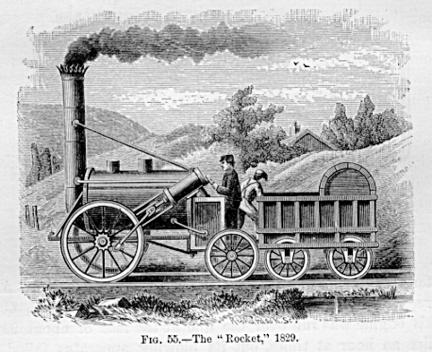
The Rocket, 1829, could
pull 30 passengers 30 mph


In the United States, Congress had invested heavily in the Eerie Canal and other waterways and resisted the idea of railroads. Public opinion eventually won. In 1827, the Baltimore and Ohio Railroad was the first railroad charter granted in the United States. By 1852, its three hundred miles of track made this the longest railroad in the world. In 1862, President Abraham Lincoln signed the provision for a nationwide rail line. Once the transcontinental rail lines were completed in 1869, America was opened to settlers from all over the world. At first used only for transporting goods, passenger travel soon developed.


In 1831 the DeWitt Clinton hauled 5 stagecoach bodies
at 25 miles per hour on the Mohawk and Hudson
Railroad from Albany to Schenectady--imagine the soot!


A wide variety of facilities awaited passengers. On some lines, the coaches were little more than rough structures that offered no comfort. Wooden benches with high backs—many times without a cushion of any kind—tortured passengers on a long journey. Still, it probably was no worse than riding in a wagon. At least the train made the trip faster. Other lines had coaches with padded bench seats, and still others with movable armchairs. Toilets sometimes were no more than a curtained off chamber pot offering minimal privacy.

1873 Steam locomotive

 Summer forced passengers to choose between tolerating soot, smoke and dust with the windows open, or sweltering with windows closed. In winter, passengers near the potbellied stove roasted while those at the other end of the car froze. Hmmm, sounds like the floor furnace of the house in which I grew up.  <G> Sometimes cars were reserved for women and their escorts and no males traveling without family were allowed in these coaches. Often as not, all travelers jumbled together.

               Sleeping Aboard!

1890 Pullman car

Soon lines developed luxury cars designed to mimic fine hotel lobbies. A major advance occurred when George M. Pullman began his line of luxury cars called Pullman Palace Cars. His company developed hotel cars, sleeping cars, club cars, dining cars, and drawing room cars.

According to George Deeming, Curator of the Railroad Museum of Pennsylvania, these coaches required high fees similar to luxury hotels and were not available to the masses. An early sleeping car had been built in 1838, the Chambersburg, for use between Chambersburg and Harrisburg, PA. The first Pullman sleeping car appeared in 1859 at only forty feet long. It was a reconstructed wooden day coach with metal wheels and a low, flat roof. A tall man was likely to bump his head. It had ten upper and ten lower berths with mattresses and blankets, but no sheets. A one-person toilet stood at one end. Two small wood-burning stoves furnished heat and candles provided light.


Note curtains at side
to be pulled at night


In 1865, the first Pullman sleeping car came into service. It featured the first upper berth that folded out of sight for daytime, heated air from a hot air furnace under the floor, upper deck window ventilation, and roomier wash rooms. This car had black walnut interior with inlay or mirrors between windows. In another ten years, the length had increased to seventy feet with even more elaborate wood interior and luxurious plush seats.

Jack Lemmon in berth with
girls, Tony Curtis looking up.

Pullman coaches offered privacy with curtained off sleeping quarters or wood paneled compartments, and separate toilets for men and women. At left is a scene from the hilarious movie "Some Like It Hot" which shows Jack Lemmon and friends in his berth while Tony Curtis looks on. Perhaps this isn't relavent to my post, but I like it. Hey, it does show life on a Pullman Palace Sleeping Car.


    DINING AWAY OR ABOARD?


Caption under station name says
"Scoot for the train when gong sounds"


At first trains stopped for passengers to debark and eat or even to spend the night in a hotel, as depicted in stories of the Harvey Girls and Harvey Hotels. Time always pressed diners and the traveler had no control over what food was available. Some dining places—due to necessity for speed—served poorly prepared rations. A few sites deliberately cheated travelers with slovenly hygiene and half-cooked food.

Harvey Girls had
strict rules
Others, such as Harvey, maintained high standards. At a dining stop, passengers rushed off the train for a hasty meal, then rushed back on board when the gong sounded. Travelers were forced to gulp and run if they were lucky enough to beat the crowd and get served. When I rode with my mom, vendors also came through selling sandwiches and drinks for those who couldn't afford the dining car. Eating in the dining car was arranged by cars and the porter would tell you what your "gong" would be: one or two gongs. Very efficient.


Note eleaborate marquetry in sloped ceiling panels,
linens on tables, china plates, and uniformed server.


The advent of the dining car meant passengers could eat a proper meal on board, provided they had the cash. The first dining car, the Delmonico, came into service in 1868 on the Chicago & Alton line. Within ten years, they were on most lines. In 1878, a full meal cost seventy-five cents, at a time when a common laborer made less than that for an entire day’s work. The meals were six courses and sumptuous. Pullman dining cars marketed luxury. Fine tablecloths had PPCC woven into the cloth, for Pullman Palace Car Corporation. Uniformed servers delivered well-prepared food to tables set with fine china, crystal and silver. Some cars had fresh flowers in built-in silver vases at each table.

                   Special Cars


Backlist reprint
now available
Shipping also changed, with railroad cars providing speed and more protection for cargo than horse or mule drawn wagons. For a fee, rail cars could be temporarily or permanently customized for specific products. In the Kansas, Texas & Pacific Railroad Museum in Dennison, Texas, books intended for railroad employees detail modifying and repair of shipping cars for a variety of purposes, such as the hero Drake Kincaid ordered in my book THE MOST UNSUITABLE WIFE, now available on Smashwords  at http://tinyurl.com/4r8ulu4 and Kindle at http://tinyurl.com/4mbo9mx  

Backlist reprint
now available
The Great Western Railway constructed a bridge across Niagara Falls to link the United States and Canada in 1855. It was not until 1882 that a bridge crossed the expanse of the Mississippi River at Memphis. Prior to that date, trains departing West from Memphis were ferried, one or two cars at a time, across the Mississippi, as is used in my book THE MOST UNSUITABLE HUSBAND, also now available at Smashwords and Kindle at the same links as above.


Parker County Peaches Ready For Consumers
In 1869 the first refrigerated rail car appeared and soon allowed the transport of fresh produce and meats. In my area, thousands of peaches were shipped to Chicago on refrigerated cars. Consumers were able to receive many varieties of fresh produce not available in their area.


Drive to rail line instead
of trail drive to market
 One of the significant changes brought about by the railroad in the West was elimination of the great cattle drives to the Midwest or Northern markets. Centralized rail shipping allowed ranchers to ship from locations near home. This relates directly to those of us who write western historicals with ranchers and cowboys.


Soldiers riding Pullman Palace car
after ending strike in 1894
 After the Civil War, train robberies occurred, particularly West of the Mississippi River. Former soldiers carried out many of these, some returning home and others looking for an easy income. Usually no one was injured, but watches, wallets, money and jewelry were collected from the passengers. Sometimes robbers forced passengers to drink liquor or sing as added aggravation.

Towns grew and flourished along the railroad. Those communities bypassed by the line often withered and disappeared. Competitions arose between communities to attract the railroad, often with bitter result. At times, towns offered bonuses to the railroad officers if the rail line came through their town.

For those fortunate enough to live near a rail line, products never before seen became available. Railroads brought easier travel, dependable shipping, and availability of goods to change America forever. Moreover, railroads opened up the West for settlers.

Thursday, March 24, 2011

Spurs by Sandra Crowley

Spurs assist reins and a rider’s natural commands of leg, seat, hands, and voice to urge a horse to step forward, sideways, or execute complicated movements such as dressage or a Lipizzaner’s "Airs Above The Ground."
Celts used spurs during the 5th century BC and their usage was also mentioned by the ancient Greek, Xenophon (c 430-354BC), an historian and soldier. In medieval times, squires’ spurs were silvered. A squire traded up when he “won his spurs,” a reference to gaining his knighthood and the gilt spurs that accompanied that honor. Spanish Conquistadors wore Espuela Grande, the “Grand Spur," with rowels as large as six inches.  
The Old West's US Calvary didn't award spurs to its new members, nicknamed "Shave Tails" for their assignment to horses whose tails had been shaved to warn other riders to give the novice more room. It was only after the amateur had proved capability with horse and saber that he was awarded his Spurs. Troopers often spent an entire month's pay to buy distinctive sets engraved with his mount's name, or his sweethearts. The traditional Calvary spur is usually a Prince of Wales type that's also popular in English style riding. It's sleek in design because the rider’s leg is positioned close to the horse and the preferred blunt tip helps provide precise aid guiding the horse into lateral and complex movements, such as pirouettes.

Antique spurs
Western spurs are heavier due to the rough country and have a longer neck to offset the saddle’s longer stirrup set and thicker fender that puts the rider’s leg further from the horse. Metal buttons, either attached to the heel band or to hinges on the heel band, fit through slits in the spur strap to fasten both pieces together. There may also be small curved-up hooks, “chap guards,” on the neck (shank) between the heel band and rowel. The hooks keep the chaps from interfering with the rowels. A tie-down (a short length of chain, leather, or rubber) goes under the instep of the boot, tight against the heel, to stop the spur from rotating upward. Some cowboys add small metal jingle bobs or jingo bobs near the rowel to create a jingling sound whenever they take a step. That’s the jingle fans of Clint Eastwood hear in many of his western movies.

Spur chap guard and jingle bobs
                                                                 
Western spurs are often highly decorated. Silver heel bands, plain or engraved, are popular as are hand-tooled or silver studded/buckled leather straps. Would you believe gem crusted? That one-of-a-kind gift for the lady who has everything.    
Roper's saddle-higher cantle, and taller, heavily wrapped swell/horn.


It only takes a few minutes in the saddle to teach a rider new to spurs how to wear them--a spur’s strap buckle goes on the outside of the boot which positions the spur so that the neck points downward, giving a smooth roll of the rowel against the horse’s side in an upward motion as the rider brings her heel in and back. It’s not the ease of reaching the horse’s side with the spur or the difficulty of making that contact that tells the rider she’s got her spurs on right. If the spur strap buckle rests against the inside of the boot, the stirrup rubs against it, quickly giving the rider a sore spot. Better her than her horse!

In the picture of my husband's roping saddle, you'll notice the leather strap flopped over the bottom spur. That strap is the spur's tie-down, described earlier, that fits between the sole of his boot and his boot heel. Chain is the preferred tie-down as it holds up to the friction and wear of walking. Of course, a cowboy would rather ride his horse five feet than walk that distance. BTW, that roping saddle is ten times heavier than my Australian saddle. The reinforced construction is necessary to stand up to the antics of the animal in the rope's loop!  

Notice the rowels on my spurs in the pic on the lower right are practically smooth while my husband's have a deeper tooth. He's ridden tougher country on less "enjoyable" horses. lol Riding is the one place I want to simply enjoy rather than be challenged. 
My Australian saddle with braided handle rather than horn.

Spurs, like the brothel tokens I posted about last month, have become a popular collectors item. Possibly one of the most famous spur makers was Oscar Crockett. Born in 1887 in Pecos, Texas, he opened his first blacksmith shop in 1916 in Pawhuska, Oklahoma. He left Oklahoma for Kansas City where he worked for or with C. P. Shipley until 1920 when Oscar bought out Shipley’s bit and spur department, creating the Crockett Bit and Spur Company with his uncle, W. Brice. Oscar and his uncle prospered, eventually moving the company to Lenexa, Kansas. By 1940, Crockett Bit and Spur Company supported 18 workers and sold 105 bits and 177 styles of spurs. Oscar made one last move, to Boulder, Colorado, in 1943. His business continued to grow and gain worldwide recognition until his death in 1949 when his wife sold out to James Renalde, owner of the Denver Metals Foundry.
A collectible spur made by Oscar will have “CROCKETT” marked inside it. A “CR” stands for Crockett Renalde. If the spur has an anchor mark, it was made by Judd and Anchor, a rival company.

This post is just a nibble of the fascinating information available on line. I highly recommend you take a few extra minutes and visit the Lipizzaner, US Calvary, and Western spurs links. Thank you. I enjoyed our visit. 


Sandra Crowley
Caught by a Clown, a spicy romantic suspense

Tuesday, March 22, 2011

The Model Man

I love a good western --but every once in a while a non-western story comes to me that I just can't ignore.  That's what happened a few years back with The Model Man.  It was my first full length publication  and was released from The Wild Rose Press in March of 2008.  Last month it was released on Audiobook. I can't describe what a thrill it was to hear my characters speak through someone else and to hear their interpretation of the story!

Whether you prefer print or audio books, I thought I'd share a snippet of it here today.


Single mom and romance novelist Kelly Michaels has no time for a man in her life. But when mega-famous cover model Derek Calavicci puts the moves on her at a romance writers’ conference, she succumbs to temptation. Common sense prevails, however, and after a few passionate kisses she turns him down; she has impressionable teenagers at home, after all, she doesn’t need a one-night-stand with a much younger man, no matter how hot he is. When photos of their passionate moonlight kiss hit the tabloids, her agent has to do some fast footwork to save her reputation. Will the notorious bad boy go along with her scheme?
Derek rarely hears a woman say “no” – it’s been that way his entire life. If Kelly isn’t interested, he’s not going to push her-- even if she does melt like ice cream on a hot sidewalk every time he touches her. But when an unexpected opportunity falls into his lap by way of Kelly’s scheming agent, he jumps at the chance. Pretend he’s in love with Kelly Michaels for two weeks? No problem. After all, the lady may say she’s never going to sleep with him... but he's got two weeks to convince her otherwise.

~*~
Derek Calavicci opened the door to his penthouse apartment and stepped inside. Home, although it never really felt that way. At one time the navy and pewter color scheme, so carefully chosen by the designer, the expensive but tasteful furniture and state-of-the-art gadgets had soothed him. But not lately. He set his keys on the kitchen counter and picked up a stack of personal mail waiting there.
Gabrielle, his younger sister and personal assistant, strolled into the room. Dressed in her robe and fuzzy pink slippers, she had a toothbrush sticking out of one side of her mouth and a towel wrapped around her head. She often stayed at his place when he was gone, and judging from the clothes, shoes and magazines strewn about, she had done so this past week.
“So, how was Tokyo?” she asked around the toothbrush.
“Fine.” He put his hands to his hips and glanced around the apartment. “It’s a good thing I pay the cleaning lady so well.”
She moved to the kitchen sink to spit out a mouthful of toothpaste. “How did the bourbon commercial go?”
“It was fine.”
“Did you get lucky?”
He didn’t answer her, merely shook his head in wonder.
“Okay, for other guys it’s getting lucky. For you it’s par for the course. So… did you?”
“Would I tell you if I did?”
“You’re always so grumpy when you get home from these things.”
He headed for the sofa and flopped down, finally allowing the exhaustion of the long flight and the time change to overtake him. “There’s a fourteen-hour time difference between here and Tokyo. I’m beat.” He leaned his head back and closed his eyes, grateful that he was no longer in motion. Not in a plane, not in a limo, just sitting still.
“Hope you aren’t too jet lagged, you’ve got an early flight in the morning.”
He raised his head just enough to look at her. “Where the hell to now?”
She laughed and headed toward his desk. “You really are out of it. The Romantic Moments conference starts this weekend.”
“Christ.” He dropped his head back down. “Little wonder I’m more comfortable in hotels than in my own home.”
“You’re never here,” she agreed, holding out a note pad for his inspection.
“What am I supposed to do with that?”
“It’s your messages. Your voice mail filled up twice so I had to write everything down.”
“I’m too tired to read them. Anything important?”
“Mmm, depends on what you call important. Or who.”
“I’m afraid to ask.”
“Let’s see… Megan called. She’ll be at the conference in Florida; she’s really looking forward to ‘hooking up’. She’ll be in room eight-twelve. Amber, also going to the conference, is in five-seventeen. Oh, and Shannon is going to be in New York next weekend and she’d like to … well, I’m not about to repeat it. Is she double jointed or something?”
“Damned if I can remember.”
“Anyway, there’s another page and a half of these.”
“I’ll look at them later.”
“Good idea. Oh, and Frankie called. About nine times.”
“What the hell did she want?”
“You. Under her tiny, little thumb. When are you going to fire her and get a new manager? One who doesn’t want to run your life.”
“Why bother when I can just avoid this one as much as possible?”
“She wants to make sure you two are on the same flight tomorrow so she can go over a few things with you on the way down,” Gabby spoke over her shoulder as she headed to the kitchen. “Something about the ‘Flawless’ campaign. You know, that new line of men’s cologne and skin care products you’re promoting.”
He raised his head again. “And?”
She returned, holding out a bottle of water and gave him a triumphant smile. “And I made sure to book you on a different flight.”
“Good girl.” He unscrewed the cap and took a long drag. “What do I have going on today?”
“I canceled everything when I realized you were getting back so late. Thought you might want a little break.”
“Thanks.”
“Don’t forget Anthony’s engagement party is tonight.”
“I can’t believe my kid brother is getting married. Did I buy them something nice?”
“Besides paying for the wedding? Crystal. Expensive and impractical, just your style.”
“I’m such a nice guy.”
“Well, you’d better be prepared to answer the inevitable from the relatives tonight.”
“You mean the ‘and when are you going to settle down’ stuff?” Now that he’d turned thirty, that was all anyone wanted to know. His younger brother’s engagement had only made it worse.
“Exactly. At this point, I’m beginning to think you’re commitment-phobic myself.”
“I’ve got nothing against commitment.” He raised his feet to set them on the coffee table. “But whenever the urge strikes, I lie down until it passes.”
“Yeah, I know. Preferably with a blonde or a redhead.”
“Gabby, I’m hurt you think I’m so shallow. I’d never turn down a hot brunette.”


The Model Man is available in print and digital format from The Wild Rose Press, and on audio book by Auidolark, where it’s a new release special!
Funny, compassionate, heart wrenching, and down right sexy – Simply Romance Reviews