Showing posts with label Texas Independence. Show all posts

Monday, June 28, 2021

Flags of the Republic of Texas

By Julia Ridgmont 

I just arrived home from a 16-hour drive into the great American state of Texas. It had been over 25 years since I had visited that state, and I wanted to show my kids some of the wonderful things that Texas has to offer, including beaches with warm water and fewer people than the beaches of our neighboring state, California. Warm beaches aside (at which they had a glorious time), my children learned a lot about Texas’ history during this trip. One thing that stood out to me as we drove and drove (and drove some more) were the many, many flags along the sides of the highways and freeway, both the American flag and the Texan flag. Too late, I realized I should have been counting the number I saw. I’ve taken several road trips with my family (with several U.S. states yet to visit—hopefully someday) and I have not seen this kind of pride and devotion displayed anywhere else, including my home state of Arizona.


Why are Texans so proud of their flag?


While I don’t know the exact answer to that question since I’ve never actually asked a Texan, I have a few theories.


Texas, as most people know, was an independent country after it revolted from Mexico in 1836. The Battle of the Alamo, though a defeat for the Texians, gave them the time they needed to gather reinforcements and fight President General Antonio Lรณpez de Santa Anna a month and a half later. At the time, Texians were flying the Mexican flag—only, instead of the eagle shown in the middle, the year 1824 was sewn into it to remind Mexican leaders of the constitution they had drafted that year and the promises they had made, which they were no longer upholding.


Independence from Mexico presented new conflicts for the young republic, including skirmishes and raids from the Comanche Indian tribe and conflicting views regarding annexation into the United States of America from political leaders. From December 1836 to January 1839, Texas represented itself with a flag bearing a gold star over a blue background, known now as the Burnet flag. In 1839, a new flag was flown, bearing a white single or “lone star” over a blue background and one white bar running horizontally over one red bar. This flag served as the Republic of Texas’ ensign to other nations until annexation came at the end of 1845. It still serves as Texas’ official state flag, and because it has served as the official flag for both a country and a state (and is the only state flag of all 50 states to have done so), it is flown at the same height as the United States’ flag.


Yes, Texans have much to be proud about as their history is full of inspiring events and people. However, I would love to see more flags flown in other U.S. states as well as other nations. Show us what you’re proud of, your accomplishments as a society and a people. I’m not talking about the kind of pride that is boastful, but one that exudes confidence in oneself and a desire to stand boldly and represent your state or country nobly. What an honor it was to visit Texas and be reminded of the old adage, if you don't stand for something, you'll fall for anything. Let's all stand up and be counted!


To learn more about Texas' fight for independence, visit:


History of the Texas State Flag, the Lone Star State flag and the Republic of Texas History (fortworthflag.com)


https://en.wikipedia.org/wiki/Republic_of_Texas


To learn more about Julia Ridgmont and her books, visit her Amazon page: https://amzn.to/2GKnBUA


Tuesday, January 14, 2014

The Runaway Scrape

By Anna Kathryn Lanier

At the beginning of 1836, General Santa Anna and his Mexican troops of 4,000 men and artillery crossed the Rio Grande River. As news of this invasion spread from San Patricio, Refugio and San Antonio, panic also increased and families fled. When the Alamo fell on March 6, 1836, full-fledged terror set in. Sam Houston, commander of the Texas Army, was in Gonzalez at the time. Thirty-two of the town’s men were killed at the Alamo, so everyone was related to or knew of someone who died.  Expecting Santa Anna to continue his march across Texas, Houston ordered the evacuation of and the burning of the Gonzalez to prevent the Mexican army any provisions. Thus began the largest exodus to take place in the United States as thousands of Texans made their way east toward the Louisiana border (and the United States).

People packed and left so fast that it is said one household left a dinner of fried chicken, coffee and a fresh pitcher of milk on the table. Families quickly hauled clothes, bedding, provisions onto sleighs, wagons, handcarts and often, their backs.  Recently widowed women gathered up children and babes in arms and made for safety in America. The travel, however, was anything but swift and sure.

Recent and continuing rains made the wagon trails boggy and muddy.  People slogged along in the sucking muck. Rivers were raging waters that made each crossing a horrifying event.  Horse thieves, claiming to be with Army, would steal the animals. Indian war parties struck families that fled, as well as those who stayed behind, kidnapping women and children.

Conrad Juergans and his very pregnant wife Mary stayed behind, thinking Santa Anna’s army would pass north of them, which they did. Shortly afterward, though, a party of Indian braves attacked the cabin.  Conrad was injured, but managed to escape to the woods.  Mary and her two young sons, however were taken captive and forced to trek toward the Red River valley.  Three months later, Mary appeared at a trading post within Indian Territory. Her family arrived and paid the $300 bounty for her release.  She had given birth to a daughter while in captivity (am not sure if she had her daughter with her or not). The fate of her two sons is unknown.

One excellent source of the Runaway Scrape was documented by Dr. Pleasant W. Rose, who lived with his family near Stafford Point.  In 1900, his daughter, Dilue Rose Harris published an account of the Runaway Scrape in the Quarterly of the Texas State Historical Association. While recalling her own memories as an eleven-year-old at the time of the Scrape, Dilue relied heavily on her father’s journal, which by 1900 had been lost for some time, but that she had read it multiple times before its disappeared.  The events of the Rose family were typical of other fleeing families.

Dilue recalled that the family quickly put belongings into a sleigh and traveled eastward with several other local families. The family’s hardship began at the Trinity River. Though the family made it across the treacherous river, the last trip made by the ferry boat, it swamped badly, leaving them stranded for several hours in the middle of the river. Finally they were rescued, but their river ordeal was only one of many faced by the evacuees.

W.G. Dewees recalled another river crossing. “There were about seventy-five wagons in the company and on arriving at the river we found no way to cross; the river was up to the top of the banks and there was no ferry.” Eventually, two large pine trees were cut down “so their length might be sufficient to reach across the river…that we might place the wagons on them and pull them across…with a rope.”

At Cedar Bayou, Emily Bryan Perry took charge of a situation when the cart of a woman and two small girls became stuck in the middle of the stream, efficiently blocking everyone else’s progress.  Emily handed off her new born baby, climbed down from her wagon and waded out to the woman. She spoke softly but firmly to the woman, encouraging her to try again.  “Up Buck!  Up Ball! Do your duty!” the woman yelled as she cracked the whip over the oxen’s head. The oxen strained hard, and managed to pull the cart free.

Dilue Rose reported seeing “children falling from the wagons which still kept on leaving the children behind, till another wagon came along and picked them up. Mothers in this manner have been separated from their children for days, and some for weeks, as the wagons would often take a different course.” William Fairfax Gary relayed seeing a family that had found a small, unattended infant. The family now had the care of the child, which they and others took turns carrying.

After a very difficult trip in mud and muck, the Roses finally arrived in Liberty. It was there that Dilue’s little sister died. The rigors of the escape proved hard, illnesses ran rampant through the groups heading toward Louisiana, and infants, small children and the elderly were particularly vulnerable. Many families lost a loved one to such diseases as cholera.

The Roses stayed in Liberty for several weeks and one day heard what they thought was distant thunder. Instead, it was the sound of cannon fire.  Sam Houston and his troops had caught up with Santa Anna and his troops. The Battle of San Jacinto could be heard thirty-five miles away. On April 21, 1836, in less than fifteen minutes, Sam Houston overtook the Mexican Army and forced their surrender.  Texas had won the war.

When word of the defeat of Santa Anna’s army reached the evacuees, they made their way back homes.  Some were burned to the ground, others had been ransacked, while others were found to be as they’d been left. The Roses returned home to find the hogs running wild. Her father’s bookcase had been toppled and his medical books and supplies scattered on the ground, the hogs sleeping on them. Emily Perry’s plantation near Peach Point didn’t fare any better. Although the house was not robbed, it was in disarray. “The hens had taken possession of beds, closet, bureaus,” Emily’s cousin wrote.   On the upside, there was an abundant supply of eggs.

In Women and the Texas Revolution, edited by Mary L Scheer, it says “The Runaway Scrape occurred in several stages. It began as an evacuation, starting South of San Antonio in February before it spread eastward to Gonzalez and Victoria early in the following month, culminating in civilian flight from the Colorado and Brazos valleys in mid- to late March.” (pp 159). Thousands, mostly women and children joined the flight away from the Mexican Army. It was an event that would define their life and the memories outlasted most of the hardships.

Works cited:

In Women and the Texas Revolution, edited by Mary L Scheer ISBN 978-57441-469-1


Anna Kathryn Lanier
Romance Author, A GIFT BEYOND ALL MEASURE
http://aklanier.com/
Never let your memories be greater than your dreams. ~Doug Ivester 

Thursday, October 10, 2013

THE FLAGS OF TEXAS - PART ll

Last month, on the tenth, I started a two part series about the twelve lesser known flags that flew over Texas from 1835-1836 before the battles for Texas Independence in 1836. This post is about the second set of six. I hope you enjoy learning about them.  


Most people have heard of Six Flags Over Texas, a fun theme park that opened in the summer of 1961. Through the years it's been the home for the first log flume ride, the Runaway Mine Train roller coaster, and the Texas Cliffhanger, the first freefall ride. Great fun, but not the focus of my post today.


Six flags of government have flown over Texas, Spain (from 1519 to1685), France (from 1685 to 1690), Spain (from 1690 to 1821), Mexico (from 1821 to 1836), Republic of Texas (from 1836 to 1845), United States (from 1845 to 1861), Confederate States (from 1861 to 1865), and United States from 1865 to the current period. These are interesting because they got us where we are today.

The ones I want to share, though, are the lesser known flags of Texas Independence from 1835-1836. Since there are twelve flags in this time period, I'll divide them up into two segments. The following descriptions are used in whole or in part from, http://www.tamu.edu/faculty/ccbn/dewitt/indepenflgs.htm. All attempts will be made to give credit where credit is due.


 Baker's Flag of San Felipe. According to the Telegraph and Texas Register, San Felipe, 5 Mar 1836 "....the English Jack showing the origin of Anglo-Americans, thirteen stripes representing that most of the colonists in Texas are from the United States; the Star is Texas, the only state in Mexico retaining the least spark of the light of Liberty; tricolor is Mexican, showing that we onced belonged to the confederacy; the whole flag is historic."

It was dubbed the San Felipe flag and based on ideas expressed to Gail Borden Jr. by Stephen F. Austin in the enclosure to a letter from New Orleans of 18 Jan 1836: "I shall preach independence all over the US wherever I go--What do you think of the inclosed idea of a flag." The flag was presented to the company of volunteers commanded by Captain Moseley Baker (John P. Borden, 1st. Lt.) by Gail Borden Jr. in the name of "two ladies" from the area as they marched from San Felipe 29 Feb 1836 for Gonzales. Capt. Baker made a speech to his company in response to the presentation referring to the flag "this banner of independence." He said "first in your hands is placed the Texas flag; let you be the last to see it strike to the invading foe! Let no other feeling ever glow in your bosom than that expressed in the motto on your banner, 'Our Country's Rights or Death.'.....Let us all raise our hands to heaven and swear, 'The Texas flag shall wave triumphant or we will sleep in death!'" It was claimed to have been flown at San Jacinto by those in Sherman's division. (Modified from Gilbert, Flags of Texas). 


Flag of the New Orleans Greys. Two groups of volunteers from New Orleans joined the Texas resistance to the Mexican centralista dictatorship. Members of the Greys participated in the Siege and Battle of Bexar, the Alamo and Goliad. The bright blue silk banner of the first company with an eagle bearing a banner stating "God and Liberty" is thought to have flown over the Alamo among possibly other flags. It is said to have been retained and transported to Mexico as a symbol of foreign military intervention in the affairs of Mexican Texas. The flag is said to have deteriorated in storage over the years at various locations in Mexico and it is unclear how much of the original still exists versus additions in restoration. Several attempts have been made to obtain the flag for traveling exhibition or even return to a site in Texas or the US. (Image modified from Gilbert, Flags of Texas)


Flag of the Alabama Red Rovers. Like their uniforms, this solid blood red flag was the banner of the Red Rovers, a company of volunteers from Alabama who came to Texas in fall 1835 to aid the Texan forces. The Red Rovers were in large part massacred at Goliad on Palm Sunday, 27 Mar 1836, although some survivors were among them. The Rovers were recruited, supported and commanded by Dr. and Capt. Jack Shackleford of Courtland, Alabama, who was with them at Goliad. Dr. Shackleford's life was spared because he was a surgeon.


San Jacinto Liberty Flag of Sherman's Volunteers from Newport, Kentucky. Although there was no single banner representing the Texian Army at the time, of those that were probably displayed, this flag is most commonly associated with the Battle of San Jacinto. This banner was presented to Sherman's Newport Volunteers upon their departure for Texas by the ladies of Newport, Kentucky. Capt. Sherman's new bride, Katherine Isabel Cox, was chosen to make the presentation. Thousands are said to have waved the company off as they departed by steamer from Cincinnatti on the Ohio River. Legend says that Private James A. Sylvester was given a long red glove (a white glove in some accounts) by the daughter of the host at a departure dance just before leaving for Texas which he tied on the flag staff. It was said to be a "talisman" and inspired the ranks at San Jacinto.
Flying the flag, Sherman's regiment met Gen. Houston in Gonzales after the Alamo defeat and followed him into the Battle of San Jacinto. In Aug 1836, the flag was returned to Mrs. Sherman at Frankfort, KY with a letter: "Velasco, August 5, 1836, War Department. This stand of colors, presented by the ladies of Newport, Kentucky, to Captain Sidney Sherman, is the same which triumphantly waved on the memorable field of San Jacinto, and is by the government presented to the lady of Colonel Sidney Sherman as a testimonial of his gallant conduct on that occasion. A. Somerville (signed), Secretary of War. Approved: David G. Burnet." The flag was kept by the family for many years and later returned to the State of Texas in a ceremony in the House of Representatives in 1933. It was placed in custody of the Daughters of the Texas Revolution. The above artist's depiction is thought to be close to the original banner brought from Kentucky. The banner on the sword says "Liberty or Death." Over the years, artist's renditions and historical narratives describing the flag vary in the clothing on the upper body of Liberty. Wooten's color plate depicting the flags of Texas in his Comprehensive History of Texas in 1898 show an out of focus, diffuse, fully-clothed Liberty similar to the Statue of Liberty in New York. The rendition in Gilbert's 1968 edition of A Concise History of Early Texas: As told by its 30 historic flags depict Liberty's upper torso fully covered with a transparent blouse while the 1994 edition shows the depiction above. Attempts at restoration of the original banner are also thought to have altered the details of Liberty's clothing. The original flag was placed in a glass case behind the Speaker's podium in the House of Representatives in Austin. Reportedly insignia on the banner is barely detectable due to fading during storage and display over the years and the actual flag is only displayed from the backside which where an image is more discernable when the House is in session. (Image modified from C. E. Gilbert, A Concise History of Early Texas: As told by its 30 historic flags)


 Suggested Independence Flags of Austin, Wharton and Archer. After the Independence Consultation of November 1835 in San Felipe, Stephen F. Austin, Branch T. Archer and William H. Wharton were sent to the United States to seek aid. In New Orleans they designed and proposed elaborate flags of independence that were never adopted, but highly symbolic of the current state of the evolution toward independence. Austin proposed a flag including the symbols shown at left, the British Union Jack indicating the origin of most Anglo-Texians, the colors of the banners of both the US and Mexico (red, white blue and green), the Lone Star for an independent Texas and the Latin words "Lux Libertas" to symbolize that Texas was the lone star of libertarian principles (light of liberty) in the Mexican Republic.


 At the convention in November 1835, despite intense debate, the objective remained independent statehood in a Federal Mexican Republic under the Constitution of 1824 rather than a full declaration of independence as a sovereign Republic. Most prepared for the latter and the seemingly inevitable impending war. Others saw that long term independence might require the overt protection of the United States and eventual annexation. Wharton and Archer insisted on replacement of the Mexican green stripe with union blue. Moreover, they suggested a sun rather than the star with George Washington's head in the center and the words shown in the banner at left. In a letter to her brother Stephen Austin in New Orleans of 1 Jun 1836, Mary Austin Holley wrote from Lexington, Texas "Miss James has painted your flag on silk--Sun Washington and all--it is beautiful--it is to be presented by Henrietta--with an appropriate speech written for her by myself--Friday afternoon--How interesting to have you here! It is to be in Mrs. Harts lawn....All the military were to parade....I furnished the silk for the flag--Gen. McCalla the Staff and spear head."

Below are links that may be of additional interest:

http://www.tamu.edu/faculty/ccbn/dewitt/dewitt.htm
http://www.tamu.edu/faculty/ccbn/dewitt/indepenflgs.htm

http://www.tamu.edu/faculty/ccbn/dewitt/dewittflgs2.htm


I hope you've enjoyed this post about a turbulent time in Texas history in the beginning fight for Texas Independence. I am passionate about my birth state and not bashful when it comes to sharing.

 
Thanks for visiting with Sweethearts of the West!

Carra


 Buy links for my debut novel, CODE OF HONOR, Texas Code Series, Book One:
Amazon for Kindle ebook and print:  http://tinyurl.com/muln4r9

and, Smashwords for nook, kobo and iTunes:  http://tinyurl.com/llshmbg
 

Find me on my website: http://carracopelin.com
Facebook: http://facebook/carracopelin
Twitter: http://twitter/CarraCopelin
Goodreads: http://tinyurl.com/mfynmj2

Tuesday, September 10, 2013

THE FLAGS OF TEXAS


Most people have heard of Six Flags Over Texas, a fun theme park that opened in the summer of 1961. Through the years it's been the home for the first log flume ride, the Runaway Mine Train roller coaster, and the Texas Cliffhanger, the first freefall ride. Great fun, but not the focus of my post today.


Six flags of government have flown over Texas, Spain (from 1519 to1685), France (from 1685 to 1690), Spain (from 1690 to 1821), Mexico (from 1821 to 1836), Republic of Texas (from 1836 to 1845), United States (from 1845 to 1861), Confederate States (from 1861 to 1865), and United States from 1865 to the current period. These are interesting because they got us where we are today.

The ones I want to share, though, are the lesser known flags of Texas Independence from 1835-1836. Since there are twelve flags in this time period, I'll divide them up into two segments. The following descriptions are used in whole or in part from, http://www.tamu.edu/faculty/ccbn/dewitt/indepenflgs.htm. All attempts will be made to give credit where credit is due.


The first Flag of the Fredonion Rebellion.

Empresario Hayden Edwards contracted with the Republic of Mexico to settle 800 families in East Texas. Article 2 of his contract stated that "all those possessions which are found in Nacogdoches and its vicinity, with corresponding titles shall be respected by the colonists; and it shall be the duty of the empresario, should any of the ancient possessors claim the preservation of their rights, to comply with this condition."

Edwards proceeded to force settlers, both Anglo and native Hispanics, to move or pay him for their land. The Mexican government canceled his contract. In response to the cancellation, Edwards made an alliance with Cherokee Indians represented by John Dunn Hunter and Richard Fields and declared the "Republic of Fredonia" independent of Mexico under the banner shown. The two colors are thought to symbolize the alliance. Inscribed also in the white field were names of key participants in the alliance. After he failed to rally a significant number of Anglo settlers in the Austin, DeWitt, DeLeon colonies and other areas of Texas, he abandoned the cause and returned to the United States. The flag was said to have been displayed later at rallies for Texas independence in 1835.


Next is the Flag of the Harrisburg Volunteers.

This banner was carried by volunteers comprising Capt. Andrew Robinson's company from Harrisburg and designed by Sarah Rudolph Bradley Dodson in Sep 1835 for her husband, 1st Lt. A.B. Dodson and colleagues. Mrs. M. Looscan in her article in Wooten's Comprehensive History of Texas, who claimed her information came from Mr. Dodson who was still living in Alice, Nueces Co, TX in 1896, describes the red, white and blue flag at left, but with the star, said to be copied from an old military coat button or seal, in a blue field next to the staff. According to Dodson she related that the flag was flown by the company in the Siege and Battle of Bexar.
 
According to Creed Taylor in Tall Men with Long Rifles, this flag was "of ordinary solid color 'calico'-tri-colored, red, white and blue, emblazoned with a five-pointed white star, set in the red background, the three color bars being set perpendicular, or upright, the red, with the star next to the flagstaff......was much in evidence on the march from Gonzales to San Antonio, being borne by Second Lieutenant James Ferguson. I remember seeing this flag at our camp on the Cibolo, and I think it was carried on to Concepcion....I have heard it was left in the Alamo....and that fragments...were found among the ruins after the fall of the fortress."

Historian John Henry Brown states that this banner was flown at the Texas Independence Convention at Washington-on-the-Brazos beginning 1 March 1836 before the fall of the Alamo. This flag employing red, white and blue stripes with the single star is the earliest flag most similar in color and number of stripes to the Lone Star flag of today while retaining the broad vertical stripes similar to the motif of the Mexican tri-color. Absent was the color green and other symbols of the Mexican Republic.


Scott's Flag of the Liberal Faction.

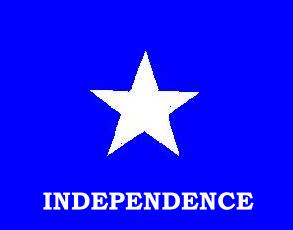
As dictatorial acts contrary to the liberal Mexican Constitution of 1824 by the centralista dictatorship began to mount, the number of Texans known as the Liberal Faction or War Party increased while the Conservatives rallied under the Mexican flags of 1824 hoping for a peaceful settlement with their adopted government and a return to the principles of local self-determination. This banner was apparently the earliest symbol of those who had abandoned hopes for reconciliation. A banner of similar color and design without the lettering was first used in 1810 when American frontiersmen rebelled against Spanish authorities at Baton Rouge in Spanish West Florida. Although never official, this design became famous as "The Bonnie Blue Flag" symbol in the Confederate States of America after secession in 1861.


Brown's Flag of Independence. This flag is said to have been designed by Capt. William S. Brown at Velasco in fall 1835 preceding Capt. Dimmitt's bloody-arm flag with which it has been commonly confused since it employs the same symbol (see Origin of the Bloody Arm Symbol). Which came first is uncertain, but it is likely that one influenced the other. This banner may have been flown by Capt. Brown and his men at the Battle of Bexar and with him when he went to Goliad after the battle where he was a signer of the Goliad Declaration of Independence. Although Capt. Dimmitt's flag is thought to be the primary one at the ceremonial announcement of the declaration, the Brown flag was probably present and may have also been displayed. References to the fact that Brown's flag was first unfurled at Goliad may refer to the simpler Dimmitt flag consisting of only the arm and knife on a field of white. Afterwards Brown also went to San Felipe where the banner was again said to be unfurled prior to his return home to Velasco.
There it may have been flown in front of the American Hotel on 8 Jan 1836 along with the Troutman flag of the Georgia Battalion. Author John Henry Brown (History of Texas) stated "Over the cabin in which the convention met and declared for independence, floated a flag with the design of a sinewy hand grasping a red sword, and underneath this was a lone star flag." Mamie Wynne Cox in Romantic Flags of Texas says "As Captain Brown's Flag was the only banner carrying a design of a bloody sword, this could have been none other than his." Cox describes the Brown flag as a large deep blue field in the upper left corner, in which is a white arm grasping a sword fromt he point of which is dripping blood. The flag has thirteen stripes, seven red and six white with the word INDEPENDENCE in the third white stripe from the top. Author Brown's description does not clearly describe either of the two "bloody arm" flags or the lone star flag. He appears to be referring to two flags on the same pole, although it could even have been a composite single banner. (Image adapted from Gilbert, Flags of Texas)


Dimmit's Goliad Flag. This militant and defiant banner, designed by Goliad garrison commander, Capt. Phillip Dimmitt, dramatically reflected the political shift of Texians and Capt. Dimmitt away from support of the independent statehood of Texas in the Mexican Federalist Republic and return to the Constitution of 1824 to support of complete separation from Mexico as an independent Republic. Before he returned from the Siege and Battle of Bexar to Goliad in the middle of Dec 1835, Capt. Dimmitt was an avid Mexican Federalist and opposed to separation which was symbolized in the 1824 Mexican tri-color which is also thought to be of his own design. Dimmitt's bloody arm flag was said to have been raised ceremonially on Dec 20 upon the signing of the Goliad Declaration of Independence as the official flag of the occasion although the banners of companies of Capt. William S. Brown and Capt. William Scott were also present at Goliad at the time.
Which banner was actually flown over the Goliad garrison is the subject of controversy and comment by historians. Mary Agnes Mitchell in First Flag of Texas Independence cites memoirs of participants John James and Nicholas Fagan "The Goliad flag was made personally by Captain Dimmitt himself....It was of white domestic, two yards in length and one in width, and in the center was a sinewy arm and hand, painted red, grasping a drawn sword of crimson.....The flagpole was made from a tall sycamore which was procured from the woods along the banks of the San Antonio River.....The flagstaff was in the yard of the quadrangle opposite the entrance to the officers' quarters." Dimmitt's flag flew over the ramparts of Goliad through 10 Jan 1836 when Dr. James Grant and the Federalist Volunteers of Texas forced its removal with threat of violence and which caused the subsequent exit of Col. Dimmitt and those loyal to him from the garrison. The banner is thought to have exited with them. The motivation behind Dimmitt's use of the bloody arm symbol is unclear as was whether he acquired it independently or simply under influence of the Brown flag which employed the same symbol (see Origin of the Bloody Arm Symbol).


 Troutman Goliad Flag. This flag was designed in Nov 1835 by Johanna Troutman, sometimes called the Betsy Ross of Texas. When the Georgia Battalion of Volunteers under Captain William Ward marched from Macon to Columbus, GA on their way to Texas in response to an appeal for aid for Texas by Col. Fannin, Miss Troutman (daughter of Col. C.A. Troutman of Knoxville, GA and later Mrs. Pope), presented the troop with the flag to carry with them. According to Mrs. Looscan, the banner was of white silk with an azure star on both sides.
On one side was the words Ubi libertas habitat ibi nostra patria est--"Where Liberty Dwells, There is my Home" in Latin, on the other side was the letters indicated. Author John Henry Brown says that the flag was flown at the American Hotel in Velasco in Jan 1836 upon the arrival of the Georgia Battalion in Texas and some have claimed it also flew at the Texas Independence convention at Washington-on-the-Brazos. However, it was said to have been taken to and flown at Goliad by Col. Fannin. Guy M. Bryan in a speech before the Texas Veterans Association in 1873 "The Georgia battalion flag was azure, lone star, five points, in white field. This flag was raised as national flag on the walls of Goliad by Fannin when he heard of the Declaration of Independence." The flag was thought to have been destroyed in haste to get it down upon retreat from the garrison at Goliad.

I hope you've enjoyed this post about a turbulent time in Texas history in the beginning fight for Texas Independence. I am passionate about my birth state and not bashful when it comes to sharing.

 
Thanks for visiting with Sweethearts of the West!

Carra


http://www.tamu.edu/faculty/ccbn/dewitt/dewittflgs2.htm


Buy links for my debut novel,CODE OF HONOR, Texas Code Series, Book One:
Amazon for Kindle ebook and print:  http://tinyurl.com/muln4r9

and, Smashwords for nook, kobo and iTunes:  http://tinyurl.com/llshmbg
 

Find me on my website: http://carracopelin.com
Facebook: http://facebook/carracopelin
Twitter: http://twitter/CarraCopelin
Goodreads: http://tinyurl.com/mfynmj2


Sunday, May 26, 2013

EMILY, THE YELLOW ROSE OF TEXAS


How many times have you heard the song “The Yellow Rose of Texas?” Since I grew up in and still live in Texas, that term “yellow rose” did not sink in until I was an adult and learned it referred to a woman who was a quadroon, a term I always thought silly. Quadroon means a person who has one Negro grandparent and three Caucasian grandparents. In our society of blended ethnic and racial bloodlines, these sorts of racial descriptions should have long ago lost their usage and meaning. But I digress.


The Yellow Rose of Texas was an attractive woman supposedly named Emily Morgan. In reality, her name was Emily West. Many assumed, due to her being a quadroon, that she was James Morgan’s slave and called her Emily Morgan. She helped win the Battle of San Jacinto, which resulted in the Texas army’s victory over Santa Anna. This created the Republic of Texas, a separate nation until it joined the United States in 1845. I think she was a heroine, a woman who turned forced servitude/prostitution into an opportunity to fight her oppressor and defend her adopted family.

She was born Emily West around 1816 in New Haven, Connecticut, but moved to New York. She was a free woman and signed a contract with agent James Morgan in New York City on October 25, 1835, to work a year as housekeeper at the New Washington Association's hotel, Morgan's Point, Texas. Morgan was to pay her $100 a year and provide her transportation to Galveston Bay on board the company's schooner, scheduled to leave with thirteen artisans and laborers in November. She arrived in Texas in December on board the same vessel as Emily de Zavala and her children. At the mouth of the San Jacinto River, Morgan laid out the town of New Washington. Morgan was away building a fortification to defend Galveston from Santa Anna when the dictator arrived at New Washington.

General Antonio Lopez de Santa Anna
The Little Napoleon
Due to lack of records, there is a lot of speculation on the actual facts. Here’s the consensus: General Santa Anna saw a beautiful mulatto woman helping load supplies at the dock to help Colonel Morgan’s family join him at Galveston. Santa Anna, the “little Napoleon” womanizing dictator, decided that Emily Morgan was to become his new “personal maid.” Soon twenty-year-old Emily occupied his three-room, candy-striped tent. But the Mexican dictator had chosen/forced the wrong woman. Emily was a Texian sympathizer.

Santa Anna ordered a slave named Turner, whom he had taken at the same time he acquired Emily, to perform a reconnaissance of the Texian army. Before Turner and his escort of soldiers left on their mission, Emily secretly had a word with him. Since Morgan kept his family apprised of Texian activity, Emily knew where Houston was camped. She also knew Turner would be sympathetic to the Texians. She disclosed Houston’s location and instructed Turner to let him know the Mexican army was in pursuit. Through guile and good horsemanship, Turner was able to pass on Emily’s warning. In addition, he fed Santa Anna false information about Houston’s location.

On April 21, 1836, all was quiet in the Mexican camp. Santa Anna was at his tent. Inside were a piano, silverware, china, food, and chests of opium to feed the dictator’s addiction. The soldiers were having a siesta with limited guards on duty. By the time the Texian soldiers arrived, Santa Anna had retired into his tent with Emily. At the first sign of gunfire, the dictator rushed out and stumbled over cases of champagne stacked at the entrance. Clad only in silk drawers and red slippers, Santa Anna could not restore order among his troops. He wrapped himself in a bed sheet, grabbed a box of chocolates and a gourd of water, and jumped on a horse to escape. He was caught the next day.

Santa Anna's surrender

After the Battle of San Jacinto, a member of the victorious Texian army escorted Emily Morgan back to New Washington. She told Colonel Morgan of the victory. He later learned of the importance she had played in the event. He immediately released her from indenture and it is rumored he bought her a house in a community of free blacks in Houston. Later, she returned to New York and faded into oblivion. (I wonder what happened to Mr. Turner, the slave who helped.)

Folklore picked up on Emily’s heroics. Eventually, Mexican historians admitted to Santa Anna’s “quadroon mistress” during the Texas campaign. William Bollaert, an Englishman who visited Texas several times and was an acquaintance of the Morgans, kept a diary of his travels and recorded Emily’s actions. The diary was not made public until 1902. By then the Yellow Rose of Texas had already become established in Texas lore.


Emily’s story inspired “The Yellow Rose of Texas,” one of the best known songs about Texas. In 1861, Texas Confederates marched off to war singing this song. In 1936 a concert arrangement was offered by David W. Guion for the Texas Centennial (and dedicated to Franklin D. Roosevelt, who ordered a White House performance). In 1955 Mitch Miller recorded an arrangement for Columbia Records that made the song popular with Americans. The lyrics were altered from the original Negro spiritual to the more politically correct version of today. A 1949 movie “She Wore A Yellow Ribbon” starred John Wayne and Joanne Dru. As long as there is a Texas, and as long as the melody of “The Yellow Rose of Texas” lingers, Emily Morgan and her part in the short-lived battle on April 21, 1836 will be remembered.


There’s a yellow rose in Texas, that I am going to see,
Nobody else could miss her, not half as much as me
She cried so when I left her it like to broke my heart,
And if I ever find her, we nevermore will part.
Chorus
She’s the sweetest little rosebud that Texas ever knew,
Her eyes are bright as diamonds, they sparkle like the dew
You may talk about your Clementine and sing of Rosa Lee,
But the Yellow Rose of Texas is the only one for me.

When the Rio Grande is flowing, the starry skies are bright,
She walks along the river in the quiet summer night:
She thinks if I remember, when we parted long ago,
I promised to come back again, and not to leave her so.
Chorus

Oh now I’m going to find her, for my heart is full of woe,
And we’ll sing the songs together, that we sung so long ago
We’ll play the banjo gaily, and we’ll sing the songs of yore,
And the Yellow Rose of Texas shall be mine forevermore.
Chorus


Thanks to FROM ANGELS TO HELLCATS: LEGENDARY TEXAS WOMEN 1836 TO 1880 by Don Blevins for part of the above information.
Wikipedia
Texas State Historical Association’s Handbook of Texas online.   


Would you become a mail-order bride?

Tabitha Masterson is certain whatever awaits her in Radford Springs, Texas will be better than what her brother and that awful William have in mind in Boston. After her father’s death, her brother has become a tyrant. She escapes to start her new life in Texas, but trouble can’t be far behind. She believes if she’s married when trouble arrives, she’ll be safe. But her fiancรฉ is reluctant to accept her as a substitute for the mail-order bride he’d courted.


Bear Baldwin is crushed when he receives a wire notifying him that the woman with whom he has corresponded for almost a year has passed him off to her friend.  Do the two women think he’s like an old shirt to be handed down? His mother urges him to give the substitute fiancรฉe a chance, but his pride is stung and he hasn’t decided.

Amazon buy link: http://www.amazon.com/dp/B00D0C3MNC

Thanks for stopping by!