Showing posts with label Jocelyn's Wedding Dilemma. Show all posts

Wednesday, July 3, 2024

Suitcases and the Shwayders of Colorado by Zina Abbott


Up until the very end of the 1800s, suitcases, as we know them today, hardly existed. Before that, those who traveled for any distance lugged along heavy, bulky trunks built of wood, leather, and often a heavy iron base. The best trunks were waterproofed with canvas or tree sap, as steamships were a reigning mode of travel. Without this protection, a suitcase in the hold of a heaving, leaky ship would probably have been wet within a few hours, and crushed by sliding trunks within a few more. The closest travel case to what we know today as a suitcase was the “cabin trunk,” which was designed with a low profile to fit under a steamship berth. For more about trunks and steamers, see my previous post by CLICKING HERE

1911 United Suit Cases

Early suitcases were called “suit cases” or “suit-cases” because they were intended to hold only suits. They were lighter and more portable than trunks, but they were still bulky by today's standards. Leather, wicker or thick rubbery cloth was stretched over a rigid wood or steel frame. Corners were rounded out using brass or leather caps. Such suitcases tended to have roughly the proportions of a hardback book: flattened and easy to carry, with a handle on the long side. Until steamship travel declined during the mid-20th century, many were advertised as waterproof. Lightweight models were often marketed specifically to women.


When the suitcase finally did catch on at the end of the 19th century, it was quite literally a case for suits. A typical suitcase came equipped with an inner sleeve for storing shirts, and sometimes a little hat box on the side. But even in the early 20th century, the “dress-suit case” was only one of countless styles of container that travelers could buy, from steamer trunks to club bags to Eveready portable wardrobes. These were boom times for the baggage business.

The late 19th century became an era of transition  in the history of transportation. Except for those emigrating—either to relocate to a new country or for employment—traveling by steamship was not utilized as much. The automobile industry and resulting travel by car called for smaller forms of luggage. That was in addition to train travel, which continued to be a major form of travel. It was an age of mass tourism—people going places to for the sake of travel to see parts of the world or country that, in previous eras, were not common pursuits.

The shift was made from bulky, heavy trunks to suitcases – then called “suit-cases” or “suit cases,” because they were designed to hold suits – accelerated in the 1930s as commercial flights began to replace steamships and trains. But the early versions, clunky contraptions made of leather and wood, were a far cry from today’s suitcases.

Jesse Shwayder, born in Black Hawk, Colorado, to Jewish parents who had emigrated from Poland, started working in his father’s furniture store since he lacked the funds to attend college.

In 1903, Jesse convinced Isaac to sell the store and open a luggage shop. Jesse was noticed by one of their suppliers and invited to come to New York City as a salesman for the Seward Luggage Company—at the time one of the largest manufacturers of trunks, steamers, and footlockers. In his first year, Jesse Shwayder earned over $4,000 in commissions – at that time, a vast sum.

On March 10, 1910, Jesse returned to Denver and opened his own luggage factory, the Shwayer Trunk Manufacturing Company. His father, Isaac, became his lead salesman. Instead of competing with low pricing, Isaac insisted that they make high quality merchandise and price it at the highest price it would bear in the luxury marketplace.
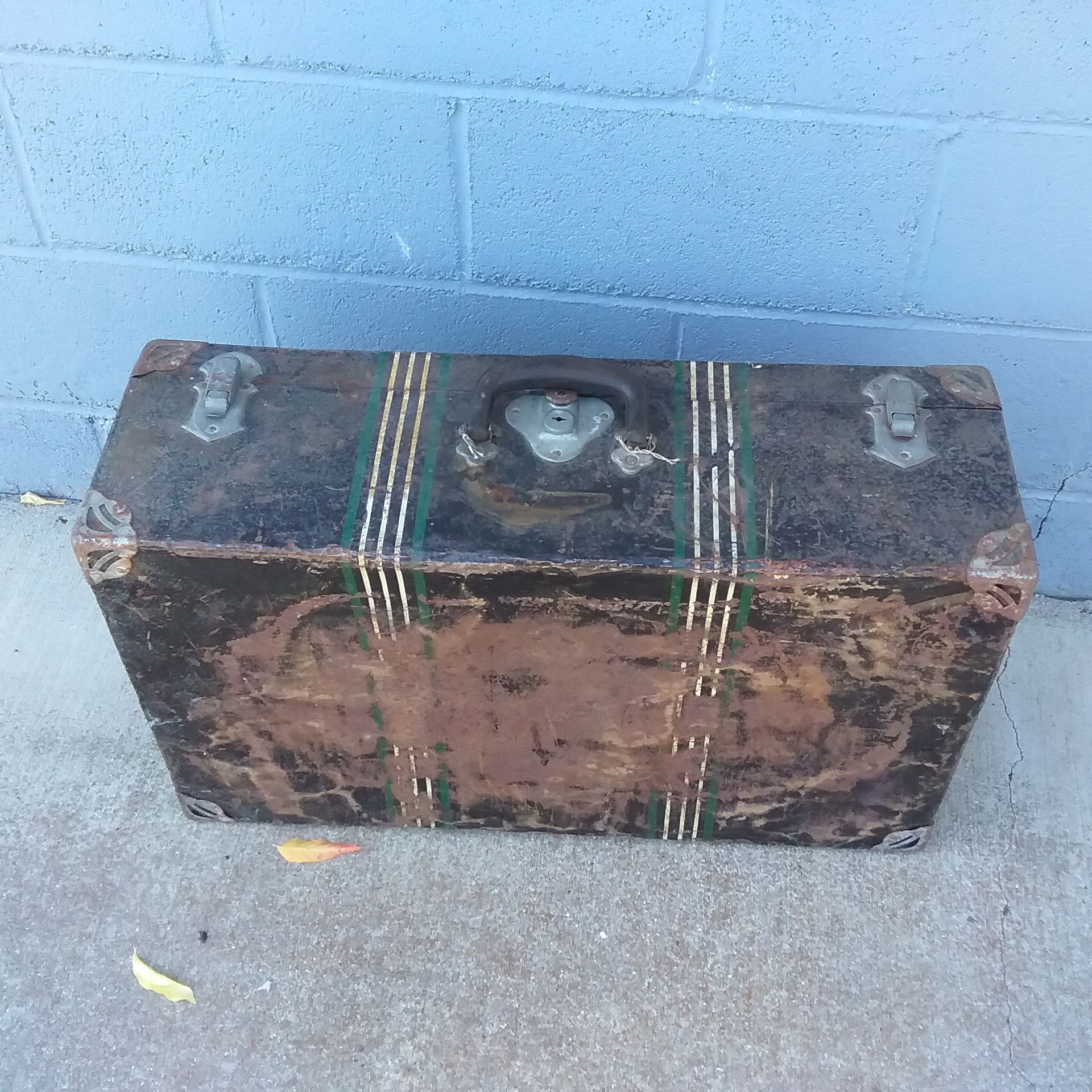
1920 Shwayder suitcase

As the whole family jumped in to help, the Shwayder Trunk Manufacturing Company began to grow. Shwayder, a religious man, named his first suitcases, “Samson,” after the Biblical strongman.


In 1916, the Shwayders took a picture that would become an advertising coup. Four brothers and their father stood on a plank positioned atop one of their suitcases with the caption: “Strong enough to stand on.” With five portly Shwayder men weighing more than 1,000 pounds together, the picture was striking and became their advertising and direct-mail gimmick for several years.

Unfortunately, in the same year (1916), Isaac Shwayder died suddenly of a stroke. His wife, and Jesse’s mother, Rachel Shwayder, used her husband’s life insurance money to build a new and larger factory, which opened in 1917.


Jesse Shwayder was president of the company from 1910 to 1960. Jesse Shwayder’s official corporate philosophy was the Golden Rule: “Do unto others as you would have others do to you.”
All company officers and salesmen carried a Golden Marble, which they were told to take out and look at whenever they had to make an important business decision. When visiting the family’s factories in later years, Jesse Shwayder would ask to see the Golden Marble. Any employee who could show it got a one hour paid work-break.

Mark Shwayder became the head of sales.

Sol Shwayder, now a lawyer, became attorney for the firm.

Vintage Samson luggage

The original name of their luggage was Samson, intended to honor the strength of the biblical hero of the same name. Today, we know their luggage as Samsonitethe largest manufacturer of luggage in the world.


I first wrote about travel trunks in Jocelyn's Wedding Dilemma, my book in The Matchmaker and the Mother-in-Law series. To find the book description and purchase options for both ebook and paperback, please CLICK HERE


My heroine in Florence's Good Deed also traveled. Although she only carried a carpetbag, her beautiful cover shows several examples of early suitcases. To find the book description and purchase options for both ebook and paperback, please CLICK HERE


Sources:

https://www.jmaw.org/shwayder-jewish-samsonite-denver/

https://www.travelandleisure.com/style/travel-bags/history-of-suitcase

https://www.foxnews.com/travel/the-history-of-luggage

https://en.wikipedia.org/wiki/Jesse_Shwayder

https://en.wikipedia.org/wiki/Samsonite

Thursday, June 6, 2024

Trunks and Steamers by Zina Abbott


 This is a continuation of the series on early luggage. You may find my first post titled “Carpetbags and Portmanteaus” written in March, 2024, by clicking HERE


Luggage in the mid-to-late nineteenth century meant some form of travel trunk. They were most commonly used for extended periods away from home or long trips abroad. Trunks, with their more rugged construction designed to hold up during travel, are different from lighter-weight chests, which were intended for storage.


Travel trunks were large and cumbersome boxes which, even when they were empty, could weigh more than a hundred pounds. Anyone wealthy enough to travel hired servants to move and load these trunks. Porters and bellhops bore the burden of moving them while travelers were in route. 

1890s trunk converts to a dresser

In the nineteenth century, trunks were often crafted with the best materials and designed to withstand the harsh conditions of early modes of travel. Steamships and stagecoaches were the main method of transport at the earlier time, followed by railroad. Trunks had to be exceptionally sturdy and heavy to withstand their journeys. They were decorated with leather and fine upholstery, cross sections and slates of painted wood, and heavy duty metal, such as brass, hinges and clasps, and leather coverings to resemble the style of furniture at the time. They often included personal inscriptions and manufacturer’s details.

Hat Box Trunk

However, all these materials that made trunks durable also made them heavy. Many trunks were so heavy and bulky that, in many cases, those traveling by stagecoach were usually not allowed to load their trunks onto the stagecoach. Stagecoach passengers with trunks were often were required to make arrangements with a freighting company to transport the trunks and steamers separately. That was why many such travelers also carried necessary items in a carpetbag or portmanteau, which could be loaded onto a stagecoach.

Long-distance travel, especially before the days of the railroads, was usually an involved process. In instances where an individual or family emigrated across the ocean to a new country, they brought everything of value packed in their trunks.

Saratoga Trunk

Most early trunks were designed with a rounded or dome-shaped top—probably for stability and durability to withstand other heavy items being piled on top. Trunk styles including barrel-tops and Saratoga steamer trunks, often included elaborate tray systems for transporting and storing a full range of items.

There were many styles of trunks such as, Jenny Lind, Saratoga, monitor, steamer or cabin, barrel-staves, octagon or bevel-top, wardrobe, dome-top, barrel-top, wall trunks, and full dresser trunks. These differing styles often only lasted for a decade or two.


Steamers differed from other trunks in order to comply with steamship regulations. Typically, they were fourteen inches tall with flat to slightly rounded tops so they could be tightly stacked within the ship’s berth during transport.


Top quality steamer trunks designed for travel on steamships were made of wood and leather. They often had a heavy iron base to prevent the trunk from being crushed while sliding around among other heavy trunks. They were also covered in canvas, leather, patterned paper, and often tree sap to make them as waterproof as possible as a protection against leaky ships.

Cabin Trunk

Cabin trunks were smaller versions of steamer trunks. Designed with low profile tops to fit under seats, they were considered the carry-on luggage of the time. 


Cabin trunks often included several compartments to store valuables that would otherwise be kept in the main luggage hold and subject to theft or damage.


One producer of high-end luggage was Louis Vuitton of Paris, France. He made a name for himself in the mid-1850s by introducing his slat trunk, considered a pioneering design. Although he died in 1892, his trunks are considered valuable collectors’ items.

Louis Vuitton steamer trunk

His trunks were covered in canvas sheathing, held well-designed drawers and had a flat top that made stacking much easier. This was a departure from the typical travel trunks of the day, which had rounded tops.

Seward Trunk Company factory in Petersburg, Virginia

Seward Trunk Company was founded in 1878 in Petersburg, Virginia. It was once the largest manufacturer of steamers, trunks, footlockers, and other luggage in the United States. The original company has gone through a few buyouts and consolidations. The original factory was put on the National Register of Historic Places, but it burned to the ground in 2018.


The use of classic trunks for luggage was widespread through the first two decades of the twentieth century but began to fade in popularity thereafter in favor of the modern suitcase.

Footlockers were a form of trunk used by the military. I still have my father’s old footlocker from his years in the Army Air Corps/U.S. Air Force. Although lighter weight than the old heavy wooden trunks of the nineteenth century, I would not want to carry it far. It is quite a departure from the old knapsacks and haversacks carried by soldiers in the nineteenth century, which I featured last month. You may find that post by clicking HERE


I first wrote about travel trunks in Jocelyn's Wedding Dilemma, my book in The Matchmaker and the Mother-in-Law series. To find the book description and purchase options for both ebook and paperback, please CLICK HERE


My heroine in Florence's Good Deed also traveled. Although she only carried a carpetbag, her beautiful cover shows several examples of early luggage. To find the book description and purchase options for both ebook and paperback, please CLICK HERE


Sources:

https://en.wikipedia.org/wiki/Trunk_(luggage)

https://theoldtimey.com/vintage-luggage-trunks-hat-boxes-early-suitcases/

https://www.foxnews.com/travel/the-history-of-luggage

https://en.wikipedia.org/wiki/Louis_Vuitton_%28designer%29

https://en.wikipedia.org/wiki/Seward_Trunk_Co

Thursday, March 7, 2024

Carpetbags and Portmanteaus by Zina Abbott


Originally, as people traveled, they carried knapsacks, bindles and other loose bags as they walked or rode horses. However, as travel and migration patterns expanded, people needed a means to pack a larger quantity of their belongings—something more portable than carrying large items in a wagon or cart.

By 1596, the Oxford English dictionary added the word “luggage.” The word meant “denoting inconveniently heavy baggage” and came from the verb “lug.” However, it was not until the 19th century that travel became prevalent enough that new means of carrying personal belongings—particularly on trains—began to make their debut.

In my most recent book, my heroine does ship some heavier things ahead using a small travel trunk instead of a shipping crate. However, she needed to be able to carry most of her belongings by herself in containers durable enough for travel, and suitable enough to protect her clothes and other items. She chose two.

1860s style carpetbag

The first item was a carpetbag—considered essential for any discerning female traveler.


 Made from carpet material, they came in a variety of colors from subdued to flamboyant. 

1850s carpetbag used by traveler from New Z


Some, made of leather, actually more closely resembled small portmanteaus.


In fact, carpetbags were widely used throughout the nineteenth century due to their relatively lighter weight, their durability, their relatively lower cost, their flexibility—which allowed its owner to stuff an unimaginable amount of clothing and personal items inside—and its ability to be locked, which provided a small measure of security from casual snoopers.


The second item she chose was a portmanteau. Similar to what many today think of as a suitcase, a portmanteau is defined as a large trunk or suitcase, typically made of stiff leather and opening into two equal parts. One did not lay it flat on one side and pull the top half up, as in suitcases developed at a later time. One set the bottom on a surface and pulled the two side halves open at the top—more like to today’s duffle bags.

Here is another definition from  Raymond Malewitz, Oregon State Associate Professor of American Literatures: “A portmanteau is an old-fashioned suitcase with a hinge in the middle that can hold equal amounts of luggage in its two storage compartments.”


Is a portmanteau the same as a valise? A valise is defined as “a small piece of luggage, usually made of leather, that can be carried by hand, used to hold clothing, toilet articles, etc.; suitcase; traveling bag.” Often, valises were cylindrical in shape. Although they could be carried by hand, they were originally designed to be carried behind the saddle of a horse. The operative word here is “small.” Generally, a valise was not as large as a portmanteau.

To see an example of a cylindrical valise from earlier times, please CLICK HERE


Here is an excerpt from Jocelyn’s Wedding Dilemma:

             Jocelyn jostled her carpetbag and the portmanteau outside—the portmanteau being wretchedly heavy due to her having packed her lap desk. She noticed the eastern sky already turning a faint gray. Still too dark to see clearly, she hoped her eyes adjusted enough to the dim light so she did not trip over her feet. Setting her baggage on the back stoop, she faced the house as she noiselessly eased the door closed.

            “Miss Wolcott? What are you doing out so early?”

            Upon hearing Homer’s soft voice behind her, Jocelyn jerked upright and grabbed the handrail on one side of the stoop to keep her balance. Licking her lips, she slowly turned and descended until she stood on the ground. “I was unaware you started your day this early, Mr. Cottingham.”

            “I seldom leave our apartment so soon. Mrs. Cottingham started boiling water for tea. However, she’s out of biscuits—the kind you call cookies. She sent me to the kitchen for the supper rolls left from last night plus a jar of jam to get us by until time for our breakfast.”

            “I see.” Jocelyn’s stomach rumbled. That does sound good. “Please don’t let me keep you. I’ll….um…”

            “It appears you plan to travel somewhere, Miss.” Homer studied the carpetbag and portmanteau.

            “Yes. I decided on a surprise visit to…family.” Jocelyn bit her lip. She knew her words were deceitful, yet not exactly a lie. At least, in a week or ten days, they would be truth.


Jocelyn’s Wedding Dilemma is now available for sale and at no additional cost with Kindle Unlimited. To find the book description and purchase options, please CLICK HERE


Sources:

https://liberalarts.oregonstate.edu/wlf/what-portmanteau

https://www.mimimatthews.com/2019/04/28/have-carpet-bag-will-travel/

Le Moniteur de la Mode, 1876, No. 1348 Toilettes de Mme Morison, RP-P-2009-3650

https://www.travelandleisure.com/style/travel-bags/history-of-suitcase

https://www.hussarsaddlery.com/valises-and-portmanteauss