Seems
I've been running a day behind since the new year began. So, I thought
I'd drag this old blog out and dust it off since Valentine's Day is just
around the corner. There are many things cowboy's do well and rustling a
young lady's heart is one of them. It's why we all love reading about
these knights on the plains.
After
all the posts on ghosts and haunted habitats, I thought it would be
nice to get back to what we all love...Romance and Cowboys! What’s
romantic about the cowboy? You might ask (if you’ve been under a
rock for a hundred or so years). What’s not romantic about the cowboy?
Cowboys have been icons of hard work, hard play, and hard lovin’ since
they shot onto the American landscape in the 19
th Century.
Below are just a samplin’ of songs, poems and letters
showin’ the heart of the Cowboy, and just one of the many reasons we
Western Romance writers fell in love with this particular breed of man.
If
there’s one thing a cowboy knew it was loneliness on the trail, and the
fear another might win his lady’s heart while he was gone for months on
a cattle drive. Some put their fears into lyrics, or wrote them in
letters home.
LONELINESS
At nights I think of her a heap,
These quiet nights when shadows creep
Down thro' the sage, and ev'ry tree
Looks like a black hearse plume to me.
Oh, lonely land and lonely heart,
It surely seems when I 'm apart
From her I hain't the least excuse
Fer livin', and I sees no use
In even daylight comin', fer
It's always nighttime without her.
@Robert V. Carr, 1912
 |
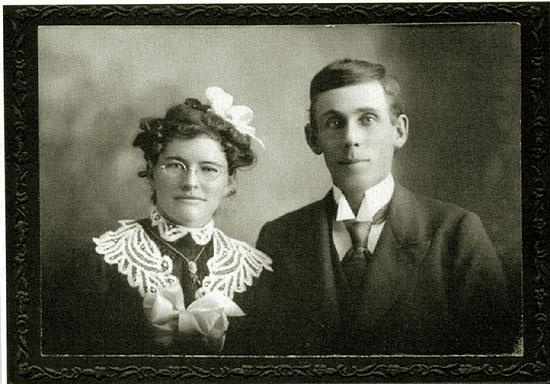
| Fred and Mittie |
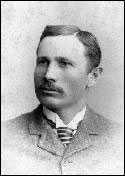
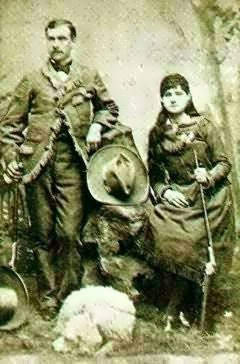
Fred Tucker and George Oathanile Bacus both vied for Mittie
Richardson’s attention. In 1902, Mittie was sent east to Boston
apparently to resolve the situation. In correspondence from family
members, it appears that Mittie's mother did not approve of either
George or Fred. Mittie's mother referred to George as "Backhouse." In
one letter, Mittie's mother wrote, "I sat there and looked at Fred while
he was eating dinner and I though of the old saying that love would go
where it is sent if it went into a dogs - - - and I just thought if
anybody fell in love
with that thing they aught to have him why he can't even talk I was
pleasant to him but O dear." Both Fred and George wrote Mittie while she
was in Boston, each expressing their love. After Mittie's return, in
June 1903 things boiled over in the bunk house with Bacus shooting Fred
(Fred survived but fled Wyoming). Bacus sent Mittie a letter of
explanation (excuse George's spelling and grammar):
Casper Wyo
June 14, 1903
Miss Mittie Richardson
My
Loved One, I sit down to drop you a few lines to let you know that I am
on deck yet. I will be back soon to see my littel love again and se
what they do weath me for what I have don. I see now where I was foolish
for leaven Elmer [LaPash, Mittie's brother-in-law] toald me to give up and I am sorry I didnt. I took the horse exptoan [expecting]
to go to town if I could of seen you before I left, I would not have
left there. Now Darling, pleas donant let eny one out side of your folks
see this letter I toald ProSiak that I was to blame for shooting and
would not give up, but I gess I well now doant tell Fred I am coming
back I donant want any more trubele weath anyone. Darling I would like
to have a talk weath you. I was not to blame for what happened in the
bunk house but had not [illegible] of shot atall but I was excited then
and could not help it Well Dear this is cloast to your birth day and I
will send you all I can from here that is thre of the pretest fours I
can fiend I must close the tears will not lit me rite eny more best
washes to you as ever your Love
G O Bacus
…These air sweet for get me nots [forget me nots]
it is all I have and hoap they will be recped weath pleasher Hope to
see you soon and Mittie when I am in Jale in Laramie Will you come and
see me I would like to tell you all about every thing but can not rite
it as I havent time no neather have I go paper this is all I have I will
be back as soon as I can rais money anouff the countey would send for
me but I doant want that I will come back weath out thair assistants if
they will let me
P S I will be back to hay if thay will let me out in time
 |
| George Bacus |
Mittie was not loyal to George or Fred and married another man altogether.
Of
controversial origin and changing lyrics, a cowboy standard is a song
known as the “Cowboy Love Song,” and reflects the sorrow of a cowboy
whose sweetheart, unable to withstand the harsh conditions of the West,
leaves him. We know this song as…
Red River Valley
From this valley they say you are going.
I will miss your bright eyes and sweet smile.
For they say you are taking the sunshine.
That has brightened our pathway awhile.
Come and sit by my side if you love me.
Do not hasten to bid me adieu.
But remember the Red River Valley
and the cowboy that loves you so true. (Chorus)
From this valley they say you are going.
I will miss your sweet face and your smile.
Just because you are weary and tired,
You are changing your range for awhile.
I've been waiting a long time my darling
For the sweet words you never say.
Now at last all my fond hopes have vanished.
For they say you are going away.
O there never could be such a longing
In the heart of a poor cowboy's breast.
That now dwell in the heart you are breaking.
As I wait in my home in the west.
Do you think of the valley you're leaving?
O how lonely and drear it will be!
Do you think of the kind heart you're breaking.
And the pain you are causing to me?
As you go to your home by the ocean,
May you never forget those sweet hours
That we spent in the Red River Valley,
And the love we exchanged mid the flowers.
Many
early drovers who came up the Texas Trail were Confederate veterans.
During the war one of the most popular songs with southern soldiers was
the sad and haunting Lorena about a lost love, and it remained a favorite among cowboys.
Lorena
Words by the Reverend Henry DeL. Webster
Music by Joseph P. Webster
The years creep slowly by, Lorena,
The snow is on the grass again;
The sun's low down the sky Lorena,
The frost gleams where the flowers have been;
But the heart throbs on as lovely now,
As when the summer days were nigh;
Oh, the sun can never dip so low,
Adown affection's cloudless sky.
A hundred months have passed, Lorena,
Since last I held your hand in mine,
And felt that pulse beat fast, Lorena,
Though mine beat faster far than thine;
A hundred months -- 'twas flow'ry May,
When up the hilly slopes we climbed,
To watch the dying of the day,
And hear the distant church bells chimed.
We loved each other then, Lorena,
More than we ever dared to tell,
And what we might have been, Lorena,
Had but our loving prospered well --
But then, 'tis past, the years are gone,
I'll not call up their shadowy forms;
I'll say to them, "Lost years, sleep on,
Sleep on, nor heed life's pelting storms."
The story of the past, Lorena,
Alas, I care not to repeat,
The hopes that could not last, Lorena,
They lived, but only lived to cheat;
I would not cause e'en one regret,
To rankle in your bosom now;
For "if we try, we may forget,"
Were words of thine long years ago.
Yes, these were words of thine, Lorena,
They burn within my memory yet;
They touch some tender chords, Lorena,
Which thrill and tremble with regret;
'Twas not thy woman's heart that spoke;
Thy heart was always true to me --
A duty, stern and pressing, broke
The tie which linked my soul to thee.
It matters little now, Lorena,
The past -- is in eternal past,
Our heads will soon lie down, Lorena,
Life's tide is ebbing out so fast;
There is a future -- Oh, thank God --
Of life this is so small a part,
'Tis dust to dust beneath the sod,
But there, up there, 'tis heart to heart.
For
some, love came hard. As was the case of Wyoming sheep rancher John
Love in his pursuit of Ethel Waxham. For four years John sent letters
that followed Ethel from Colorado to Wisconsin back to Colorado, until
finally in June 1910, Ethel became John’s wife.
 |
| John Love |
Muskrat, Wyoming
September 12th, 1906
Dear Miss Waxham,
Of course it will cause many a sharp twinge and heartache to have to
take "no" for an answer, but I will never blame you for it in the least,
and I will never be sorry that I met you. I will be better for having
known you. I know the folly of hoping that your "no" is not final, but
in spite of that knowledge... I know that I will hope until the day that
you are married. Only then I will know that the sentence is
irrevocable. Yours Sincerely,
John G. Love
November 12th, 1906
Dear Miss Waxham,
I know that you have not been brought up to cook and labor. I have
never been on the lookout for a slave and would not utter a word of
censure if you never learned, or if you got ambitious and made a "batch"
of biscuits that proved fatal to my favorite dog... I will do my level
best to win you and... If I fail, I will still want your friendship just
the same.
Yours Sincerely,
John G. Love
April 3, 1909
Dear Mr. Love,
There are reasons galore why I should not write so often. I'm a beast
to write at all. It makes you -- (maybe?) -- think that "no" is not
"no," but "perhaps," or "yes," or anything else... Good wishes for your
busy season
from E.W.
P.S. I like you very much.
October 25th, 1909
Dear Miss Waxham,
There is no use in my fixing up the house anymore, papering, etc.,
until I know how it should be done, and I won't know that until you see
it and say how it ought to be fixed. If you never see it, I don't want
it fixed, for I won't live here. We could live very comfortably in the
wagon while our house was being fixed up to suit you, if you only would
say yes.
John Love
Dear Mr. Love,
Suppose that you lost everything that you have and a little more; and
suppose that for the best reason in the world I wanted you to ask me to
say "yes." What would you do?
E.
 |
| Ethel Waxham |
For
the lucky cowboys their true loves came without a fight and remained
true to the end. These cowboys settled into lifetime partnerships,
either building empires (both large and small) of their own, or seeking
new adventures wherever the trail took them.
John and Eula Kendrick (John Kendrick was a Wyoming Cowboy, Governor, Senator with Eula his partner in ranching and politics)
 |
| Eula Kendrick |
In
1889, following time at finishing schools in Boulder, Colorado, and
Austin, Texas, seventeen-year-old Eula was reintroduced to one of her
father's former employees, a cowboy named John B. Kendrick. She
remembered meeting him before: at age seven she had climbed into the
lanky cowboy's lap and announced that when she was old enough, she
intended to marry him. In 1891, she did just that.
Following a
church wedding in Greeley and a reception at the Wulfjen residence, the
newlyweds left immediately for New York on the afternoon train. When
their two-month wedding trip through the Eastern U. S. was over, Eula
had to face the reality of her new home: a mud-chinked log cabin fifty
miles from the nearest town.
It would be several months before
Eula would get to live in that cabin, however. Upon their return from
the East, Eula went back to her parents' home while John went to Montana
to finish construction. He felt that the rough bachelor digs he'd left
behind were not good enough for his cultured bride. It was a lonely time
for both John and Eula and letters flew back and forth between them.
For a man accustomed to solitude, separation from a loved one was a new
thing for John and he expressed his loneliness eloquently and often
during this period:
 |
| John Kendrick |
Do
you miss your old man? Not one half so much as I miss "the girl I left
behind me." Somehow the feeling of loneliness is inexplainable.
Everything lacks interest: the scenes along the road, the different
views of the snow peaks of the Big Horns, things that I used to enjoy so
much.
By the end of April 1891, the cabin was still not
finished. Fed up with living apart, Eula announced to her husband that
she was going to Montana, even if she had to sleep on the floor and cook
for herself. This response delighted John to no end:
You can
never know how many false notions you have driven from my mind in your
proposal to come out and do your own cooking, not that I want you to do
it, but I did want so much for you to show the spirit of a true little
wife and helpmate and the one thing needed to fill my cup of happiness
you have supplied.
The OW Ranch in southeastern Montana was
Eula's home for the next eighteen years. Though isolated and far from
friends, she had no time to be bored: she cooked, cleaned, ironed, sewed
and did all the bookkeeping for the ever-growing Kendrick Cattle
Company.
To read more about the Kendricks go to:
http://www.kirstenlynnwildwest.com/blog/?p=5
Frank Butler and Annie Oakley:
 |
| Frank and Annie |
Frank
Butler, an immigrant from Ireland, developed a shooting act, banking on
the growing popularity of marksmanship displays in America in the
1870s. He and his partner would perform as one of up to 18 acts in a
variety show, rattling off trick shots for about 20 minutes. Butler
often issued a challenge to any local shooting champion. In November
1875, while he was performing in Cincinnati, someone took him up in it.
There would be a match nearby, Butler was told, with a prize of $100. He
accepted.
The last opponent Butler expected was a five-foot-tall
15-year old named Annie. "I was a beaten man the moment she appeared,"
Frank later said, "for I was taken off guard." His surprise continued
when his young challenger scored 25 hits in 25 attempts -- Butler missed
his last target and with it lost the match. But he recovered quickly
enough to give Annie and her family free tickets to his show, and soon
he began courting her. Butler was 10 years older, had been married and
already fathered two children. He never drank, smoked, or gambled,
traits that appealed to Annie's Quaker mother. The couple was married on
August 23, 1876, although Butler would later claim June 20, 1882, as
the date. Perhaps Butler was not yet divorced when he first met Annie,
or maybe the later date was given because Annie had lopped six years off
her actual age in the midst of her rivalry with the younger
sharpshooter Lillian Smith. Either way, the marriage was a happy one,
lasting for some 50 years.
Frank often included poetry in his letters to Annie.
“Her presence would remind you, Of an angel in the skies, And you bet I love this little girl, With the rain drops in her eyes."
After
they were married Frank Butler continued to tour with his marksman act
while Annie returned home to complete her schooling. On May 9, 1881,
Frank sent Annie this poem outlining his plans for their future.
Some fine day I'll settle down
And stop this roving life;
With a cottage in the country
I will claim my little wife.
Then we will be happy and contented,
No quarrels shall arise
And I'll never leave my little girl
With the rain drops in her eyes.
The
famous couple never really did settle down in a cottage in the country,
but spent the majority of their years together traveling the world in
various wild west shows.
 |
| Frank and Annie |
Whether riding the range, building a ranching empire, or trailing an outlaw the cowboy’s mind often wondered…
To Her
Cut loose a hundred rivers,
Roaring across my trail,
Swift as the lightning quivers,
Loud as a mountain gale.
I build me a boat of slivers;
I weave me a sail of fur,
And ducks may founder and die
But I
Cross that river to her!
Bunch the deserts together,
Hang three suns in the vault;
Scorch the lizards to leather,
Strangle the springs with salt.
I fly with a buzzard feather,
I dig me wells with a spur,
And snakes may famish and fry
But I
Cross that desert to her!
Murder my sleep with revel;
Make me ride through the bogs
Knee to knee with the devil,
Just ahead of the dogs.
I harrow the Bad Lands level,
I teach the tiger to purr,
For saints may wallow and lie
But I
Go clean-hearted to her!
@Badger Clark
Wylie and the Wild West put some music behind “To Her,” and it’s a beautiful song! Take a listen!
TO HER by WYLIE AND THE WILD WEST
SOURCES:
http://www.pbs.org/weta/thewest/program/episodes/eight/psilikeyou.htm
http://www.wyomingtalesandtrails.com/cattle.html
Chartier, JoAnn and Chris Enss.Love Untamed: Romances of the Old West. The Globe Pequot Press: Guilford, CT, 2002.
Kirsten Lynn is a Western and Military Historian. She worked six
years with a Navy non-profit and continues to contract with the Marine
Corps History Division for certain projects. Making her home where her
roots were sewn in Wyoming, Kirsten also works as a local historian. She
loves to use the history she has learned and add it to a great love
story. She writes stories about men of uncommon valor...women with
undaunted courage...love of unwavering devotion ...and romance with
unending sizzle. When she's not writing, she finds inspiration in day
trips through the Bighorn Mountains, binge reading and watching sappy
old movies, or sappy new movies. Housework can always wait.